Modern Australian
The Times

Job creation isn't always a good thing. Hobart's new stadium can only make Tasmania's housing crisis worse

  • Written by John Quiggin, Professor, School of Economics, The University of Queensland
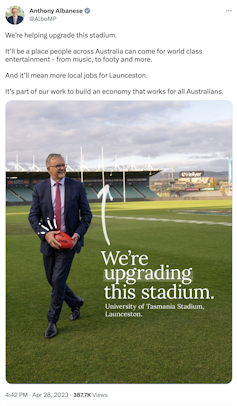
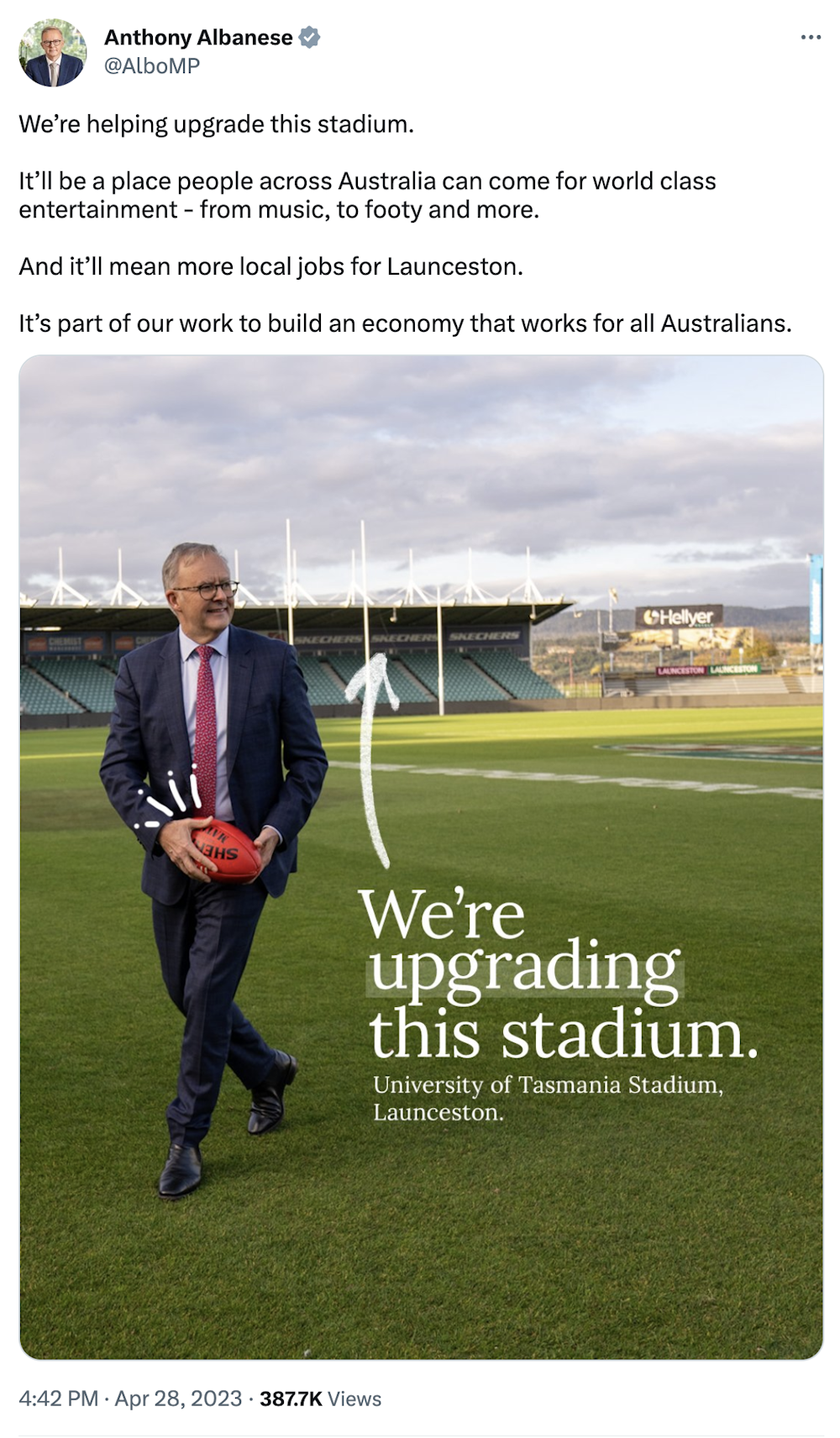
Anthony Albanese's Twitter account spruiks the federal funding for Tasmania.

The Albanese government’s announcement it will provide $240 million for a new stadium in Hobart has not had the favourable reception it might have hoped.

Those concerned with the proper operation of the federal system can point out that this kind of funding is the concern of state and local governments.

Anthony Albanese's Twitter account spruiks the federal funding for Tasmania.
Twitter, CC BY Concerns about process are reinforced by the sorry history of “sports rorts”. Both Labor and Liberal federal governments have funded sports facilities to curry political favour. To be fair, it is hard to see this project as targeted at a particular seat, but presumably the aim was to win support in Tasmania as a whole. Even compared with the dubious economics of sporting events such as the Formula 1 Grand Prix and the Olympic Games, stadium developments stand out as boondoggles. Extensive research in the US is summarised by the conclusion that over the past 30 years, building sports stadiums has been a profitable undertaking for large sports teams, at the expense of the general public. While there are some short-term benefits, the inescapable truth is the economic benefit of these projects for local communities is minimal. Indeed, they can be an obstacle to real development. Read more: Devils in the detail: an economist argues the case for a Tasmanian AFL team – and new stadium Making the business case The economic case for the Hobart Stadium is startlingly thin. The only clear-cut benefit attributable to the project is that the new Tasmanian AFL team will play its home games there, replacing the small number of AFL rounds played at Hobart’s existing stadium, Bellerive Oval. In 2022, eight AFL men’s games were played in Tasmania – four at Bellerive, four at UTAS Stadium in Launceston. A local AFL team will play 11 home games. The North Melbourne Kangaroos warm up before their Round 15 match against the Adelaide Crows at Blundstone Arena, also known as Bellerive Oval. Linda Higginson/AAP The state government’s business case estimates that 5,000 interstate visitors will attend seven matches a year. It seems safe to assume some will fly in and out on the same day, and that few will stay more than two nights. If we allow an average of one night per visitor, that’s 35,000 bed nights, or an increase of about 0.3% in current visitor nights for Tasmania (about 11 million a year in 2022). Against that must be offset the Tasmanians who will travel to Melbourne and elsewhere for away games. What about housing? All of this is par for the course for projects of this kind. The big problem for both state and federal governments is that it comes at a time of a housing crisis. The federal government’s press release contains some vague references to housing developments associated with the project. But this is little more than the sort of PR spin we’d expect from, for example, the proponents of a new coal mine. The numbers here are quite startling. The centrepiece of federal Labor’s election platform was a $10 billion fund for housing, providing $500 million year to support social housing. (Labor’s bill is currently held up in the Senate, with the Coalition opposed, and the Greens demanding stronger action.) Read more: Labor's proposed $10 billion social housing fund isn't big as it seems, but it could work If this $500 million were allocated proportionally by population, Tasmania would get about $10 million a year. The Commonwealth’s $240 million contribution to the stadium would cover this expenditure until nearly 2050. The total public outlay on the Hobart stadium (with $375 million from the Tasmanian government) would cover most of this century. At a time of extreme fiscal stringency, such a massive outlay on a luxury project is very hard to justify. What about job creation? No serious benefit-cost analysis of this project has been made. Instead, supporters have relied on announcing the number of jobs it will create – 4,200 jobs during construction and 950 jobs when operational. Such numbers are questionable. To make them bigger, governments typically count on the “multiplier effect” of work created for suppliers of various kinds. This is a long-standing tradition taken to new heights by the Albanese government. The announcement of the AUKUS submarine project, for example, was all about the jobs it would create. Read more: $18 million a job? The AUKUS subs plan will cost Australia way more than that But wait a moment. At the same time as trumpeting the creation of jobs for construction workers, the government is seeking to solve Australia’s “skills shortage” arising from historically low unemployment. Tasmania’s unemployment rate is 3.8%, marginally above the average for Australia, but lower than at any time since the economic crisis of the 1970s. This low rate represents a situation of full employment, where numbers of unemployed workers and job vacancies are roughly equal. In such circumstances, creating a job means luring a worker away from another. If the new job is on a major construction project, that means one less worker available to build housing. As I argue in my book, Economics in Two Lessons (Princeton University Press, 2019), the true costs of wasteful public expenditure are opportunity costs – the alternatives that are foregone. Multiplier effects make opportunity costs even larger. The project diverts the workers employed directly, and takes all kinds of resources that could otherwise be used for socially useful purposes. This diversion of necessary resources is the truly pernicious aspect of publicly subsidising projects like the AFL stadium. Tasmania, like the rest of Australia, does not need government action to create any more jobs, particularly in construction. It needs to ensure skilled workers are employed where they can be most valuable. Authors: John Quiggin, Professor, School of Economics, The University of Queensland

Read more https://theconversation.com/job-creation-isnt-always-a-good-thing-hobarts-new-stadium-can-only-make-tasmanias-housing-crisis-worse-204806

Important Things To Know Before Starting An SMSF Setup

Planning for retirement requires careful financial decisions, and many Australians are now looking for more direct control over how their superannua...

Why Retail Cleaning Plays a Key Role in Customer Experience and Business Success

Professional retail cleaning services are an essential part of maintaining a welcoming, safe, and professional environment for customers and staff...

Simple Ways to Make a Commercial Property More Appealing to Buyers

Selling or leasing a commercial property isn’t just about listing the square metres, taking a few photos and waiting for the right person to appea...

What Café Owners Should Know Before Upgrading Their Display Setup

A café display fridge does a lot more than keep cakes cold and sandwiches fresh. It quietly shapes the way customers browse, the way staff move beh...

Creating a Backyard That Feels Comfortable All Year Round

A great backyard doesn’t need to be huge, expensive or perfectly styled. Most of the time, the spaces people actually use are the ones that feel e...

How Homeowners Can Make Smarter Energy Decisions Before Upgrading

Energy upgrades used to feel like something you only looked into after a power bill gave you a nasty surprise. These days, though, more homeowners a...

Why Retail CX Breaks During Peak Sales Events and How to Prevent It

Retail customer experience has become one of the most important drivers of revenue growth, especially during high-intensity sales periods. However, ev...

15 South Indian Dishes Everyone Should Try

If your only experience of "Indian food" is butter chicken and garlic naan, South Indian cuisine is going to feel like discovering an entirely new c...

What Every Homeowner Should Know About Roof and Drainage Maintenance

A home's roof and drainage system work together every day to protect the property from water damage. While many homeowners focus on visible areas such...

From Plans to Priced Quote: The Estimating Workflow Most Builders Skip

For a small one-off job, an experienced builder can size up the materials in their head. The problem is that most jobs are not small one-off jobs, and...

Organisational Experts Share Their Tips for Achieving a Clutter-Free Kitchen

They say the kitchen is the heart of a house which means a clutter-free kitchen not only makes your home in general look nicer, it also makes cookin...

10 Creative Ways AI Image Extenders Are Transforming Digital Content Creation in 2026

Introduction Artificial intelligence continues to reshape the digital landscape, and one of the most exciting innovations in 2026 is the rise of AI i...

What to Do When You're Arrested in Victoria

Most people have thought about this in the abstract. A knock at the door, a hand on the shoulder, a car pulled over on the Hume. In the abstract, th...

Common Financial Disputes During Separation

Separation hits on many levels, not just emotionally. When a partnership ends, untangling the financial side — assets, debts, and everything built t...

Why Posting More Content is Killing Your Brand

More content. More often. More platforms.Most brands have been running this playbook for three years. Most brands have nothing to show for it.Not be...

Garden Clean-Up vs. Regular Maintenance: Which Do You Really Need?

Most people ring a gardener and ask for a "tidy up." What they mean by that, and what the garden actually needs, are often two completely different ...

Solar Panel Maintenance Tips for Melbourne Homes

Three years in and the panels are still on the roof. The inverter is still blinking. The electricity bills are still lower than they used to be, rou...

Cost Effective Kitchen Renovations – From the Ground Up

Even in times of uncertainty, it seems renovations continue to be on the to-do list for many Australian property owners. As a result, demand on materi...