

blending Western science with Indigenous knowledges, David Suzuki's influential book has been updated for this moment
- Written by: Jana Norman, Alfred Deakin Postdoctoral Research Fellow, Deakin University
In an occasional series, we look at books that have become cultural touchstones.
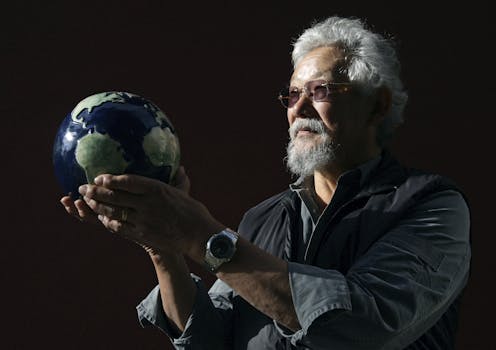
Canadian scientist, author, and environmental activist David Suzuki knows firsthand the power of books. Speaking in Adelaide in 2016, he testified to the life-changing effects of Rachel Carson’s Silent Spring, saying it “impelled” him to join “millions of people around the world in what we now see was a modern environmental movement”.
Suzuki, now 87, may be one among millions active in today’s environmental movement, but he is one in a million. As Tim Flannery puts it, he is “the greatest environmentalist of our age”.
Suzuki’s influence is decades deep, world-wide and much celebrated. A former professor of genetics, he has written or co-authored over 50 books, including 19 for children, and received awards, accolades and 29 honorary degrees. In 1990, Suzuki and his wife Tara Cullis co-founded a foundation to do research, policy work and public engagement on climate solutions, sustainable communities and protecting and restoring nature. This year, he retires after 43 years hosting Canadian science education program, The Nature of Things.
 Adam, from the Hebrew adama, means earth or soil.
Eric Gay/AP
His conclusion, drawing from these and other creation stories is classic Suzuki: “One way or another, we are Earthenware”.
Turn the page, and he has put his scientist hat back on, explaining clay as a “protected haven for […] organic molecules”.
‘You are what you do’
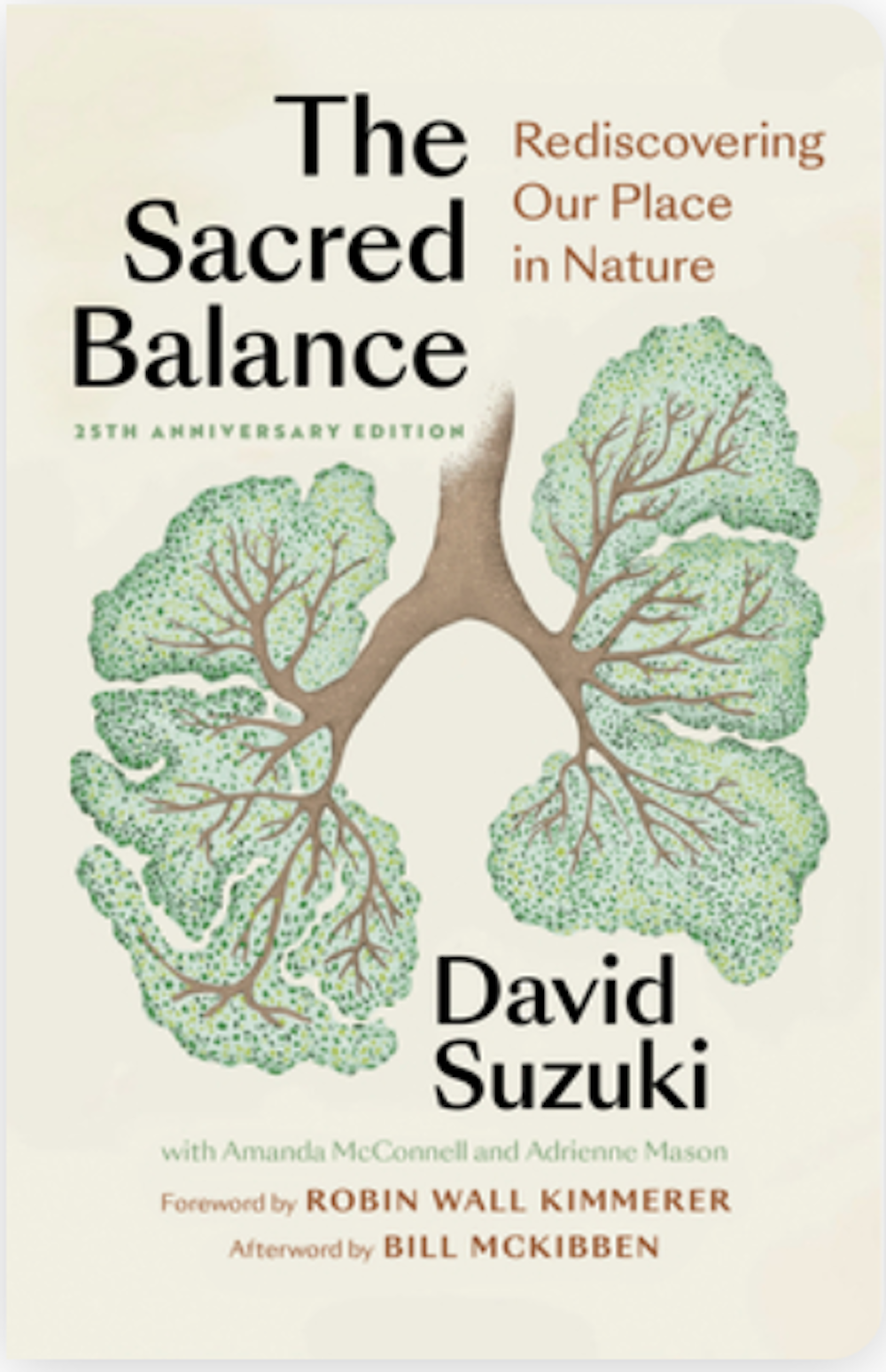
Despite some detractors (one reviewer said the book ventured “into murky waters of sentimentality and anthropomorphism”), The Sacred Balance became a bestseller, spawning further editions and a documentary series. On the 25th anniversary of its release, a new edition has been published.
It retains the core focus and structure of the original, linking human needs to the “four sacred elements of earth, air, fire and water” along with other broader, more social “elements” that enable us to flourish as human beings: the biodiversity of which we are a part, as well as love and spiritual connectedness – the “need to understand where we belong”.
In a new introduction to the book, Suzuki acknowledges current realities such as COVID-19, numerous IPCC reports, and recent reports on the state of the extinction crisis from the World Wildlife Fund and others. They bring renewed urgency to his message that “we have to see ourselves in a different relationship with the rest of nature”. The major crises we face – “pandemics, climate disruption and biodiversity loss” – “all have roots in our lack of recognition of our place in nature”.
This edition also updates the section on practical approaches to “changing the way we think and live” and Suzuki’s own selection of stories of individuals who inspire him.
One of these is Swedish activist Greta Thunberg, emblematic of a “new generation of young people” fighting for climate action. Included are a few key lines from Thunberg’s address to the 2019 World Economic Forum, in which she told adults:
I don’t want your hope […] I want you to act as you would in a crisis. I want you to act as if our house is on fire. Because it is.
Adam, from the Hebrew adama, means earth or soil.
Eric Gay/AP
His conclusion, drawing from these and other creation stories is classic Suzuki: “One way or another, we are Earthenware”.
Turn the page, and he has put his scientist hat back on, explaining clay as a “protected haven for […] organic molecules”.
‘You are what you do’
Despite some detractors (one reviewer said the book ventured “into murky waters of sentimentality and anthropomorphism”), The Sacred Balance became a bestseller, spawning further editions and a documentary series. On the 25th anniversary of its release, a new edition has been published.
It retains the core focus and structure of the original, linking human needs to the “four sacred elements of earth, air, fire and water” along with other broader, more social “elements” that enable us to flourish as human beings: the biodiversity of which we are a part, as well as love and spiritual connectedness – the “need to understand where we belong”.
In a new introduction to the book, Suzuki acknowledges current realities such as COVID-19, numerous IPCC reports, and recent reports on the state of the extinction crisis from the World Wildlife Fund and others. They bring renewed urgency to his message that “we have to see ourselves in a different relationship with the rest of nature”. The major crises we face – “pandemics, climate disruption and biodiversity loss” – “all have roots in our lack of recognition of our place in nature”.
This edition also updates the section on practical approaches to “changing the way we think and live” and Suzuki’s own selection of stories of individuals who inspire him.
One of these is Swedish activist Greta Thunberg, emblematic of a “new generation of young people” fighting for climate action. Included are a few key lines from Thunberg’s address to the 2019 World Economic Forum, in which she told adults:
I don’t want your hope […] I want you to act as you would in a crisis. I want you to act as if our house is on fire. Because it is.
 Police officers carry Swedish climate activist Greta Thunberg away from the edge of the Garzweiler II opencast lignite mine during a protest action by climate activists in Luetzerath, Germany in January.
Federico Gambarini/AP
The parallels with Suzuki’s own daughter, Severn Cullis-Suzuki, the director of the David Suzuki Foundation, are striking. In 1992 when she was 12, she told the audience at the Rio Earth Summit:
My dad always says, ‘You are what you do, not what you say.’ Well, what you do makes me cry at night. You grown-ups say you love us. I challenge you. Please, make your actions reflect your words.
Indigenous worldviews
Of course, those familiar with Indigenous knowledges and worldviews will recognise Suzuki’s view of human-nature connection is not at all new. As he acknowledges, it has been at the heart of Indigenous worldviews for millennia.
Indeed Suzuki credits an early encounter with a First Nations group in Canada as a key to shaping his approach to environmentalism and holistic sciences. On a visit in the 1980s to Haida Gwaii off the coast of British Columbia, home of the Haida people, Suzuki was given “a glimpse into a profoundly different way of seeing the world”.
In a new prologue, he remembers being told by the Haida artist Guujaaw:
The forests, those oceans, are what keep us as Haida people today […] If (the forests) are logged off, we’ll probably end up the same as everyone else, I guess.
Reflecting on the implications of this statement, Suzuki came to understand that for the Haida,
the trees, the birds, the fish, the water and wind were all parts of Haida identity. Haida history and culture and the very meaning of why Haida are on Earth reside in the land.
Police officers carry Swedish climate activist Greta Thunberg away from the edge of the Garzweiler II opencast lignite mine during a protest action by climate activists in Luetzerath, Germany in January.
Federico Gambarini/AP
The parallels with Suzuki’s own daughter, Severn Cullis-Suzuki, the director of the David Suzuki Foundation, are striking. In 1992 when she was 12, she told the audience at the Rio Earth Summit:
My dad always says, ‘You are what you do, not what you say.’ Well, what you do makes me cry at night. You grown-ups say you love us. I challenge you. Please, make your actions reflect your words.
Indigenous worldviews
Of course, those familiar with Indigenous knowledges and worldviews will recognise Suzuki’s view of human-nature connection is not at all new. As he acknowledges, it has been at the heart of Indigenous worldviews for millennia.
Indeed Suzuki credits an early encounter with a First Nations group in Canada as a key to shaping his approach to environmentalism and holistic sciences. On a visit in the 1980s to Haida Gwaii off the coast of British Columbia, home of the Haida people, Suzuki was given “a glimpse into a profoundly different way of seeing the world”.
In a new prologue, he remembers being told by the Haida artist Guujaaw:
The forests, those oceans, are what keep us as Haida people today […] If (the forests) are logged off, we’ll probably end up the same as everyone else, I guess.
Reflecting on the implications of this statement, Suzuki came to understand that for the Haida,
the trees, the birds, the fish, the water and wind were all parts of Haida identity. Haida history and culture and the very meaning of why Haida are on Earth reside in the land.
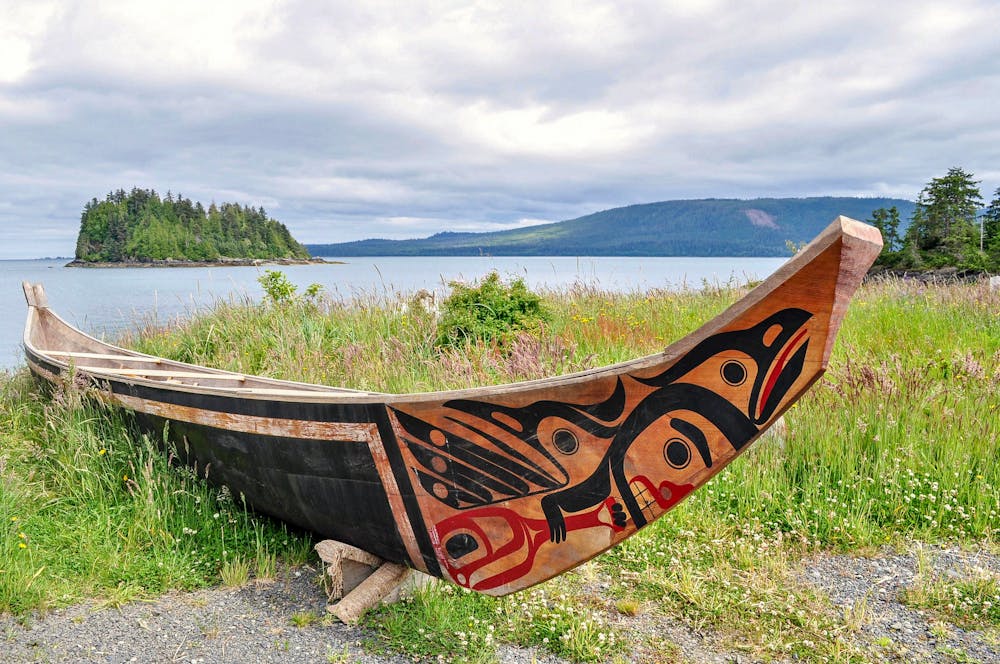 A traditional canoe in Haida Gwaii.
Shutterstock
Read more:
'I am Country, and Country is me!' Indigenous ways of teaching could be beneficial for all children
Indigenous perspectives are central to the discussions in The Sacred Balance, although the sense in which non-Indigenous sciences are presented as a “corroboration” of ancient, continuing Indigenous wisdom and knowledges feels outdated amid contemporary postcolonial and decolonising critical discourses.
There’s a risk with the new edition that this content may feel too generalised, more along the lines of gesture than engagement. This is not to criticise the author’s intent or credibility in this regard: Suzuki and his foundation are deeply committed to reparative Indigenous/non-Indigenous shared futures.
A traditional canoe in Haida Gwaii.
Shutterstock
Read more:
'I am Country, and Country is me!' Indigenous ways of teaching could be beneficial for all children
Indigenous perspectives are central to the discussions in The Sacred Balance, although the sense in which non-Indigenous sciences are presented as a “corroboration” of ancient, continuing Indigenous wisdom and knowledges feels outdated amid contemporary postcolonial and decolonising critical discourses.
There’s a risk with the new edition that this content may feel too generalised, more along the lines of gesture than engagement. This is not to criticise the author’s intent or credibility in this regard: Suzuki and his foundation are deeply committed to reparative Indigenous/non-Indigenous shared futures.
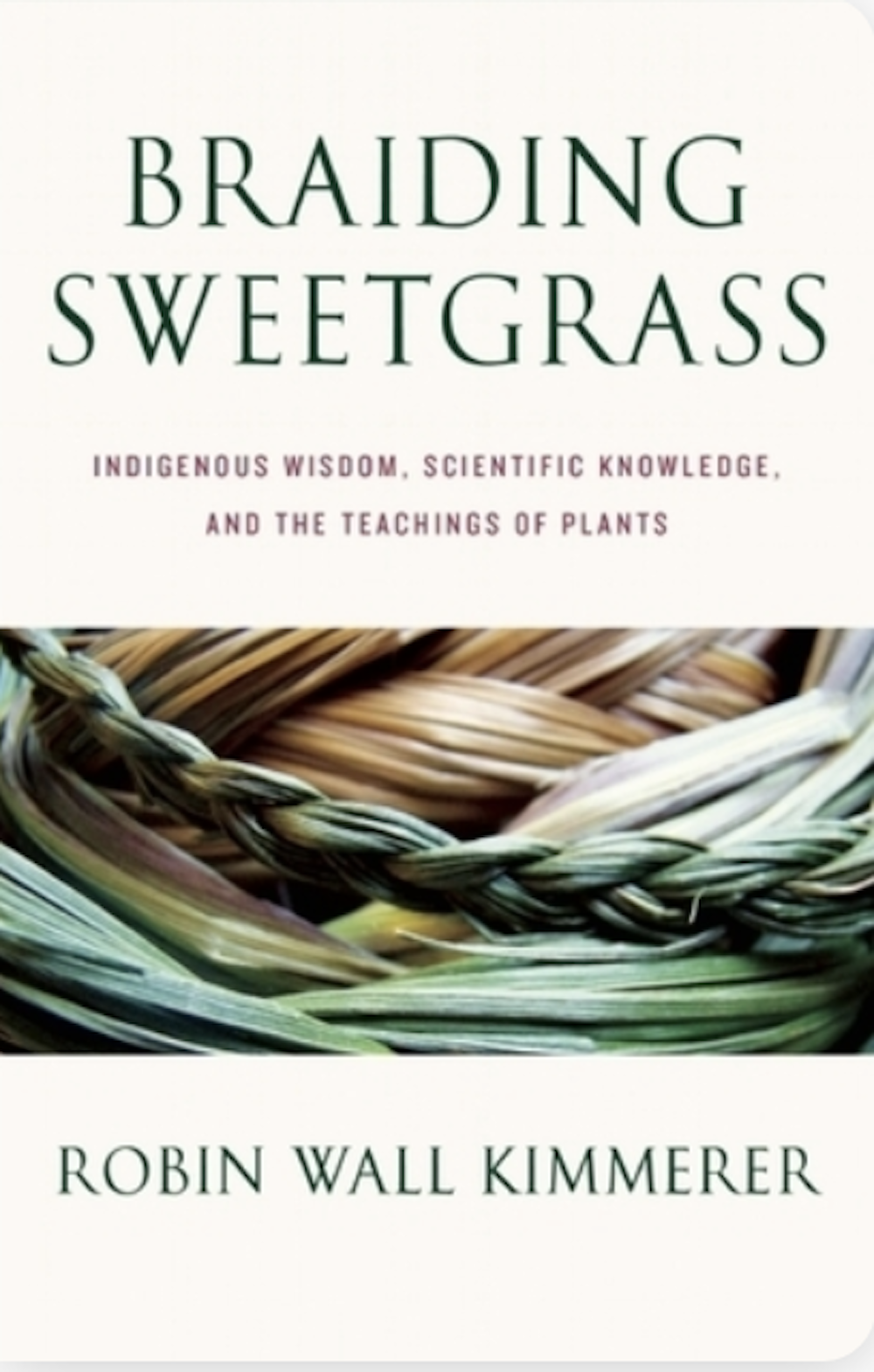 However, the popularity of contemporary works by First Nations writers such as Robin Wall Kimmerer’s Braiding Sweetgrass: Indigenous Wisdom, Scientific Knowledge, and the Teachings of Plants; Bruce Pascoe’s Dark Emu and Tyson Yunkaporta’s Sand Talk: How Indigenous Thinking Can Save the World, means today’s audience is more sophisticated than it was in 1997.
A foreword to the anniversary edition by Wall Kimmerer goes a long way towards acknowledging this:
We already live in the presence of the model and the guidance of Indigenous worldviews, which marry science with spirit, gift and responsibility. The very knowledge that colonialism sought to violently erase and replace offers an alternative to the anthropocentric worldview, a pathway toward mutual flourishing of land and people – not to appropriate and take as our own, but to learn from with gratitude and humility, a universe of knowing generated, maintained and safeguarded by Indigenous Peoples.
Still, both Kimmerer in the foreword and author and environmentalist Bill McKibben in the afterword to this new edition underscore the continuing importance of the book and Suzuki in efforts to correct the environmentally devastating impacts of a worldview separating humans from nature.
Their remarks highlight Suzuki’s commitment to bringing western sciences and Indigenous knowledges into dialogue. Notes Kimmerer,
at a time when 80% of the world’s remaining biodiversity is safeguarded by Indigenous Peoples, yet they legally own only 10% of the land mass, this book recognises the imperative for Western science to learn from Indigenous knowledge.
Read more:
Friday essay: lessons from stone – Indigenous thinking and the Law
Wins and losses
Suzuki has been part of the environmental movement long enough to reflect that “despite decades of experience, we have not yet turned onto a different path”.
In his introduction, he looks back at the “many victories” achieved by the environmental movement, including land protections, conservation efforts and preventative measures such as successful blocking of dam projects that would have damaged ecosystems irrevocably.
But he notes that,
no matter how many wins we celebrated, new threats arose: protected land nibbled away, mining and logging allowed in parks, halted projects renewed and environmental legislation overturned.
However, the popularity of contemporary works by First Nations writers such as Robin Wall Kimmerer’s Braiding Sweetgrass: Indigenous Wisdom, Scientific Knowledge, and the Teachings of Plants; Bruce Pascoe’s Dark Emu and Tyson Yunkaporta’s Sand Talk: How Indigenous Thinking Can Save the World, means today’s audience is more sophisticated than it was in 1997.
A foreword to the anniversary edition by Wall Kimmerer goes a long way towards acknowledging this:
We already live in the presence of the model and the guidance of Indigenous worldviews, which marry science with spirit, gift and responsibility. The very knowledge that colonialism sought to violently erase and replace offers an alternative to the anthropocentric worldview, a pathway toward mutual flourishing of land and people – not to appropriate and take as our own, but to learn from with gratitude and humility, a universe of knowing generated, maintained and safeguarded by Indigenous Peoples.
Still, both Kimmerer in the foreword and author and environmentalist Bill McKibben in the afterword to this new edition underscore the continuing importance of the book and Suzuki in efforts to correct the environmentally devastating impacts of a worldview separating humans from nature.
Their remarks highlight Suzuki’s commitment to bringing western sciences and Indigenous knowledges into dialogue. Notes Kimmerer,
at a time when 80% of the world’s remaining biodiversity is safeguarded by Indigenous Peoples, yet they legally own only 10% of the land mass, this book recognises the imperative for Western science to learn from Indigenous knowledge.
Read more:
Friday essay: lessons from stone – Indigenous thinking and the Law
Wins and losses
Suzuki has been part of the environmental movement long enough to reflect that “despite decades of experience, we have not yet turned onto a different path”.
In his introduction, he looks back at the “many victories” achieved by the environmental movement, including land protections, conservation efforts and preventative measures such as successful blocking of dam projects that would have damaged ecosystems irrevocably.
But he notes that,
no matter how many wins we celebrated, new threats arose: protected land nibbled away, mining and logging allowed in parks, halted projects renewed and environmental legislation overturned.
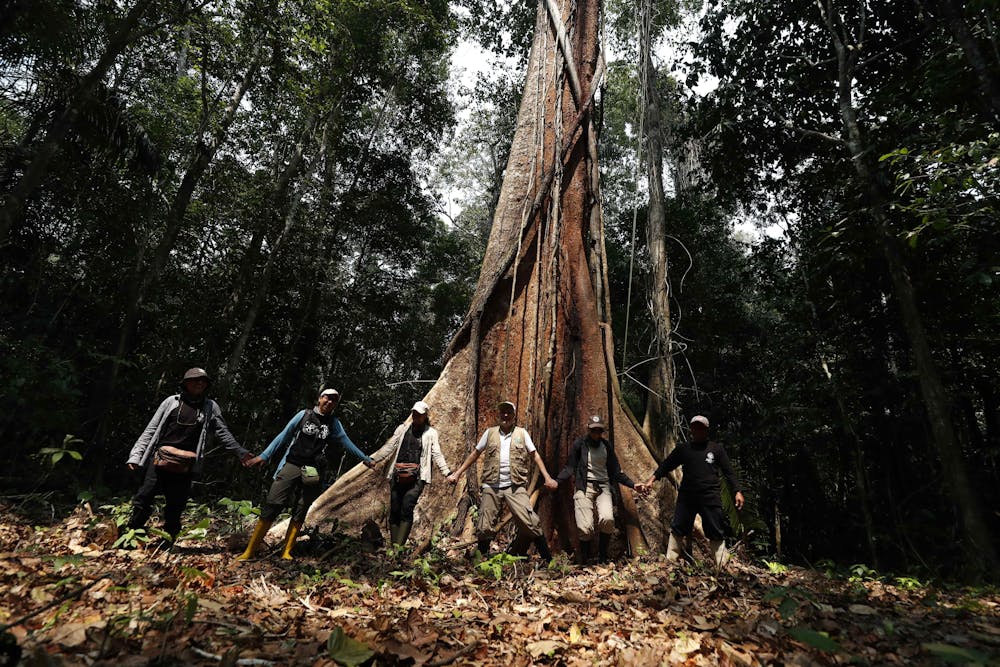 Environmental activists and defenders gather beside an approximately 1000-year-old shihuahuaco tree, in Madre de Dios, Peru, September 2022. Indiscriminate logging is causing the disappearance of this species.
Paolo Aguilar/EPA
The science is in, he writes:
the consequences of human activity are clear and the threats to our survival are a stark reality.
What matters now is that “we shift from anthropocentrism to ecocentrism” and “reformulate” our legal, economic and political systems.
Cross-cultural collaboration incorporating wisdom “passed through generations of Indigenous Peoples worldwide” plays a crucial role in getting us onto this “different path”.
A form of devotional reading?
So much has changed since Suzuki first wrote The Sacred Balance. Perhaps a book we read for information in 1997, is now read more for love; the need to be informed has transformed into the need to be encouraged.
In Religion for Atheists, contemporary philosopher Alain de Botton makes a case for borrowing ideas and practices from religion which may help to “assuage a few of the most persistent and unattended ills of secular life”. Amongst these is the practice of devotional reading, or partaking in a “calibrated daily dose of ideas”.
A reader of the new edition of The Sacred Balance may pick up a new fact or two about basic life sciences and find this satisfying. A practitioner, on the other hand, revisiting the book regularly to hold onto what de Botton calls a “quiet truth”, is availed of a deeper possibility.
Wall Kimmerer suggests The Sacred Balance “sows a vision of the future we want to live in, with guidance to get there”. It is a vision, she writes, that “nourishes us in ways both physical and spiritual”. We could all use a dose of that.
Authors: Jana Norman, Alfred Deakin Postdoctoral Research Fellow, Deakin University
Environmental activists and defenders gather beside an approximately 1000-year-old shihuahuaco tree, in Madre de Dios, Peru, September 2022. Indiscriminate logging is causing the disappearance of this species.
Paolo Aguilar/EPA
The science is in, he writes:
the consequences of human activity are clear and the threats to our survival are a stark reality.
What matters now is that “we shift from anthropocentrism to ecocentrism” and “reformulate” our legal, economic and political systems.
Cross-cultural collaboration incorporating wisdom “passed through generations of Indigenous Peoples worldwide” plays a crucial role in getting us onto this “different path”.
A form of devotional reading?
So much has changed since Suzuki first wrote The Sacred Balance. Perhaps a book we read for information in 1997, is now read more for love; the need to be informed has transformed into the need to be encouraged.
In Religion for Atheists, contemporary philosopher Alain de Botton makes a case for borrowing ideas and practices from religion which may help to “assuage a few of the most persistent and unattended ills of secular life”. Amongst these is the practice of devotional reading, or partaking in a “calibrated daily dose of ideas”.
A reader of the new edition of The Sacred Balance may pick up a new fact or two about basic life sciences and find this satisfying. A practitioner, on the other hand, revisiting the book regularly to hold onto what de Botton calls a “quiet truth”, is availed of a deeper possibility.
Wall Kimmerer suggests The Sacred Balance “sows a vision of the future we want to live in, with guidance to get there”. It is a vision, she writes, that “nourishes us in ways both physical and spiritual”. We could all use a dose of that.
Authors: Jana Norman, Alfred Deakin Postdoctoral Research Fellow, Deakin University 

















