

Australia is facing a 450,000-tonne mountain of used solar panels. Here's how to turn it into a valuable asset
- Written by: Archie Chapman, Senior Lecturer, School of IT and Electrical Engineering, The University of Queensland
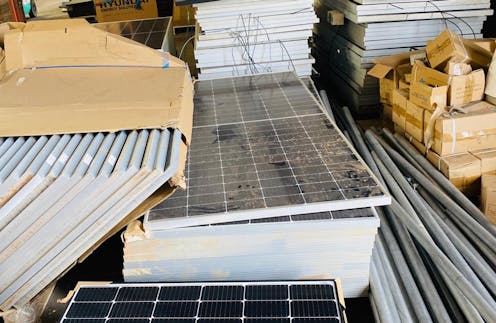
There were an estimated 100 million individual solar photovoltaic (PV) panels in Australia at the end of 2022. We estimate this number will likely grow to over 2 billion if we are to meet Australia’s 2050 net-zero emissions target. This growth means Australia is facing a 450,000-tonne mountain of used PV panels by 2040.
Managing all those discarded PV panels will be a huge job. Rather than treating them as “waste”, though, these panels could be a source of social, environmental and economic value. Our new industry report outlines how we can realise that value.
PV panels contain a variety of valuable materials. The panels can also be put to new uses, such as on uninhabited community and sports club buildings, for agricultural irrigation pumps, or for camping and caravanning.
However, at present, they tend to follow a linear, “take, make, dispose” lifecycle. This results in many PV panels being sent to landfill or stockpiled. Much of their value is wasted.
Read more: Stop removing your solar panels early, please. It's creating a huge waste problem for Australia
What did the research look at?
The University of Queensland and Circular PV Alliance have assessed the market for used and surplus PV panels, with funding from Energy Consumers Australia. Our findings are in the report launched today at the Smart Energy Council Expo in Sydney.
Our goal was to understand potential customers and value streams for used PV panels. We also wished to identify market or policy barriers to reusing, repurposing and recycling these panels.
We reviewed the academic research on the topic and conducted a series of interviews. Thirteen organisations with diverse interests in solar energy and PV panel reuse and recycling participated. A series of recurrent themes emerged that indicate potential or perceived opportunities and challenges for PV panel reuse.
Read more: How to maximise savings from your home solar system and slash your power bills
What did the research find?
Overall, there was broad concern among interviewees that PV panels are being decommissioned before the end of their productive lives. A few key reasons stood out:
renewable energy certificates encourage PV investors to install new panels rather than extend the life of older panels, because the subsidy is paid in full on installation, rather than as power is generated
low-quality PV products have a high failure rate
an array that combines different PV panels can be limited by the lowest-performing panel.
These issues contribute to the already large amounts of discarded panels coming from solar farms, and warranty and insurance claims.
However, we also found reclaimed PV panels offer low-cost, clean energy options for households and community energy projects.
Read more: Solar power can cut living costs, but it's not an option for many people – they need better support
Even when not reusable, PV panels include valuable materials that can be recovered. The average silicon panel contains silver (47% of recycled materials value), aluminium (frame, 26%), silicon (cells, 11%), glass (8%) and copper (8%).
And PV panel recycling is becoming more efficient. This has led to better-quality outputs and higher recovery rates. For example, nano-silicon created by processing recovered silicon can sell for over A$44,000 per kilogram.
A shift towards viewing a PV panel as a valuable resource or asset, rather than “waste”, will improve both consumer and industry understanding of its inherent value, even when it’s not brand new.
How do we turn ‘waste’ into an asset?
We can keep used PV panels out of landfill by treating them as an asset through a value-capture system. This will create a variety of benefits and opportunities.
The circular economy model loops the “take, make, reuse” phases into a self-sustaining cycle. It provides a foundation to grow markets for used PV panels. This will tap into consumer demands for credible and sustainable products and services.
There are already successful examples of similar solutions for other products in Australia and around the world. Australian examples include the National Television and Computer Recycling Scheme and Tyre Stewardship Australia, as well as state-based beverage container deposit schemes.
So how do we set up a circular economy for PV panels? We found a combination of policies, regulations and commercial services can overcome the obstacles to reuse and recycling.
A consistent, national approach is needed to establish successful markets for used PV panels. Standards for testing and certifying these panels, as well as repair warranties, are essential to build consumer trust in this product.
Industry reporting and accreditation requirements as well as product traceability, so the reused and recycled panels can be accounted for, are all important elements of product stewardship and used PV panel markets.
Targeted engagement with a broader range of potential consumers, insurers and PV panel manufacturers will help overcome their perceived barriers to reusing panels.
Taken together, these actions are the building blocks of creating a circular economy for PV panels in Australia. The looming volumes of used panels and ever-increasing amount of solar energy being installed in Australia compel us to do this. Consumers, industry and the environment will all benefit.
The author acknowledges Megan Jones, Circular PV Alliance co-founder and director, for her contribution to this article.
Authors: Archie Chapman, Senior Lecturer, School of IT and Electrical Engineering, The University of Queensland

















