

After decades of trying, how can we deliver more effective alcohol regulation in the NT?
- Written by: Elizabeth Crawford Spencer, Professor of Law, Charles Darwin University
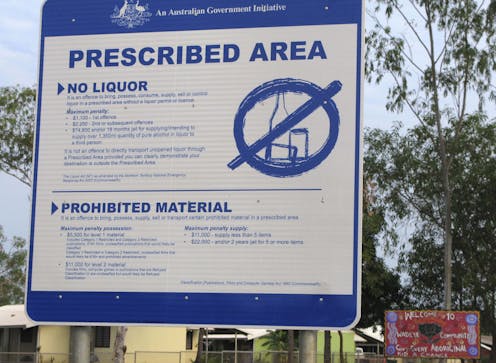
The Northern Territory continues to report the highest levels of alcohol consumption and harm in Australia, despite decades of reform.
As we’ve seen over the years, there’s been a concerning link between alcohol consumption and domestic violence, crime and antisocial behaviour. When federal laws restricting access to alcohol lapsed last year, it led to a surge in crime that many had warned about. The alcohol ban was swiftly reinstated.
But NT-based and Indigenous communities have long argued that banning alcohol is only part of the solution to a complex problem. The challenge is to find a more long-term, sustainable solution to alcohol consumption that incorporates a mix of policy, legislative, industry and community strategies.
Here are three possible strategies for the NT:
1) Controlling supply and distribution
The simplest way governments can reduce alcohol-related harm is to decrease supply and access to alcohol.
The NT has done this by regulating alcohol outlet availability and density in cities, limiting the hours and days when alcohol can be sold, and enhancing enforcement of laws restricting or banning alcohol. The public anger over the planned opening of a Dan Murphy’s near three dry communities in 2021 indicates that Territorians understand the link between supply and harm.
There is also compelling evidence that restrictions on Good Friday and Christmas Day – which are common throughout Australia - are associated with a decreased incidence of alcohol-related harm.
In addition, the NT government has recently announced plans to buy back liquor licences, which has been welcomed by health, First Nations and other community groups.
We can also learn from other countries how to take a more comprehensive approach.
In Norway, for instance, the government controls production and distribution through a state-owned monopoly called Vinmonopolet, which decides where outlets will be located, the hours of operation and stock.
These measures are combined with targeted and adequately resourced alcohol-related public health campaigns, such as a recent one aimed at reducing the supply of alcohol to minors.
2) Changing purchasing and consuming behaviour
The NT was the first jurisdiction to introduce a minimum unit pricing scheme, a policy that sets a minimum price at which alcohol can be sold per unit of alcohol, currently at $1.30. This has proven effective in reducing alcohol consumption – especially for wine products.
However, recent research from the UK shows that when higher-percentage alcohol products go on sale (which happens more frequently than for lower- or zero-percentage alcohol products), minimum unit pricing can be less effective.
More broadly, there have been calls to increase regulations on retail alcohol outlets. Currently, alcohol regulation is more extensive for hotels, pubs and clubs than retail outlets.
As a result, consumers may be motivated by the cheaper cost and reduced scrutiny when buying alcohol from a bottle shop. This dynamic can also facilitate risky patterns of consumption, such as pre-drinking.
Another way of changing behaviour is through health messaging. Most alcohol labelling is covered under Australia’s food standards code – with a strong pregnancy focus.
However, a recently published study found that using both words and images on health warning labels can better informs people about the health risks associated with alcohol (including cancer). This would be similar to the warnings used on tobacco labels.
These enhanced warning labels also lead people to form stronger intentions to reduce consumption, compared to text or photograph warnings alone.
3) Empowering community-led approaches
Another way governments and communities can manage alcohol-related harm is to promote drink-free activities and one-month alcohol abstinence campaigns, such as “dry July”. These types of campaigns have lasting positive effects on health, wellbeing and maintaining control over drinking.
Some Darwin locals have also formed a social sober club, where socialisation without alcohol is emphasised.
However, such efforts often go against entrenched drinking norms in Australia.
And many people drink not for socialisation, but to cope with broader social problems and stressors. Issues such as unemployment, housing stress and mental health are linked to alcohol use, which are especially relevant in regional and remote areas in the NT.
Similarly, the continued effects of colonisation and intergenerational trauma experienced by First Nations people necessitate an approach that emphasises the right to self-determination in addressing alcohol-related issues.
We need to provide adequate resources and support to help communities alleviate these sources of stress and trauma, which will hopefully have an impact in reducing alcohol-related harm.
A way forward
Ultimately, effective reform will require deep reflection on what alcohol means to us as individuals, and as a society.
In the NT, we need a consultative, co-design process that brings together the territory and Commonwealth governments, representatives from the alcohol industry, the alcohol rehabilitation community, tourism providers, pub owners and leaders from Indigenous communities.
By learning from the successes and failures elsewhere, we can deliver a tailored approach for the NT that will have a better chance of success in the long term.
Authors: Elizabeth Crawford Spencer, Professor of Law, Charles Darwin University


















