

why 'the divine right of kings' (still) matters
- Written by: Kit MacFarlane, Lecturer, Creative Writing and Literature, University of South Australia
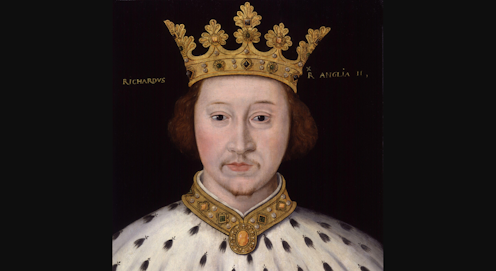
What do you do with a bad king? And what do you do when that bad king is (allegedly) appointed by God?
Shakespeare’s Richard II is a play that asks us, among other things, what it means to have power, what it means to take power, and what we’re left with when power is gone. It is also a play that saw Shakespeare risking some serious trouble with the God-appointed monarch of his time, Elizabeth I.
Shakespeare wrote Richard II around 1595. It is the first part of the “Henriad”, a sequence of eight historical plays that span the “Wars of the Roses”: Richard II, Henry IV parts 1 and 2, Henry V, Henry VI parts 1, 2 and 3, and Richard III. These plays were recently presented as the BBC series The Hollow Crown (2012-2016).
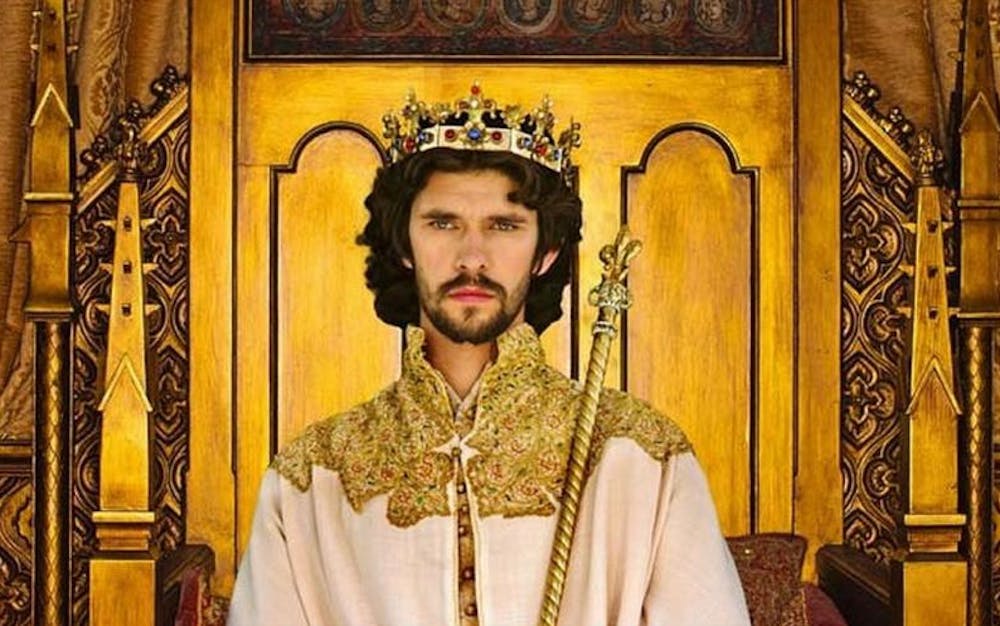
The “Henriad” shows the monarchy in a state of turmoil. When Richard II begins, Richard is in full king mode: throne, crown, sceptre. His authority is absolute. By the end of the play, he is not king anymore; he is dead. A brief comment by the new king, Henry IV, leads to Richard being murdered in his cell.
The Hollow Crown Trailer (Focus Features)Read more: Macbeth by William Shakespeare: a timeless exploration of violence and treachery
What went wrong?
The play begins with an argument in front of Richard. Henry Bolingbroke – Richard’s cousin and the future Henry IV – calls Thomas Mowbray, the Duke of Norfolk,
a traitor and a miscreant,Too good to be so and too bad to live.
He accuses Mowbray of killing his uncle. Mowbray, in response, calls Bolingbroke “a slanderous coward and a villain”.
Richard knows even a king cannot command these two enemies to be friends, so ritual combat seems the way to sort things out:
We were not born to sue, but to command;Which since we cannot do to make you friends,Be ready, as your lives shall answer it.
Bolingbroke and Mowbray spend a long time prepping; after all, one of them is about to die. But just when they are about to fight, Richard calls the whole thing off. He banishes them both instead.
On the surface, Richard is not doing too badly. He listens to these two hotheads arguing and tries to get them to simmer down: “Forget, forgive; conclude and be agreed”.
They will not forget or forgive, so Richard goes along with the plan for ritual combat until it is clear they won’t back down from that either. At that point, he stops it with the lesser (but still tough) penalty of banishment.
Compared to some of Shakespeare’s kings, this might seem fairly considerate. Yet Richard’s actions are undermined by his implied motivation. He responds with patience to Bolingbroke and Mowbray arguing about the murder of Bolingbroke’s uncle, but we quickly learn from Bolingbroke’s father, John of Gaunt, that Richard probably arranged the murder himself.
Richard’s petty qualities are wonderfully demonstrated when he is delighted to hear that “Old John of Gaunt is grievous sick”. He has just banished Gaunt’s son, so he figures he might as well help himself to Gaunt’s estate:
Come, gentlemen, let’s all go visit him:Pray God we may make haste, and come too late!
Even if we are hissing Richard, there is an underlying question: at what point do Richard’s actions as king allow us to ignore the fact that he is king?
John of Gaunt’s brief role in the play highlights this central tension. At first, he is not willing to make a fuss about Richard having his brother killed. Why? Because Richard is God’s appointee, and that means he is God’s problem.
Shortly before his death, however, Gaunt is less forgiving. He suggests Richard’s abuses of power are serious enough to have delegitimised his position: “Landlord of England art thou now, not king.”
Richard II: “This Sceptered Isle” speech (Good Tickle Brain)A dangerous play?
The historical Richard II ruled from 1377-1399, but his power in the play is in line with the monarchy of Shakespeare’s time, when the monarch’s absolute power did not leave much room for opposition. When Henry Bolingbroke returns from exile to demand his stuff back, he is heading into dangerous territory by threatening Richard’s crown.
Bolingbroke is defined by his uneasy negotiation with Richard’s seemingly unquestionable right to the throne. But so is Richard himself. He declares
Not all the water in the rough rude seaCan wash the balm off from an anointed king.
Yet he struggles to reconcile this with his humanity:
I live with bread like you, feel want,Taste grief, need friends: subjected thus,How can you say to me, I am a king?
When Bolingbroke’s quest for recompense shifts to him taking Richard’s crown in “God’s name”, Shakespeare himself enters potentially dangerous territory. Dethroning monarchs was not exactly a benign topic in Shakespeare’s time. Elizabethan England was a censorious and restrictive society, with death looming as a possible penalty for subversive activity.
Shortly before the Earl of Essex attempted to overthrow Elizabeth I in February 1601, some of his supporters requested and paid for a special performance at the Globe of one of Shakespeare’s old plays: Richard II. As Stephen Greenblatt observes,
the conspirators must have felt that there was a benefit to be gained from representing to a large public (and perhaps to themselves as well) a successful coup d’état. Perhaps they wanted, quite simply, to make what they intended imaginable.
“I am Richard II; know ye not that?”, Elizabeth is supposed to have declared not long after the would-be usurpers were dealt with.
Greenblatt suggests “the Queen understood the performance as a threat”. Having written a play about the toppling of a king and being part of the company presenting it a day before the attempt to topple Elizabeth, Shakespeare may have been lucky to escape serious repercussions.
Read more: How to read Shakespeare for pleasure
Why does ‘divine right’ still matter?
The “divine right of kings” may not exist now – or does it? It is still technically illegal in England to call for the abolition of the monarchy. British monarchs have sovereign immunity, which places them beyond the reach of laws that apply to ordinary citizens.
The concept of “divine right” may seem like an obsolete concept, but it still resonates today when we consider those people whose power, wealth or status seem to elevate them above the rules governing others in society. Social, economic and political systems can also seem to be largely immune from individual questioning and dissent.
In 2014, the late Ursula LeGuin made one of these connections plain:
We live in capitalism, its power seems inescapable – but then, so did the divine right of kings. Any human power can be resisted and changed by human beings. Resistance and change often begin in art. Very often in our art, the art of words.
Shakespeare reminds us we don’t have to think about power in an absolute way. He highlights the tension between absolute power and human limitations. As Greenblatt argues, Shakespeare throws “a garish light on an unnerving fact: even those in the innermost circles of power very often have no idea what is about to happen”.
Read more: Guide to the classics: Shakespeare's Hamlet, the Everest of literature
Where does that leave Richard?
Shakespeare often refuses to let us pick sides as cleanly as we might like. As Emma Smith, professor of Shakespeare studies at Oxford, has written, Shakespeare’s plays “prompt questions rather than supplying answers”.
In an online lecture, Smith considers the core question raised by Richard II: “was it right for Bolingbroke to take the throne from Richard?” Richard’s reign may evoke little sympathy, but Bolingbroke’s motivations remain questionable.
Shakespeare recognises the pathos of Richard’s fall. When Richard is overthrown, his place in the universe (its centre) is suddenly denied him. Stripped of his crown, he must confront his fallible humanity. His sense of himself is thrown into disarray: he hasn’t just lost power; he has lost his understanding of who he is.
Richard’s existence is suddenly one of “radical doubt and questioning”. Whatever we think of him as a king and person, his uncertainty is a trait we do not need to be a deposed king to understand. Like Richard, we can understand ourselves and our place within our own lives as something that might fluctuate between defiant certainty and debilitating doubt.
Slavoj Žižek has interpreted the play as
the progressive questioning by the King of his own “kingness” – what is it that makes me a king? What remains of me if the symbolic title “king” is taken away from me?
Literary critic Harold Bloom noted Richard has two roles that “are antithetical, so that his kingship diminishes even as his poetry improves”. For Bloom, the play “studies the decline and fall of a remarkable poet, who happens to be an inadequate human being, and a hopeless king”.
Sometimes overshadowed by the spotlight-stealing Richard III, Richard II is a versatile and resonant play. It has recently been presented by a cast made up entirely of women of colour as a reflection on Brexit, and by a “predominantly BIPOC ensemble” in a radio version dedicated to the Black Lives Matter movement.
Shakespeare is not asking us to think about only one historical monarch. How we understand power and the “divine right of kings” in Richard II relates to his society, and to our own. The play can also prompt deeply personal reflections. As The Flaming Lips said, “to be thought of as a king, you don’t need a crown”.
Richard II asks us to question our certainties, and how we understand our own sense of power and identity.
Authors: Kit MacFarlane, Lecturer, Creative Writing and Literature, University of South Australia
-matters&media=https://www.modernaustralian.com/https://images.theconversation.com/files/524032/original/file-20230503-24-zp5j43.png?ixlib=rb-1.1.0&rect=0%2C2%2C1732%2C947&q=45&auto=format&w=496&fit=clip&description=why%20'the%20divine%20right%20of%20kings'%20(still)%20matters "Pin It")

















