

Modern Australian
The Times

People are complaining about Mercury in retrograde. But what does it actually mean?

  • Written by Laura Nicole Driessen, Postdoctoral researcher in radio astronomy, University of Sydney
People are complaining about Mercury in retrograde. But what does it actually mean?

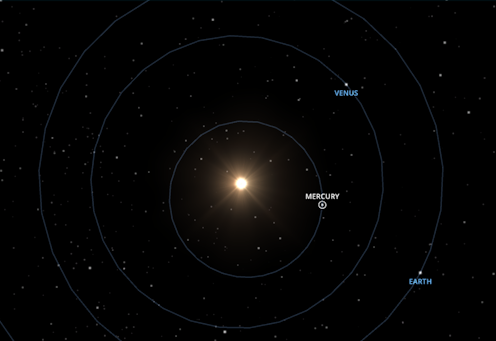
Mercury is the closest planet to the Sun, whipping around our star every 88 days compared to Earth’s 365.25 days. Mercury will also be the first planet destroyed when the Sun expands on its way to becoming a red giant in about 5 billion years.

So it seems a bit rough that we blame Mercury for all our problems three to four times a year when it’s in retrograde. But what does it mean when we say Mercury is “in retrograde”?

An image of Mercury - a partially obscured dark grey sphere with lots of texture created by many craters on its surface, on a black background
Image of Mercury from MESSENGER’s Wide Angle Camera. NASA/Johns Hopkins University Applied Physics Laboratory/Carnegie

A matter of orbits

Retrograde motion means a planet is moving in the opposite direction to normal around the Sun. However, the planets never actually change direction. What we are talking about is apparent retrograde motion, when to us on Earth it looks like a planet is moving across the sky in the opposite direction to its usual movement.

Because Mercury is closest to the Sun and has the fastest orbit, it appears to move backwards in the sky more often than any other planet.

Let’s use my dog Astro to help explain what’s happening when we see a planet in retrograde. Astro is a whippet, or a mini-greyhound, and he has a need for speed. If I take Astro for a run on my local cricket oval, he does super-speed laps on the inside while I run much more slowly around the outside.

If we’re both going anti-clockwise around the cricket pitch, when Astro is on the opposite side of the oval to me it looks like he’s going left while I’m jogging right. But when he gets to the same side of the oval as me, it suddenly looks like he’s running right instead of left (retrograde).

This happens because Astro is going much faster than me, and is inside my “orbit” of the oval.

Diagram of me (Laura) and Astro running around the oval, from my point of view. At the top we can see the top-down view of the oval. At the bottom we can see the side-on view. From my point of view it looks like Astro is running right-to-left when he’s on the opposite side of the oval to me, but it looks like he’s running left-to-right when he’s on the same side of the oval to me. Laura Driessen (author provided)

Because Mercury’s orbit is inside Earth’s orbit, seeing it from our planet is like me watching Astro run.

But Mercury isn’t the only planet to do this. Venus also orbits inside our orbit of the Sun, zipping around once every 224.7 days. This means Venus is in retrograde twice every three years.

Diagram of the concentric rings around the Sun showing the orbits of all the planets (and Pluto).
Diagram of the orbits of the planets (and dwarf planet Pluto) in the Solar System. The dwarf planet Ceres orbits between Mars and Jupiter. NASA Space Place

The other retrograde

It works the other way around, too. The planets outside our orbit (Mars, Jupiter, Saturn, Uranus, and Neptune) also go into retrograde.

To work this out, we need to swap our perspective. Astro is definitely not a deep thinker, but let’s imagine for a moment that he is and think about what he sees as he runs around the oval.

He’s running around the oval and he starts catching me up from behind. At this moment it seems like we’re both going the same direction, to the right. But as he starts to pass me, it seems like I’m going backwards or left (retrograde) while he continues to run forwards to the right.

This is what happens when we look up at the sky and see one of the outer planets in retrograde.

Mars is in retrograde once every two years. The other planets are so far from the Sun and travelling so slowly compared to Earth that it’s almost like they’re standing still. So we see them in retrograde approximately once a year as we whip around the Sun so much faster than they do.

Artist's impression of retrograde motion from Astro the whippet's perspective.
Diagram of me (Laura) and Astro running around the oval, this time from Astro’s perspective. At the top we can see the top-down view of the oval. At the bottom we can see the side-on view. From Astro’s view, it appears that I’m going backwards as he overtakes me. Laura Driessen (author provided)

A well-known illusion

Retrograde motion bamboozled ancient astronomers since humans started looking up in space, and we only officially figured it out when Copernicus proposed in 1543 that the planets are orbiting the Sun (though he wasn’t the first astronomer to propose this heliocentric model).

Before Copernicus, many astronomers thought Earth was the centre of the universe and the planets were spinning around us. Astronomers like Apollonius around 300 BCE saw the planets going backwards, and explained this by adding more circles called epicycles.

So, humans found out retrograde motion was an optical illusion 500 years ago. However, the pseudoscientific practice of astrology continues to ascribe a deeper meaning to this illusion.

Diagram with coloured lines spanning the dates in 2023 that each planet is in retrograde.
Diagram of the dates in 2023 that each planet (and the two dwarf planets Pluto and Ceres) will be in retrograde. Laura Driessen (author provided)

There’s a retrograde most of the time

If we consider the seven planets other than Earth, at least one planet is in retrograde for 244 days of 2023 – that’s around two-thirds of the year.

A white dog with a brown patch over his eye is wearing a yellow jacket and sitting in from of a dam
Astro the whippet thinking about all the possums he’s going to bark at later. Laura Driessen (author provided)

If we include the dwarf planets Pluto and Ceres (and exclude the other seven dwarf planets in the Solar System), at least one planet or dwarf planet is in retrograde for 354 days of 2023, leaving only 11 days without any retrograde motion.

I like to think the biggest impact the planets have on Earth is bringing wonder and joy every time we turn our eyes (and our telescopes) to the night sky. Astro, on the other hand, is happy as long as he gets to run around the oval and bark at possums.

Read more: From platypus to parsecs and milliCrab: why do astronomers use such weird units?

Authors: Laura Nicole Driessen, Postdoctoral researcher in radio astronomy, University of Sydney

Read more https://theconversation.com/people-are-complaining-about-mercury-in-retrograde-but-what-does-it-actually-mean-205032

Road Signs: Understanding Their Role in Clear and Effective Signage

Effective signage and display hardware can help businesses communicate information, promote products and organise customer or visitor movement. Road...

Bottle Label Printing: Key Factors to Consider Before Your Next Packaging Run

Effective packaging begins with understanding the product, bottle material, artwork and production requirements when planning bottle label printing. H...

Planning a Long-Distance Move With Interstate Movers Melbourne

Moving between states involves more planning than a typical local relocation. Along with packing and transporting household belongings, you need to...

Understanding the Role of an I/O Controller in Industrial Automation

Modern industrial systems depend on accurate communication between sensors, machines and control systems. An I/O controller can help manage this commu...

How the Right Mining Hose Supports Demanding Operations

Mining environments place considerable demands on equipment used for material transfer, water management and processing. Hoses operating in these co...

Simple Ideas for Making Social Gatherings More Memorable

We have all been to those parties where everyone just stands around the kitchen island, staring at their phones, waiting for someone else to make a mo...

Outdoor Wall Lights: Improving Exterior Lighting Around Your Home

Lighting can influence how a room looks, feels and functions, so the right fitting should be selected according to both appearance and practical req...

Commercial Office Cleaning: Combining Routine Office Cleaning With Melbourne Service

Keeping a workplace clean requires a service that can accommodate everyday tasks as well as the particular needs of the business. Professional comme...

Caravan Sales in Queensland: How to Find the Right Caravan for Sale QLD

Caravan ownership is about more than having somewhere to sleep while travelling. For many Queenslanders, it is one of the best ways to explore regio...

What Sir Walter Buffalo Turf Actually Costs in 2026 (And Why Quotes Vary So Much)

Two quotes landed on a Hills District homeowner's kitchen table last spring for the exact same 80-square-metre backyard. One said $12 a metre. The o...

Nearly 1,300 NSW Hospital Beds Are Occupied By People Who Are Ready To Go Home

1,276 people in NSW hospitals have been medically cleared for discharge but remain in hospital because they're still waiting for NDIS or aged care sup...

National Survey Launched to Measure Operational Impacts of Federal NDIS Policy Reforms

The effects of recent NDIS reforms are beginning to move beyond policy papers and into day to day service delivery. A new national survey is asking ...

Beyond the Nappy Cake: Baby Shower Gifts That Get Used

What new Australian parents unwrap, keep, and quietly thank you for months later. Six weeks after my daughter was born, I did an audit of the baby sh...

Parent-Advocates Are Reshaping Frontline Disability Service Delivery

Parents have always been part of the disability sector. They advocate, coordinate services, challenge decisions and often become the person holding ev...

Vista Cruises Enters "Two-Flagship Era" as Vista Aurora Completes Inaugural Voyage

Vista Aurora Sets Sail along the Yangtze. (Photo courtesy of the company)YICHANG, China — August 5, 2026 — Vista Aurora, a high-end interprovinc...

A Digital Preparation Checklist For International Medical Conferences

An international medical conference compresses many responsibilities into a few days. A delegate may need to present research, move between venues, ...

The Growing Popularity of Lab Grown Diamonds in Sydney and Hong Kong

The diamond industry has changed significantly in recent years as more buyers seek ethical, affordable, and sustainable alternatives to mined diamon...

Modern AI SEO Agency vs Traditional SEO: What’s the Difference

Search engine optimisation has changed dramatically over the past few years. Search engines have become smarter, user behaviour has evolved, and bus...

















