

in Netflix's Beef, Asian migrants are allowed to have real emotions
- Written by: Sukhmani Khorana, Associate Professor, Faculty of Arts, Design and Architecture, UNSW Sydney
If you ever watched the Korean-Canadian television show Kim’s Convenience or the Taiwanese-American Fresh off the Boat, you would have felt seemingly content with the progress of Asian diasporic representation on mainstream screens.
These drama series may have been occasionally peppered with stereotypes, but at least they centred on migrant stories. Both shows were subsequently criticised for the lack of diversity behind the scenes, particularly in the writers’ rooms.
More recently, there has been growing interest in the representation of cultural diversity on our screens and more broadly in our cultural institutions in the wake of #OscarsSoWhite and the Black Lives Matter movement. Despite controversy and some limitations, the Netflix series Beef is more complex and nuanced than many other onscreen renderings of first and second-generation migrants in the Global North.
This success can be attributed to the fact that it humanises migrants by focusing on their inner lives and not just on their cultural difference. It also helps that most of its directing and writing crew have lived experience of being othered.
New migrant tales
In 2023, Asian-American-themed content and creators have become even more central to the most powerful media industry, with the film Everything Everywhere All at Once sweeping several Oscars at the 95th Academy Awards.
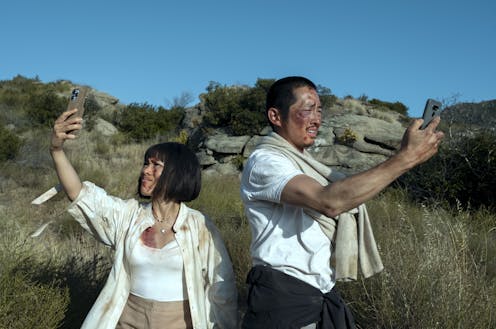
Then, in April of this year, came a dark comedy called Beef produced by Netflix and A24, and starring Asian-American talent like Ali Wong and Steven Yeun in leading roles. What is new about these migrant tales is that their lead characters are as flawed, and have as much agency as those in an average drama series or psychological thriller with a majority white cast.
Read more: Oscars 2023: The philosophy of Everything Everywhere All at Once explained
Why is the emotional heft of the series a talking point for both white and non-white audiences across the globe? Research on racial minorities and emotions suggests that those seen as socially less powerful are rarely allowed to be angry in the public domain.
Beef breaks this stigma by basing the fued between Yeun and Wong’s characters on a road rage incident in a parking lot in Southern California. As the anger escalates, it ruins their lives, but also serves as a valve for their repressed emotions as children of migrants who worked hard and were told not to complain.

Emotion and inadequacy
What is also specific to the Asian-American condition, as writer Cathy Park Hong explores in her book of essays, Minor Feelings, is being seen as “emotionless functionaries” and having persistent feelings of inadequacy.
This is largely due to Asian-Americans and other racialised groups being cast as “model minorities” and often internalising this characterisation. Justifying immigration for economic reasons in most immigrant nations also drives a wedge between groups such as Asian-Americans and African-Americans.
The undercurrent of anger in Beef is shame that both Amy (Wong) and Danny (Yeun) have experienced since their respective childhoods due to personal and systemic circumstances. In the wake of the COVID-19 pandemic and the accompanying rise in anti-Asian racism in countries like the US and Australia, anxiety in these diverse communities has amplified and ally-ship initiatives with Black Lives Matter organisers have also come about.
In the creative realm, we have seen the desire for self-expression] to resist racism and hate.
Empathy, aspiration and belonging
While there is ample interest in anger, fear and hate in relation to race, politics and representation, my own work explores more ambivalent and complex emotions like empathy, aspiration and belonging in relation to migration.
It is in the exploration of these grey zones that Beef excels, showing us what is both universal and culturally specific about intergenerational trauma.
There is now some recognition that migrants who move from the Global South to the Global North for economic reasons aspire for more that just social mobility.
However, we see very little of their underlying emotions and how they shift over time in most screen drama. In Beef, when Amy visits her parents after a fight with her Japanese-American husband, her mother is both reticent to talk about the past and enjoying her present life of travelling. Danny undoes racial and masculine typecasting in one powerful scene where he breaks down in the middle of Korean church choir.
Amy and Danny belong to starkly different social milieus, with the latter working as a contractor and struggling to save for a house for his parents and the former owning a lifestyle small business on the verge of a multi-million dollar acquisition deal.
This small detail itself is noteworthy as it depicts the vast range of Asian-American class experiences, including Amy’s husband’s family who have cultural capital, hailing from the art world. This means that the characters’ economic aspirations look very different from one another and often mask a deeper desire for belonging.
 Ali Wong in Beef.
Netflix
Ali Wong in Beef.
Netflix
A desire for belonging
Without giving away the final episode that is part surrealism and part culturally attuned therapy session, what is clear is that Beef gives permission to its feuding central characters and racial minority audience members to feel. These are feelings of wanting to be at home, to be loved unconditionally, to not be bullied, and ultimately to belong to wherever they happen to have been planted.
The overwhelming desire for belonging explored in Beef may resonate more with the children of migrants, or the second generation as they are sometimes referred to, but is has proven to be cathartic for a surprisingly broad range of viewers.
It works because it is a contemporary yet specific take on anger as an outlet for other emotions. It neither exoticises anger, nor does it render belonging colour-blind.
Authors: Sukhmani Khorana, Associate Professor, Faculty of Arts, Design and Architecture, UNSW Sydney


















