

What BBC and Stan series Ten Pound Poms gets right – and wrong – about the British migrant experience in Australia
- Written by: Carmel Pascale, Visiting Research Fellow, School of Humanities, University of Adelaide
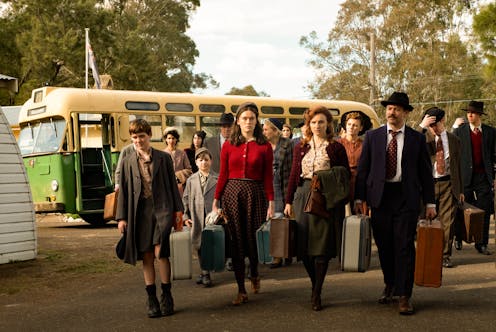
The first episode of Ten Pound Poms opens onto a bleak scene.
As snow falls against a grey sky in Manchester, Terry Roberts (Warren Brown) works to repair buildings damaged during the second world war. We can barely see him through the smog; the sound of hammering dominates the scene. As it gets louder, it triggers flashbacks to his time as a prisoner of war.
At home, his wife Annie (Faye Marsay) carefully scrapes used tea leaves into a jar, fed up with the sacrifices and depredations of post-war Britain.
That night, while tending to Terry – who has collapsed after another evening at the pub where he has spent their meagre income – Annie seizes on a newspaper advertisement offering her family the opportunity to “build a new life in sunny Australia” for only ten pounds.
Set in 1956, Ten Pound Poms, a co-production between the BBC and Stan, tells the story of British migrants as they struggle to build new lives in a distant and unknown land.
Australia’s post-war migration program
Migration to Australia offers the Roberts family the promise of a fresh start, “a bright future” in a “modern” country with abundant fresh food, and a brand-new whitewashed house and family car.
The “Ten Pound Pom” scheme was launched in 1945 and continued into the early 1970s. It was just one of Australia’s assisted passage schemes of the post-war era. Most of the 1.5 million Britons who came to Australia until 1981 were part of such a scheme.
Australia’s post-war migration program was driven by the imperative to “populate or perish”. The second world war had demonstrated Australia’s vulnerability to foreign invasion, and migrants were needed to fuel its burgeoning post-war industrial development and infrastructure projects.
But until the 1960s, the White Australia Policy was very much in place. Australia was still a British country and a proud member of the British Empire, with a preference for British migrants.
Read more: The changing face of Australian immigration
A new life?
Australia offered the Roberts family an opportunity to “work hard, prosper” and own their own home. But once they arrive in Australia, their dream of a new life is dealt a blow.
As assisted migrants, they are sent straight to a migrant hostel camp, where they will live while earning enough to pay their own way. Their dream of “white washed houses and huge gardens” dissipates as they take their first look at the “squalor” of the Nissen huts, outdoor communal showers and drop toilets.
“They lied to us,” says Annie.
Most assisted migrants who arrived by ship ended up in these camps, where they could stay while they looked for work and resettled. But those who had trouble finding work stayed for many months, if not years.
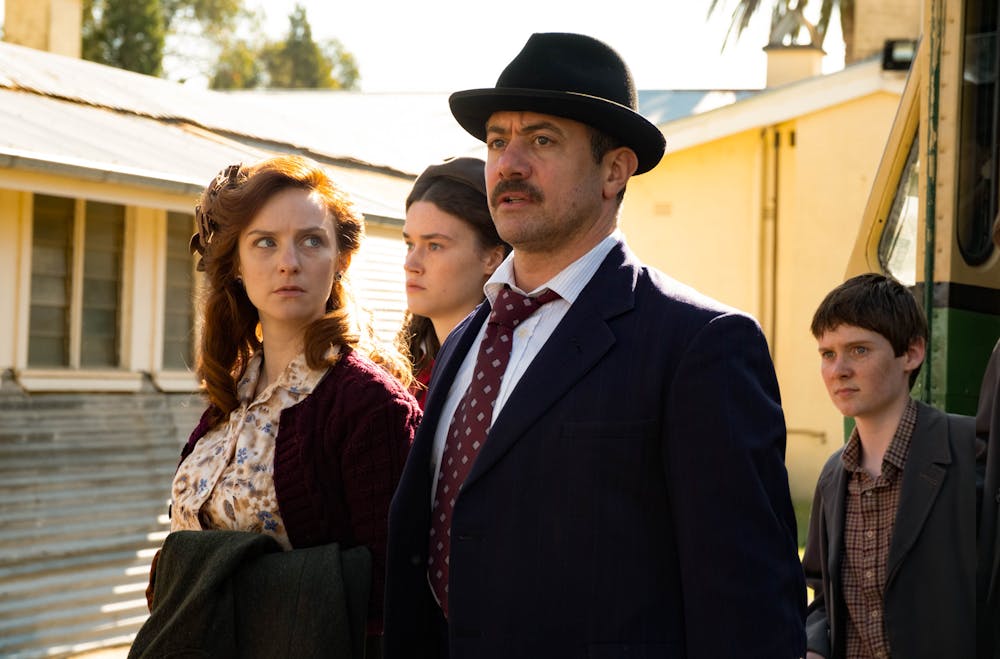
Terry, a qualified builder, must take any work he is offered as long as no Australians want it. His first job is digging ditches for a gas pipeline.
At work, he is subject to name-calling, ostracism and the threat of violence.
Under the scheme, migrants were obligated to stay and work in Australia for at least two years to repay their subsidised travel. After this, up to 25% chose to return home.
The challenges faced by British migrants were shared by those from many other countries. These migrants were not only subject to the same onerous visa conditions and racist attitudes, but denied the privileges accorded the British: the right to vote, get an Australian passport, and receive social security benefits.
But in the series, these non-British migrants are used only as a backdrop. Their stories could have given us a much richer picture of hostel life. Instead they make only brief appearances, and even then, often as caricatures, such as the lazy and overly-emotional Italian, Maria (Sarah Furnari).
An imperial past
Ten Pound Poms is a pacy, character-driven story grounded in historical research.
The series is also very interested in examining the experiences of First Nations Peoples, which it does through war veteran Ron Mahoney (Rob Collins) and his community at an old mission station near the hostel.
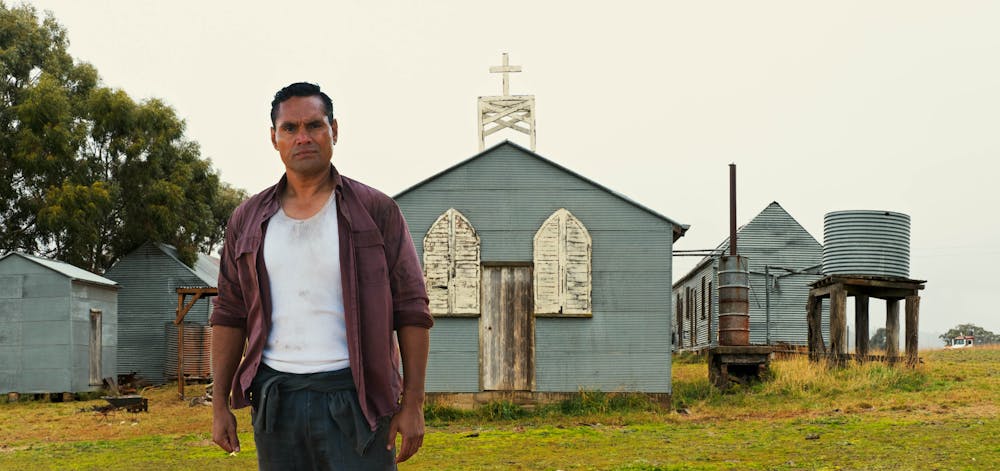 The series also looks at First Nations experiences.
Stan
The series also looks at First Nations experiences.
Stan
But Ten Pound Poms gives us an idealised portrayal of the migrants’ relationship with Ron and the other Aboriginal characters. While the local Australian characters exemplify the racist attitudes of white Australia, the Roberts family’s many interactions with Aboriginal people are entirely friendly and enlightened.
“They’re just people,” Annie tells Terry’s racist co-worker. “They were here long before you were.”
The series largely skips over Britain’s role in the history of colonisation.
Series writer, English screenwriter and playwright Danny Brocklehurst, rightly points out these migrant stories are an important aspect of Australia’s past that have received little attention. But equally important is that this remembering takes account of both Britain and Australia’s imperial past.
Despite these flaws, Ten Pound Poms has a cast of characters you’ll want to follow to the end. It will especially appeal to the many British migrants – both “back home” and in Australia – who will see their own family histories reflected in these characters.
Ten Pound Poms is on Stan and the BBC from Sunday.
Authors: Carmel Pascale, Visiting Research Fellow, School of Humanities, University of Adelaide


















