

An expert’s guide to drinking beer for people who don’t do well with gluten
- Written by: David Bean, Senior Lecturer in Microbiology and Fermentation Technology, Federation University Australia

It’s estimated coeliac disease affects 1.4% of the world’s population – a staggering 112,000,000 people or so in total.
People with this condition develop an abnormal immune reaction when they consume gluten – a protein found in grains including barley, wheat and rye. It can damage the lining of their small intestine and lead to a range of (often debilitating) symptoms.
Coeliacs are forced to forgo glutenous food and drinks, including bread, pasta, cakes, biscuits, pastries and, of course, beer – which has malted barley as its main ingredient. Other alcoholic beverages are considered gluten-free (although diligence is still required since drinks can have flavours added after distillation).
Brewers around the world work on producing beers that can be enjoyed by people with coeliac disease, or general gluten sensitivity. They achieve this through two common approaches:
- making beer with grains that don’t contain gluten
- breaking down the gluten into smaller compounds during the manufacturing process.
The former approach is widely used in Australia and New Zealand.
Read more: Everything you need to know about coeliac disease (and whether you really have it)
How they make gluten-free beer
Consider your breakfast. Did you eat rice bubbles, corn flakes or puffed wheat? Each one of these cereals will give you energy to start your day, but only the last one contains gluten.
Similarly, brewers can use gluten-free grain such as sorghum, buckwheat or rice to try to replicate the flavour of beer, but without the gluten. Beers produced in this way are truly “gluten-free”. They contain none at all.
But brewing with these alternative grains isn’t as common or straightforward as brewing with barley.

Think back to your breakfast: all three cereals are suitable enough, but they don’t taste the same. While there is plenty of diversity in beer flavours, all commonly consumed beer has the underlying flavour of malted barley. This is the taste beer drinkers have come to know and love.
Brewing processes for gluten-free beer must be modified to accommodate the unusual characteristics of alternative grains. For example, barley has a husk, which is used for filtration while making beer. Gluten-free grains tend to not have husks, so rice husks might be added in.
Also, if a particular brewery produces both gluten-free and gluten-containing beer, then gluten contamination is possible. That’s why most Australian breweries that produce gluten-free beer do so in a dedicated facility.
How they make gluten-reduced beer
The natural role of gluten in the barley plant is to provide nutrients to the seedling for germination. Given gluten’s importance to the life cycle of the plant, it’s inevitable some gluten will end up in beer that’s made using barley. In which case, the gluten must then be removed.
To do this, brewers treat the beer with an enzyme called a prolyl endopeptidase (PEP), which is traditionally used to clarify beer by removing hazes formed by proteins.
The PEP enzyme can “recognise” specific parts of the gluten protein and break them down into smaller compounds that don’t cause an immune response in coeliacs.
These beers can be considered “gluten-reduced”. They aren’t completely gluten-free. Whether they are safe to be consumed by coeliacs is a matter of debate among health professionals. Some coelics can tolerate one or two gluten-reduced beers, while others can’t tolerate any.
Research has found gluten-reduced beers would induce an immune response that could be detected through a blood test in two out of 31 coeliac patients.
People who are very sensitive to gluten should exercise caution when considering gluten-reduced beers.
Different countries, different standards
The US Food and Drug Administration states that foods, including beer, with less than 20 parts per million (ppm) gluten can be labelled gluten-free.
The rule in Europe is the same; products containing no more than 20 ppm are considered “gluten-free”. An additional category of “very low gluten” can be used to describe products containing up to 100 ppm.
Australia and New Zealand, by contrast, have some of the strictest legislation concerning gluten-free labelling. By Food Standards Australia New Zealand’s (FSANZ) criteria, products containing 20 ppm or less can be labelled “low gluten”, but not gluten-free. To be labelled gluten-free, the beer must not contain any detectable gluten whatsoever.
In other words take note of where your beer was brewed, because it makes a difference. Products sold in Australia and New Zealand adhere to stricter labelling regulations than other countries. Low levels of gluten have been detected in foods produced overseas and sold as “gluten-free” in Australia. The same could be true for imported beers.
Fortunately, most gluten-free beers available in Australia and New Zealand are produced here, so country-specific labelling might be a bigger issue for the jet-setting beer drinker.
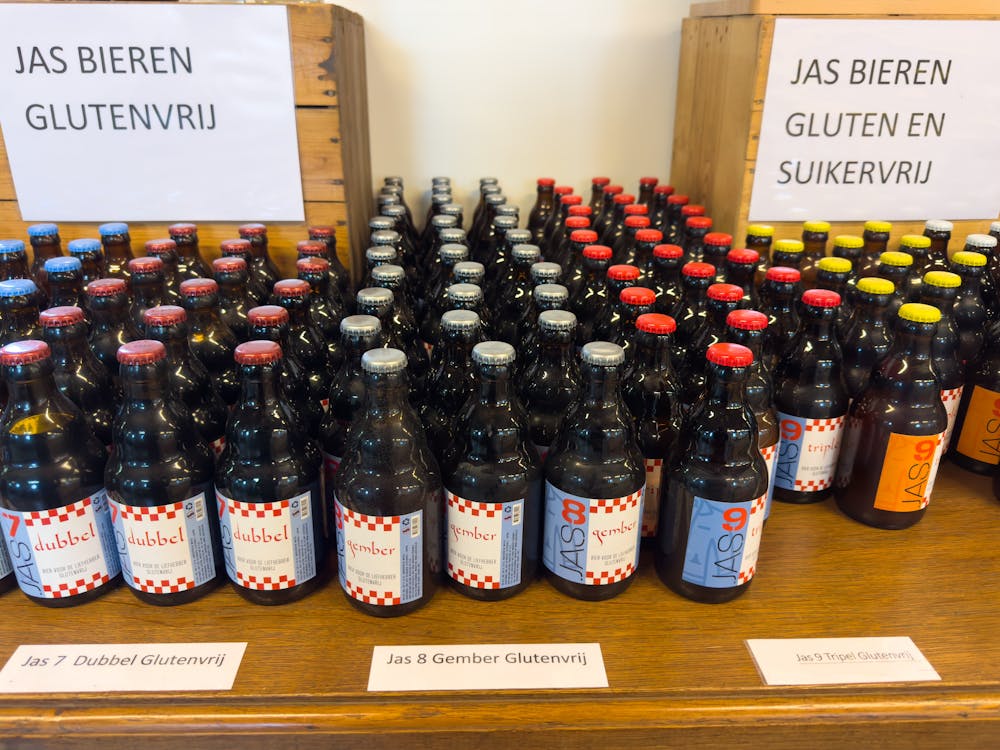 Take note when travelling: different countries have different standards for what can be labelled as ‘gluten-free’ or ‘gluten-reduced’ beer.
Shutterstock
Take note when travelling: different countries have different standards for what can be labelled as ‘gluten-free’ or ‘gluten-reduced’ beer.
Shutterstock
Not just for coeliacs
People who aren’t coeliacs can still have allergies and aversions to gluten – and this may be more common than you think. A 2020 study in Australia found almost one-quarter of people interviewed chose to avoid gluten in their diet, even though only 1% of respondents were coeliacs.
Just like the boom in alcohol-free beers, the range of gluten-free beers is expanding. Brewers are producing exciting new beers not just for coeliacs but also for other people who may be conscious about their gluten intake.
Authors: David Bean, Senior Lecturer in Microbiology and Fermentation Technology, Federation University Australia


















