

The WHO says we shouldn't bother with artificial sweeteners for weight loss or health. Is sugar better?
- Written by: Evangeline Mantzioris, Program Director of Nutrition and Food Sciences, Accredited Practising Dietitian, University of South Australia
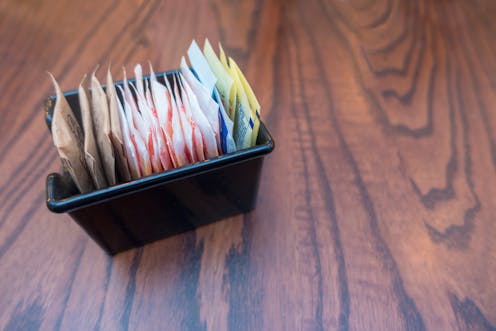
This week, the World Health Organization (WHO) advised that “non-sugar sweeteners should not be used as a means of achieving weight control or reducing the risk of noncommunicable diseases” such as diabetes and heart disease.
Artificial sweeteners are either natural compounds or synthesised compounds that taste sweet like sugar – and are are up to 400 times sweeter by weight – but provide no or negligible energy. As a comparison, sugar has 17kj (or four calories) per gram, so one teaspoon of sugar would have 85 kilojoules.
Several types of artificial sweeteners are used in Australia. Some are synthetic, others are extracted from foods such as monk fruit and the stevia plant.
So, what do the new WHO guidelines mean for people who have switched to artificial sweeteners for health reasons? Should they just go back to sugar?
Read more: Food and drinks are getting sweeter. Even if it's not all sugar, it's bad for our health
Promoted for weight loss
As a practising clinical dietitian in the 1990s, I remember when artificial sweeteners began to appear in processed foods. They were promoted as a way of substituting sugar into food products that may lead to weight loss.
A can of sugar-sweetened soft drink contains on average about 500kj. Theoretically, the substitution of one sugar-sweetened can of soft drink with an artificially sweetened can of soft drink every day would reduce your weight by about 1kg per month.
But research over the past few decades shows this doesn’t hold up.
What’s the new advice based on?
The WHO has based its recommendation on a systematic review it has conducted. Its objective was to provide evidence-based guidance on the use of artificial sweeteners in weight management and for disease prevention.
Weight management is important, given obesity increases the risk of diseases such as diabetes and certain types of cancer, which are the leading cause of death globally.
The WHO’s systematic review included data from different types of studies, which give us different information:
50 were randomised controlled trials (when scientists intervene and make changes – in this case to the diet – while keeping everything else constant, to see the impact of that change)
97 were prospective cohort studies (when scientists observe a risk factor in a large group of people over a period of time to see how it impacts an outcome – without intervening or make any changes)
47 were case-control studies (another type of observational study that follows and compares two groups of otherwise matched people, aside from the risk factor of interest).
Randomised controlled trials provide us with causal data, allowing us to say the intervention led to the change we saw.
Prospective cohort and case-control only give us associations or links. We can’t prove the risk factors led to a change in the outcomes – in this case, weight – because other risk factors that scientists haven’t considered could be responsible. But they give great clues about what might be happening, particularly if we can’t do a trial because it’s unethical or unsafe to give or withhold specific treatments.
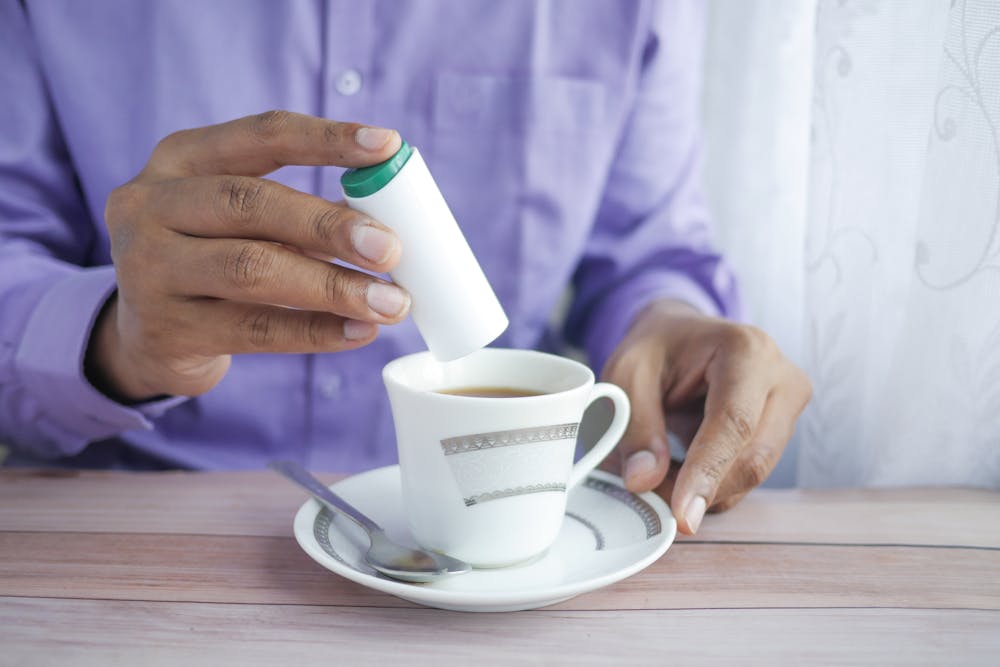
The WHO’s systematic review looked at body fatness, non-communicable diseases and death.
For body fatness, the randomised controlled trials showed those consuming more artificial sweeteners had slightly lower weight – an average of 0.71kg – than those consuming less or no artificial sweeteners.
But the cohort studies found higher intakes of artificial sweeteners were associated with a higher BMI, or body mass index (0.14 kg/m2) and a 76% increased likelihood of having obesity.
The prospective cohort studies showed for higher intakes of artificial sweetened beverages there was a 23% increase in the risk of type 2 diabetes. If artificial sweeteners were consumed as a tabletop item (that the consumer added to foods and drinks) there was a 34% increase in the risk of diabetes.
In people with diabetes, artificial sweeteners did not improve or worsen any clinical indicators used to monitor their diabetes such as fasting blood sugar or insulin levels.
Higher intakes of artificial sweeteners were associated with an increased risk of type 2 diabetes, cardiovascular disease and death in the long-term prospective observational studies that followed participants for an average of 13 years.
But artificial sweeteners were not associated with differences in overall cancer rates or premature death from cancer.
Overall, while the randomised controlled trials suggested slightly more weight loss in people who used artificial sweeteners, the observational studies found this group tended to have an increased risk of obesity and poorer health outcomes.
Does the review have any shortcomings?
The WHO’s advice has led to some criticism because the randomised controlled trials did show some weight loss benefit to using artificial sweeteners, albeit small.
However the WHO clearly states its advice is based on the multiple research designs, not just randomised controlled trials.
Additionally, the WHO assessed the quality of the studies in the review to be of “low or very low certainty”.
Read more: Sweeteners may be linked to increased cancer risk – new research
Are they unsafe?
This advice is not suggesting artificial sweeteners are unsafe or should be banned. The WHO’s scientific review was not about chemical or safety issues.
So are we better off having sugar instead?
The answer is no.
In 2015, the WHO released guidelines on added sugar intake to reduce the risk of excess weight and obesity. Added sugars are found in processed and ultra-processed foods and drinks such as soft drinks, fruits drinks, sports drinks, chocolate and confectionery, flavoured yoghurt and muesli bars.
It recommended people consume no more 10% of total energy intake, which is about 50 grams (ten teaspoons), of sugar per day for an average adult who needs 8,700kj a day.
The WHO’s recommendation is in line with the Australian Dietary Guidelines, which recommends no more than three serves of discretionary foods per day, if you need the extra energy. However it’s best to get extra energy from the core food groups (grains, vegetable, fruit, dairy and protein group) rather than discretionary foods.
Read more: 8 everyday foods you might not realise are ultra processed – and how to spot them
So what do I drink now?
So if artificial and sugar in drinks are not advised for weight loss, what can you drink?
Some options include water, kombucha with no added sugar, tea or coffee. Soda and mineral water flavoured with a small amount of your favourite fruit juice are good substitutes.
Milk is also a good option, particularly if you’re not currently meeting you calcium requirements.
Authors: Evangeline Mantzioris, Program Director of Nutrition and Food Sciences, Accredited Practising Dietitian, University of South Australia


















