

Bees can do so much more than you think – from dancing to being little art critics
- Written by: Caitlyn Forster, Associate Lecturer, School of Life and Environmental Sciences, University of Sydney
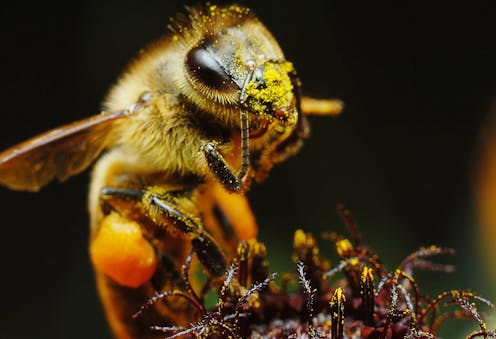
Bees are among the most important insects on Earth – vital pollinators of our crops and significant contributors to human societies for thousands of years.
While visiting various plants, bees need to figure out the best flowers so they can be the most efficient foragers possible, and communicate this to their hive.
But there’s much more these insects’ tiny brains are capable of.
Bees have a great memory and can learn a lot
Bees can visit hundreds of flowers a day across multiple locations, and are great at learning which floral colours, shapes and locations are best for finding food. These flower memories can last for days, allowing for individual workers to return to the best flowers.
Bees are capable of learning in complex ways. They can use “cross-modal” learning, recognising an object they’ve experienced with one sense when it’s presented in another sense. In one study, bumblebees were trained to tell cubes and spheres apart using only touch, but could still distinguish them visually if they were unable to touch the shapes – and vice versa.
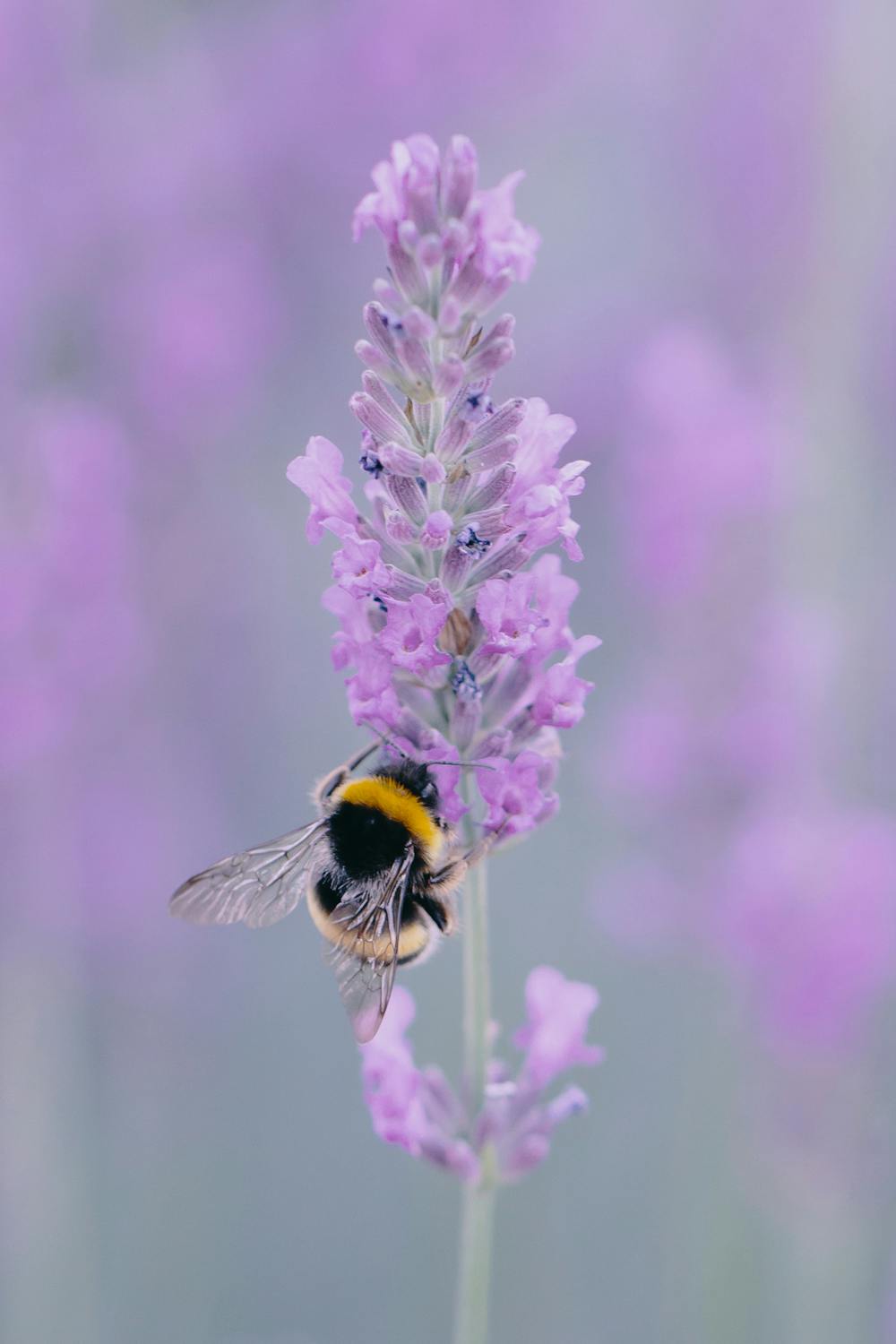
Bumblebees were trained on different combinations of higher and lower quality coloured flower pairs. When bees were presented with flower combinations that had never been paired together, bumblebees forgot information about how sweet a flower was, but could remember if their experience was better or worse for the two flowers displayed.
This demonstrates bees can integrate sensory information independently of the specific sense involved. This is something human babies do when developing, and how we learn to read and write.
Bees also learn from each other
Honeybees are possibly most famous for the “waggle dance”, which is how they tell their nest mates about the distance, direction, and quality of a food source.
Honeybees are born to dance, but when young bees are able to observe older, more accomplished dancing bees, the young bees become “better” dancers.
Aside from the waggle dance, social bees use a range of social information to learn from others. They follow each other to good flowers, they use scent marks to mark both rewarding and empty flowers, or simply watch more experienced individuals to learn how to access food.
Bees are also individuals, with differences in their ability to learn – some are fast learners, whilst others are a bit slow.
Their learning isn’t simply passive either. Bumblebees have been trained to push balls into holes to get rewards. During these experiments there have been observer bees who have learnt the skill either by watching (and no direct interaction with the teacher bee), or interacting with the teacher bee and then spontaneously improving on the technique.
This demonstrates an understanding of the task at hand and the desired outcome, allowing the observer bee to find her own, better way to get the reward.
As the FIFA Women’s World Cup approaches, we can even use this training technique to get bees to learn to play soccer.
Bees can recognise faces – and paintings
Bees’ ability to memorise doesn’t stop at flowers. In one example, honeybees were rewarded every time they visited a painting by a “rewarding” artist (either Monet or Picasso). When bees were given paintings they had never seen before, they still visited the rewarding artist, suggesting they can discriminate between art styles.
This extends beyond Picasso and Monet, with bees learning to discriminate between Monet and Indigenous artist Noŋgirrŋa Marawili in a single afternoon.
Their discrimination ability beyond flowers is also impressive, as honeybees can even recognise people’s faces.
Bees can play
Play is considered a really important part of learning and cognition, and it’s not limited to humans. A previous study of bumblebees showed they meet the criteria of play – repeated behaviours that occur voluntarily for pleasure, and offer little value to the animal’s ability to mate, reproduce, or feed successfully.
Bumblebees that entered a room full of wooden balls willingly rolled around with the balls, and were more likely to enter a room that was previously associated with wooden balls, even though they were given no food reward for doing so.
Native bees are smart
Most of our understanding of bee brains focuses on two groups of bees: honeybees and bumblebees. These bees are widely distributed across the globe and are commercially important pollinators.
But there are a lot of other species of bees we don’t know as much about.
In Australia, we have over 2,000 species of native bees, and we know that a lot of them have great colour vision, and innate preferences for particular shapes and colours. Halictid bees can learn to avoid flowers associated with predation, for example.
It is highly likely that most other bee species are capable of clever feats – we just need to spend more time studying them.
Read more: Move over, honeybees: Aussie native bees steal the show with unique social and foraging behaviours
Could bees be… sentient?
Thinking about these abilities and taking the research all together, it becomes clear that the “simple” minds of bees are far more capable than we could have imagined.
Though they only have about a million neurons (we have about 100 billion), bees show complex behaviours like tool use, they have a representation of space, and they can learn through observation.
This has brought about some exciting discussions around bees potentially having consciousness. If that were true, it could change not only how we see bees, but how we interact with them. It also raises the question – could other invertebrates have consciousness?
Stress and other factors limit their ability to do these clever things
Native bees face many risks, including the negative impacts of habitat loss, pollution, climate change, and the overuse of pesticides.
For bees generally, stress is a problem as well. All kinds of stress can make it harder for bees to learn, as it impacts their cognitive functions, their ability to think, and remember.
There is evidence that pesticides and air pollution can impair memory and learning in bumblebees and honeybees. When honeybees were exposed to road pollution, they were less able to remember floral scents, which makes it harder for them to locate the flowers they need to sustain their hive.
Next time you’re watching bees in your garden, don’t forget to appreciate all of the things their brains are able to do – and how much we need to look after them.
Authors: Caitlyn Forster, Associate Lecturer, School of Life and Environmental Sciences, University of Sydney


















