

At a G7 summit high on ambition, nuclear disarmament takes a backseat to Zelensky's diplomatic appeals
- Written by: Donna Weeks, Professor of Political Science, Musashino University
Hiroshima, the site of this year’s G7 summit, is one of just a handful of places in the world that provides a stark reminder of the horrors of war.
The A-bomb Dome in the Hiroshima Peace Memorial Park, for example, is one of few structures left standing in the neighbourhoods that were flattened by the atomic blast in August 1945. Around the city, there are also “survivor trees” from the blast and burn marks on temple stoneware and statues – reminders of how far and wide it radiated.
It is no surprise that Japanese Prime Minister Fumio Kishida chose Hiroshima as the setting for the 2023 G7 meeting. Not only are his electoral constituency and family roots located here, he is also an advocate of a nuclear weapons-free world.
And there were hopes the meeting could spur further action towards this ultimate goal of global nuclear disarmament. Kishida said ahead of the meeting,
I believe the first step toward any nuclear disarmament effort is to provide a first-hand experience of the consequences of the atomic bombing and to firmly convey the reality.
Ukraine takes priority
It wasn’t to be. Though the final communique from the summit did make a vague commitment toward a “Hiroshima Vision” for nuclear disarmament, it took a backseat to the main headline from the weekend – the continued global support for Ukraine in its war against Russia.
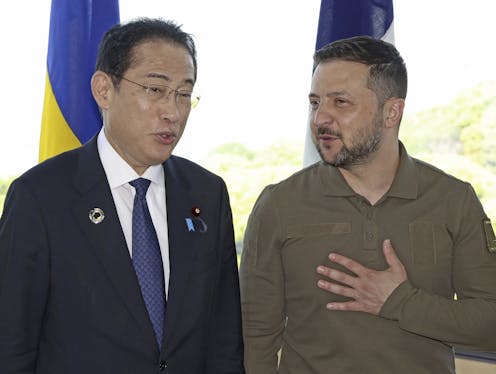
An “unscheduled” visit by Ukrainian President Volodymyr Zelensky certainly raised the stakes for the summit at a critical time in the war.
On Friday evening, the leaders released a strongly worded, six-page statement on Ukraine, which reaffirmed their commitment “to stand together against Russia’s illegal, unjustifiable and unprovoked war of aggression against Ukraine” and condemned “Russia’s manifest violation of the Charter of the United Nations and the impact of Russia’s war on the rest of the world”.
But it was the potential impact of the in-person attendance that might amplify the otherwise rhetorical words of the summit leaders.
Perhaps most importantly, Zelensky’s visit offered countries like India, Brazil, Indonesia and others from the Global South – who haven’t been as strong in their condemnation of Russia’s invasion – an opportunity to meet with Zelensky to hear his side of the story.
For example, Indian Prime Minister Narendra Modi sounded appropriately empathetic in his first face-to-face meeting with Zelensky since the war began, saying he didn’t consider the war to be “just an issue of economy or politics. For me, it is an issue of humanity.”
Zelensky’s opportunity to make a direct appeal to the leaders may end up being the key statement of the summit, distinguishing it from previous gatherings.
A bigger role for the Global South
But Kishida had other goals for Hiroshima. In fact, he had spent the better part of a year making several trips overseas to talk up his vision for the summit – greater support from the world’s largest economies for developing nations. This is part of his broader aims to ensure global economic security and his brand of “new capitalism”, which he has brandished since becoming prime minister.
In March, he visited Poland and Ukraine, where he met with Zelensky. A month later, he went to Egypt, Ghana, Kenya and Mozambique, where he declared the “Global South” to be an integral part of his economic security strategy. There were also stops in India, Singapore and South Korea in recent months.
The list of attendees at this year’s conference reflected this deeper focus on the “Global South”. South Korea, Vietnam, Australia, India and Brazil were invited, as well as the Comoros (chair of the African Union), the Cook Islands (chair of the Pacific Islands Forum) and Indonesia (chair of ASEAN).
Japan’s interest here lies partially in countering Chinese and Russian investment and influence in Africa and other parts of the Global South.
The G7 leaders’ final communique reflected this, with a significant focus on African security and a specific mention of Russia’s Wagner mercenary group:
We are seriously concerned about the growing presence of the Russia-affiliated Wagner Group forces on the continent and their destabilising impact and human rights abuses.
For Kishida, having the African and Pacific representatives engaging with the G7 leaders was an important strand of his diplomatic efforts of the last few months, as he noted in his closing remarks.
A sideline Quad, or the Quad sidelined?
Australia had been viewing the summit as a prelude to the official Quad leaders meeting scheduled for Sydney this week. Instead, after US President Joe Biden cancelled the Australia leg of his trip to deal with the budgetary deadlock back home, a meeting of the four member countries was hastily arranged in Japan.
Although it was quite short, the meeting provided the necessary optics – the four leaders still prioritising their shared goals of working together to exert pressure on China’s regional ambitions.
The Quad, like the AUKUS security arrangement between the US, UK and Australia, however, remains something of an anomaly in a region already rich in security arrangements. It is seen by some as exclusionary, perhaps contributing to rising tensions in the region, rather than diminishing them.
The meeting on the sidelines this time may well serve to turn down the gauge, just a little, in the regional security environment.
How much can we expect to change?
When Japan last hosted the G7 in 2016, Kishida, then the foreign minister, managed to persuade US President Barack Obama to make a quick visit to Hiroshima, the first serving US president to do so. The symbolism and hope of that visit quickly dissipated, however, leaving just the folded cranes and words of Obama as another exhibit of many in the Peace Museum.
Inevitably, at each G7 Summit, there are calls for a review of its purpose. Originally an “informal” grouping of the world’s leading economies, it has become, like the UN Security Council, an institution of a different time. It is somewhat of an anachronism, no longer representative of today’s global economy.
Kishida obviously had great ambitions for this version of the summit, with the invitees from the Global South and a genuine desire to push the issue of nuclear disarmament. In his press conference on Sunday, Kishida reiterated his reasons for gathering world leaders in Hiroshima – to emphasise the importance of pursuing peace.
This summit will be most likely be remembered for Zelensky’s visit and the message it intended to send to Russia. But as leaders make their journeys home, wars will continue and all we are left with are the platitudes that will carry over to the next G7 Summit in 2024.
As for the ageing hibakusha, the survivors of the 1945 atomic bomb in Hiroshima, this may have been their last major opportunity to press for an end to nuclear weapons.
Authors: Donna Weeks, Professor of Political Science, Musashino University


















