

The pre-eminent novelist-critic of his generation, Martin Amis's pyrotechnic prose captured life's destructive energies
- Written by: Camilla Nelson, Associate Professor in Media, University of Notre Dame Australia

Martin Amis, pre-eminent novelist-critic of his generation, has died at the age of 73. His dazzling, pyrotechnic prose dominated the world of English writing from the mid-1970s through the fin de siècle.
Amis captured the contemporary world’s sinister, destructive energies in a savage and glittering series of novels, essays and memoirs.
His books include the tour de force novel Money (1984), which summed up the 1980s before the decade of greed and narcissism was even halfway through and London Fields (1989), a strangely prescient vision of urban, moral, and environmental decline that turned the familiar, depressing, post-industrial cityscape into something oddly more terrifying.

 Germaine Greer: wrote Amis an (unsent) 30,000 word love letter.
AP
It is also true that late in life, he broke the bounds of the acceptable. His essay The Age of Horrorism, written five years after the attack on New York’s World Trade Centre, prompted literary critic Terry Eagleton to compare Amis’s statements on Muslims to “the ramblings of a British National Party thug”.
Amis wrote in The War Against Cliche that, “you hope to get more relaxed and confident over time: and you should certainly get (or seem to get) kinder”.
And yet he didn’t seem to learn. He once called Nobel Prize-winning author JM Coetzee a writer with “no talent”. He admits that “Angus Wilson and William Burrows nursed my animadversions … to the grave”.
Amis, who was married to the writer Isabel Fonseca, spent the later part of his life in the United States. He died at his home in Lake Worth in Florida.
Middle-bohemian
Amis came of age in what he once described as an “unrecognisably remote” era in which it seemed perfectly feasible to reorganise the world and socio-economic reality from an armchair, or by banging on a typewriter.
He once described himself in his twenties, at work at the Times Literary Supplement:
… wearing shoulder length hair, a flower shirt, and knee-high tricolour boots (well concealed, it is true, by the twin tepees of my trousers). My private life was middle-bohemian – hippyish and hedonistic, if not candidly debaunched: but I was very moral when it came to literary criticism. I read it all the time, in the tub, on the tube: I always had about me my Edmund Wilson – or my William Empson. I took it seriously. We all did.
Germaine Greer: wrote Amis an (unsent) 30,000 word love letter.
AP
It is also true that late in life, he broke the bounds of the acceptable. His essay The Age of Horrorism, written five years after the attack on New York’s World Trade Centre, prompted literary critic Terry Eagleton to compare Amis’s statements on Muslims to “the ramblings of a British National Party thug”.
Amis wrote in The War Against Cliche that, “you hope to get more relaxed and confident over time: and you should certainly get (or seem to get) kinder”.
And yet he didn’t seem to learn. He once called Nobel Prize-winning author JM Coetzee a writer with “no talent”. He admits that “Angus Wilson and William Burrows nursed my animadversions … to the grave”.
Amis, who was married to the writer Isabel Fonseca, spent the later part of his life in the United States. He died at his home in Lake Worth in Florida.
Middle-bohemian
Amis came of age in what he once described as an “unrecognisably remote” era in which it seemed perfectly feasible to reorganise the world and socio-economic reality from an armchair, or by banging on a typewriter.
He once described himself in his twenties, at work at the Times Literary Supplement:
… wearing shoulder length hair, a flower shirt, and knee-high tricolour boots (well concealed, it is true, by the twin tepees of my trousers). My private life was middle-bohemian – hippyish and hedonistic, if not candidly debaunched: but I was very moral when it came to literary criticism. I read it all the time, in the tub, on the tube: I always had about me my Edmund Wilson – or my William Empson. I took it seriously. We all did.
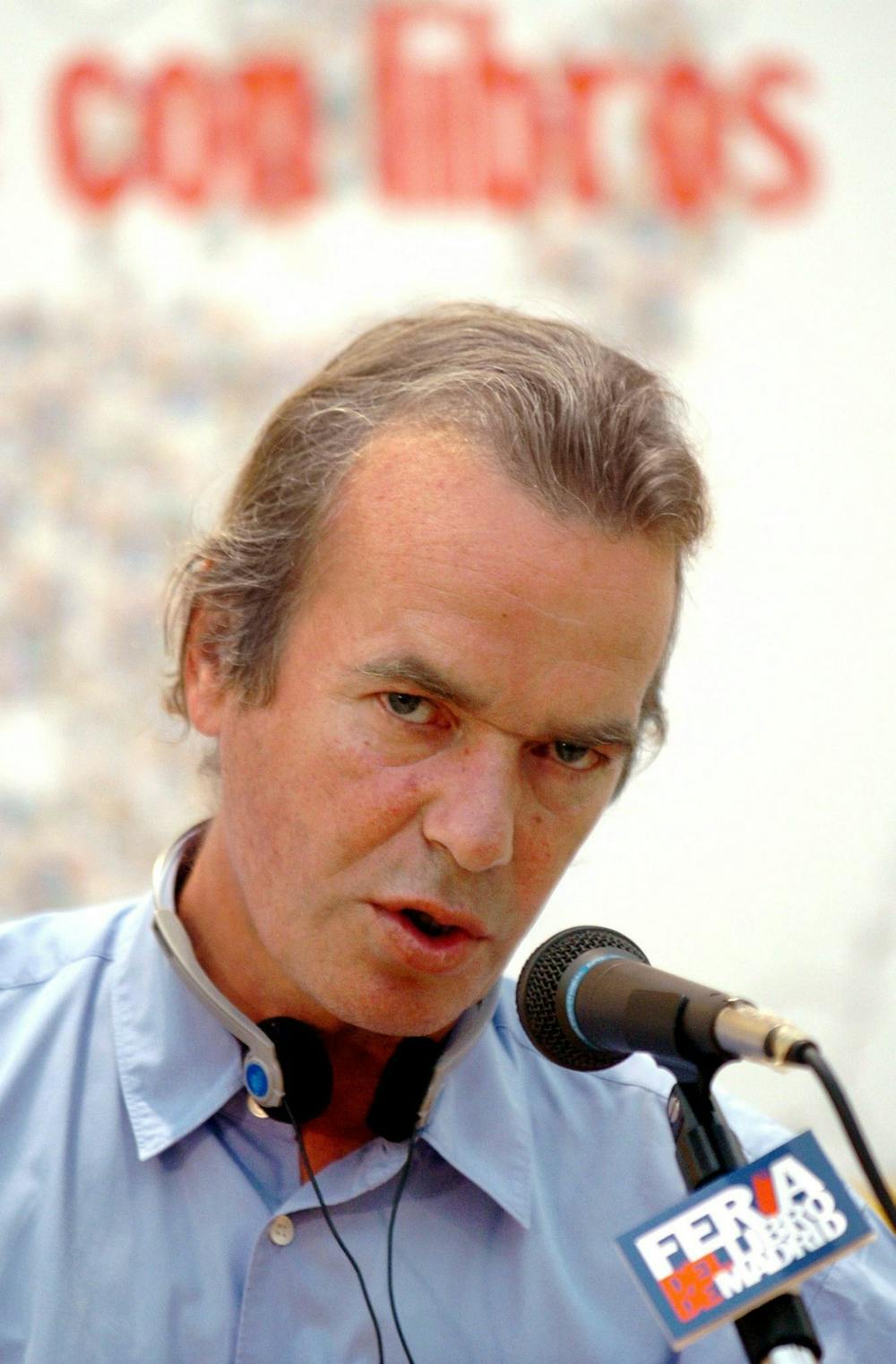 Amis pictured in 2004.
Sergio Barrenechea/AP
“We” included critic, writer and broadcaster Clive James, journalist Christopher Hitchens, and novelist Julian Barnes. Amis would later have a spectacular falling out with the latter over a book contract.
This “we” also included much of the British literary establishment. Amis was born a literary celebrity – the son of Kingsley – but
quickly crawled out of his father’s shadow, publishing his first novel, The Rachel Papers, just out of university. This was swiftly followed by Dead Babies, the title a clear signal that he was out to break a shibboleth or three.
According to Amis, OPEC put an end to the literary bohemia of his youth. The “oil hike, and inflation, and then stagflation” meant nobody could live on ten shillings a week. The whole idea of literature, which, for Amis, was intrinsically based on an idea of elitism, was doomed to be pulverised by money and necessity.
Read more:
Christopher Hitchens was a model of the public intellectual as celebrity. Could he really be the saviour of the Left?
A post-industrial Dickens
Amis pictured in 2004.
Sergio Barrenechea/AP
“We” included critic, writer and broadcaster Clive James, journalist Christopher Hitchens, and novelist Julian Barnes. Amis would later have a spectacular falling out with the latter over a book contract.
This “we” also included much of the British literary establishment. Amis was born a literary celebrity – the son of Kingsley – but
quickly crawled out of his father’s shadow, publishing his first novel, The Rachel Papers, just out of university. This was swiftly followed by Dead Babies, the title a clear signal that he was out to break a shibboleth or three.
According to Amis, OPEC put an end to the literary bohemia of his youth. The “oil hike, and inflation, and then stagflation” meant nobody could live on ten shillings a week. The whole idea of literature, which, for Amis, was intrinsically based on an idea of elitism, was doomed to be pulverised by money and necessity.
Read more:
Christopher Hitchens was a model of the public intellectual as celebrity. Could he really be the saviour of the Left?
A post-industrial Dickens
 He set himself to work, a post-industrial Dickens, to capture his times. And the language in which he did so contained endlessly inventive combinations of the extravagant and unexpected.
In the novel Money, for instance, the protagonist John Self, a boorish, wreck of a human being, addicted to fast food, fast cars and alcohol, takes the reader through the turbulent mental and emotional landscape of postmodern Los Angeles, replete with unforgettable descriptions combining deliberately smarmy schoolboy images shot through with Old Testament judgement.
… You come out of the hotel, the Vraimont. Over boiling Watts the downtown skyline carries a smear of God’s green snot. You walk left, you walk right, you are a bank rat on a busy river. This restaurant serves no drink, this one serves no meat, this one serves no heterosexuals. You can get your chimp shampooed, you can get your dick tattooed, twenty-four hour, but can you get lunch? And should you see a sign on the far side of the street flashing BEEF-BOOZE – NO STRINGS, then you can forget it. The only way to get across the road is to be born there. All the ped-xing signs say DON’T WALK, all of them, all the time. That is the message, the content of Los Angeles: don’t walk. Stay inside. Don’t walk. Drive. Don’t walk. Run!“
Amis’s writing style is instantly recognisable: inimitable, caustic and savagely funny. But there is also, underneath it all, tremendous pathos. London Fields, for example, Amis’s darkly comic novel featuring the small time crook, sex addict and aspiring darts champion Keith Talent, who watches rich people on television and dreams that he might yet become one, is also an extended meditation on death, anxiety and self-delusion.
We are all poets or babies in the middle of the night, struggling with being.
In Experience, Amis’s voice is similarly moving: angry, honest, wildly stylish, casting back and forth between youth and middle age. The book was notable for its magnificent footnotes, telling stories within stories, a little like life itself.
Amis was larger than life; a rock star writer. He moved freely between fiction, non-fiction, and literary criticism. His death marks the end of an era.
It seems fitting to give him the last word. As he wrote in Experience:
The trouble with life is its amorphousness, its ridiculous fluidity. Look at it: thinly plotted, largely themeless, sentimental and ineluctably trite. The dialogue is poor, or at least violently uneven. The twists are either predictable or sensationalist. And it’s always the same beginning, and the same ending.
Authors: Camilla Nelson, Associate Professor in Media, University of Notre Dame Australia
He set himself to work, a post-industrial Dickens, to capture his times. And the language in which he did so contained endlessly inventive combinations of the extravagant and unexpected.
In the novel Money, for instance, the protagonist John Self, a boorish, wreck of a human being, addicted to fast food, fast cars and alcohol, takes the reader through the turbulent mental and emotional landscape of postmodern Los Angeles, replete with unforgettable descriptions combining deliberately smarmy schoolboy images shot through with Old Testament judgement.
… You come out of the hotel, the Vraimont. Over boiling Watts the downtown skyline carries a smear of God’s green snot. You walk left, you walk right, you are a bank rat on a busy river. This restaurant serves no drink, this one serves no meat, this one serves no heterosexuals. You can get your chimp shampooed, you can get your dick tattooed, twenty-four hour, but can you get lunch? And should you see a sign on the far side of the street flashing BEEF-BOOZE – NO STRINGS, then you can forget it. The only way to get across the road is to be born there. All the ped-xing signs say DON’T WALK, all of them, all the time. That is the message, the content of Los Angeles: don’t walk. Stay inside. Don’t walk. Drive. Don’t walk. Run!“
Amis’s writing style is instantly recognisable: inimitable, caustic and savagely funny. But there is also, underneath it all, tremendous pathos. London Fields, for example, Amis’s darkly comic novel featuring the small time crook, sex addict and aspiring darts champion Keith Talent, who watches rich people on television and dreams that he might yet become one, is also an extended meditation on death, anxiety and self-delusion.
We are all poets or babies in the middle of the night, struggling with being.
In Experience, Amis’s voice is similarly moving: angry, honest, wildly stylish, casting back and forth between youth and middle age. The book was notable for its magnificent footnotes, telling stories within stories, a little like life itself.
Amis was larger than life; a rock star writer. He moved freely between fiction, non-fiction, and literary criticism. His death marks the end of an era.
It seems fitting to give him the last word. As he wrote in Experience:
The trouble with life is its amorphousness, its ridiculous fluidity. Look at it: thinly plotted, largely themeless, sentimental and ineluctably trite. The dialogue is poor, or at least violently uneven. The twists are either predictable or sensationalist. And it’s always the same beginning, and the same ending.
Authors: Camilla Nelson, Associate Professor in Media, University of Notre Dame Australia 
















