

Australia is in a unique position to eliminate the bee-killing Varroa mite. Here's what happens if we don't
- Written by: Scarlett Howard, Lecturer, School of Biological Sciences, Monash University
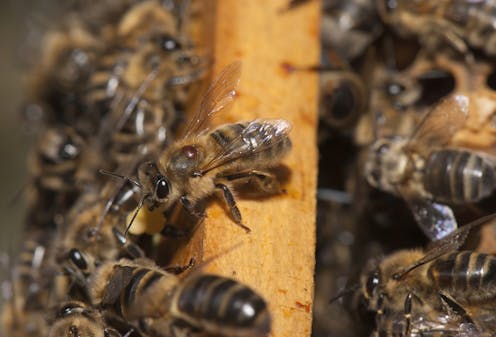
Varroa mites – notorious honey bee parasites – have recently reached Australian shores, detected at the Port of Newcastle in New South Wales last year. If they establish here, there would be significant implications for agricultural food security, as honey bees are heavily relied on for the pollination of many crops.
However, while Australia is the last continent to be invaded by the mite, it has an opportunity to be the first to eradicate it.
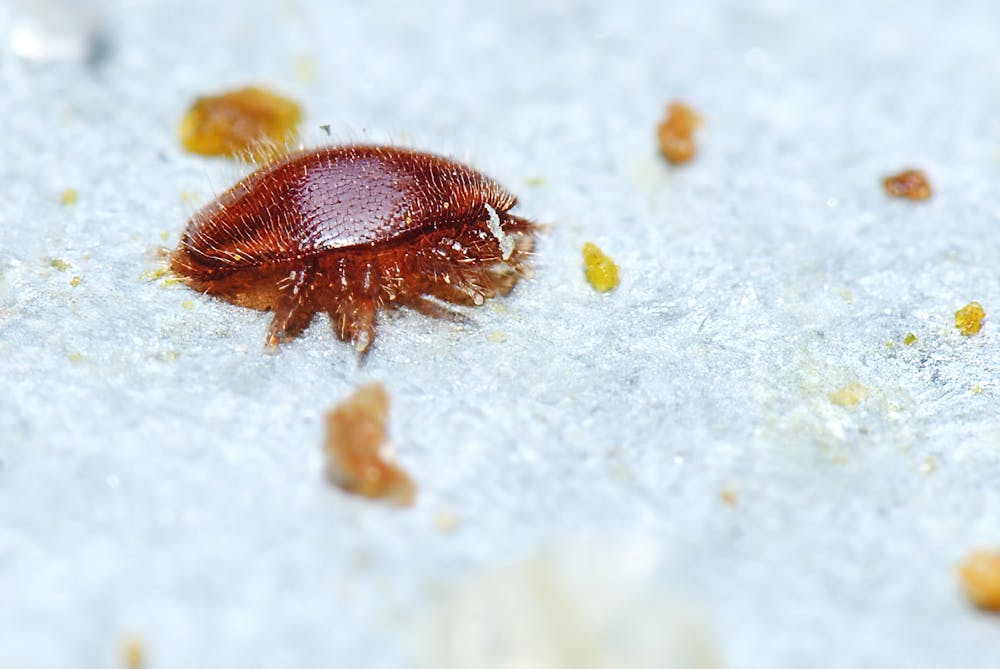
Varroa destructor is a small mite that attaches to bees and eats their “fat body”. The fat bodies of honey bees are the insect equivalent of a liver. Varroa weakens bees, reduces their lifespan and increases the spread of deadly viruses.
Scientists need to be ready: this might be Australia’s best chance to collect important data on the spread and evolution of this parasite. Our new paper published today in Biology Letters outlines what questions scientists need to ask and what data they need to collect if Varroa spreads in Australia.
Such data could help us understand how parasites evolve, why Varroa are so damaging for honey bees, and how Varroa mites impact other insects and the environment.
Read more: Explainer: Varroa mite, the tiny killer threatening Australia's bees
Will Varroa establish in Australia?
Australia is in close proximity to countries that have the mite, including New Zealand, Papua New Guinea, Timor-Leste and Indonesia.
This probably explains why invasive honey bee swarms are frequently intercepted at our ports, many of these carrying Varroa. Australia currently bans importation of honey bee colonies due to the biosecurity risk, so these interceptions are typically due to stowaway swarms taking up residence in shipping containers.
Previous invasions of Varroa have been successfully eradicated before establishing, but this time Varroa circumvented the biosecurity surveillance near Newcastle and spread locally.
The New South Wales Department of Primary Industries has been contact-tracing and culling hives in contaminated areas, and the spread has been slow so far. Australia has large populations of feral honey bees, which could potentially act as a reservoir for Varroa and are much harder to trace and control, so the department is tackling this with a wild honey bee baiting program.
What threats does Varroa pose?
Varroa mites are a threat to food security. Although Australia has an abundance of food and exports it to other nations, the price of food is likely to increase if Varroa escapes confinement.
Currently, pollination of crops in eradication zones such as berries in Coffs Harbour is at risk due to the removal of all honey bees in the region, which may lead to short-term increases in food costs.
However, establishment and spread of Varroa will lead to lower pollination and lower crop production across the country, which will raise the price of most fruit and vegetables that depend on bee pollination.
This could worsen the food affordability crises caused by the current inflation, affecting the ability of low income households to buy nutritious and fresh produce. Almond pollination has already noted a deficit of 80,000 hives in the last season.
Many of the honey bee colonies that pollinate our crops are thought to be feral, living in tree hollows or nest-boxes designed for native animals. These feral bees are not managed by beekeepers and so won’t be saved by the use of Varroa treatments, meaning they will most likely disappear.
Varroa may be a threat to wild pollinators including native bees. Varroa often spreads viruses, which can jump between species and may threaten our wild native pollinators. Of particular concern are viruses that deform insect wings and cause paralysis. Fortunately, these viruses have not been detected in the current Varroa incursion.
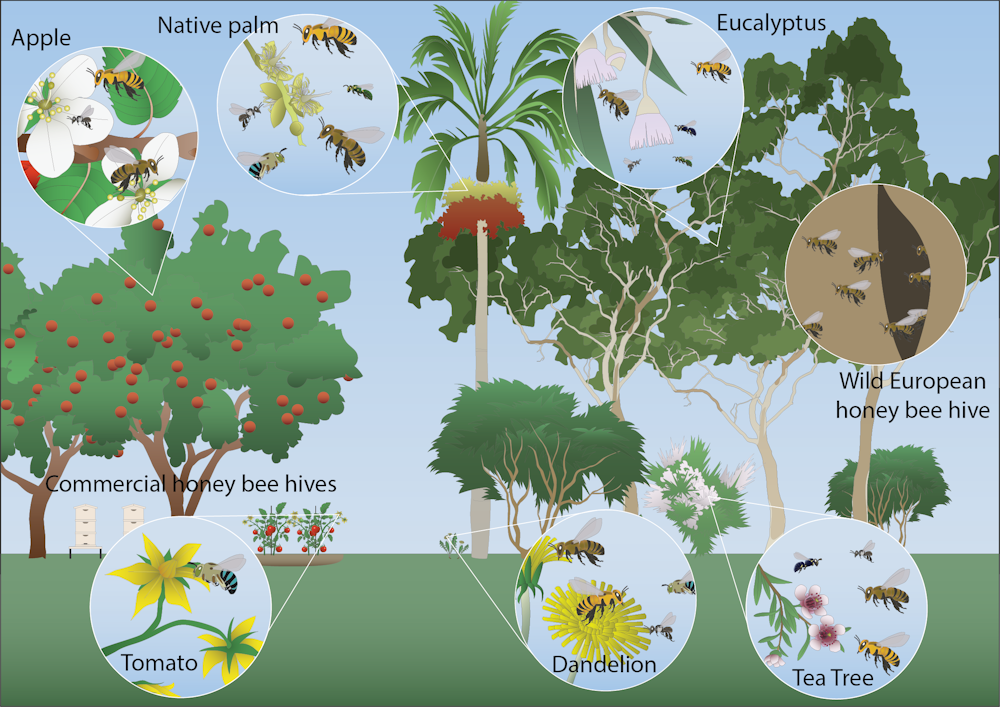 Australia currently relies on pollination by commercial honey bees (yellow), supplemented by feral honey bees (brown), though we have many native bee species like stingless bees and blue banded bees that are also being used in crop pollination.
Boris Yagound, adapted from Chapman et al. 2023, CC BY
Australia currently relies on pollination by commercial honey bees (yellow), supplemented by feral honey bees (brown), though we have many native bee species like stingless bees and blue banded bees that are also being used in crop pollination.
Boris Yagound, adapted from Chapman et al. 2023, CC BY
How can we secure Australia’s agricultural industry?
Australia’s agricultural industry relies mostly on pollination by European honey bees. This choice has been risky.
In Europe, pollination services are also provided by diverse species like bumble bees, mining bees and mason bees (e.g. Osmia rufa), many of which are un-managed wild species that nest alone.
If Varroa escapes confinement, beekeepers will still be able to maintain colonies of honey bees but at greater costs, due to colony losses and the need for chemicals to treat Varroa mites in the hives. These costs have the potential to sink businesses, and affect the livelihoods of beekeepers.
Australia needs to decrease its reliance on the European honey bee in agriculture and improve pollinator diversity via the use of other native pollinator species such as native stingless bees, blue banded bees, or even flies. For example, native Australian stingless bees aid in the pollination of macadamia and capsicum crops and could be used for the pollination of other crops.
Native blue banded bees pollinating tomatoes in Australia.Australia’s unique situation
Australia is different from other Varroa infected regions of the world. Our incursion was smaller, it was identified early and the management zone is small enough to be feasibly eradicated.
Even if Varroa spreads in Australian landscapes, hopes are that the pace of the spread may be slower in Australia than it was in other regions due to the smaller incursion, the colossal eradication effort and large tracts of land that are inhospitable to honey bees. Managed honey bee populations are concentrated around coastal regions, or in Australia’s major rural food bowl regions where pollinator-dependant crops (such as almonds, blueberries and apples) are located.
This gives us a chance to prevent the spread of Varroa across inland Australia, where there are no honey bees.
Luckily for us, most of the world has already spent the last few decades trying to minimise Varroa mite management costs. As a nation, we now have the chance to initiate a fresh and coordinated management response. Australia could organise state-wide integrated pest management approaches and treatment regimes to prevent Varroa’s resistance to chemical treatments from developing rapidly.
In short, there are good reasons to remain positive about the future of Australian beekeeping and horticultural industries, but there is still much work for our research community to do.
Read more: Bees can do so much more than you think – from dancing to being little art critics
Authors: Scarlett Howard, Lecturer, School of Biological Sciences, Monash University


















