

‘Whose side are you on mate?’ How no one is free from bias – including referees
- Written by: Tim Dare, Professor of Philosophy, University of Auckland
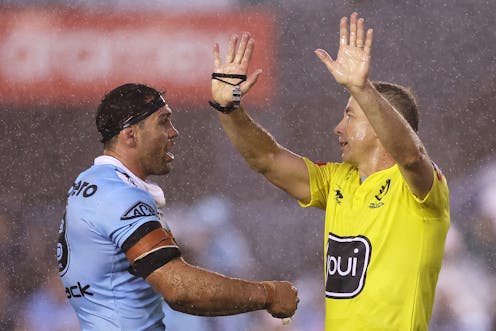
When Jason Paris, head of the company that sponsors the New Zealand Warriors NRL team, complained recently about Australian referee bias, more than a few heads will have nodded in agreement.
Sports fans often think the ref is biased against their team – penalising them for the very same actions the other side is getting away with.
But taking the element of trans-Tasman rivalry out of the argument for the moment, it’s worth asking whether it’s even possible for referees to operate without being unconsciously influenced by factors beyond their immediate control.
The honest answer is probably not – despite most professional sporting bodies regularly rejecting claims of bias.
It’s clear from a wide range of research that, while it’s unlikely professional referees consciously cheat, they are likely to be affected by unconscious biases. In fact, referee bias has been reported in pretty much every aspect of most sports, including the use of yellow cards, red cards and penalty kicks.
None of this is surprising, or even particularly critical of referees. Humans are all subject to unconscious bias, and it’s very difficult to overcome.
Confirmation bias is real
We all use a range of reasoning shortcuts – also known as “heuristics” – to make decisions and assessments. While useful, many of these shortcuts can lead us astray, despite our best efforts.
For example, one such heuristic leads us to notice evidence that confirms positions we already hold and to overlook evidence that is inconsistent with those views.
This tendency – known as confirmation bias – has its uses. It lets us make quick decisions when we don’t have the time to consider all the evidence. And it may reduce mental conflict and increase self-esteem, since it reduces how often we have to acknowledge we were wrong.
Read more: Two refs are better than one, so why does the NRL want to drop one?
However, confirmation bias can also be problematic. In one striking non-sports experiment, researchers asked five fingerprint experts to say whether a suspect’s fingerprints matched those from a crime scene. They didn’t tell the experts that they’d seen those same fingerprints five years earlier.
The experts had no reason to remember them, and they didn’t realise that five years earlier, they’d said they were a match. This time they were told they were looking into a probable case of mistaken identity; that the prints taken from the crime scene probably didn’t match those taken from the suspect.
Now only one of the five experts said they matched. Given exactly the same prints, but primed to look for evidence that the fingerprints didn’t match, their judgement changed.
Expectations influence outcomes
What does all this have to do with referees? Well, they’re only human. Even if not consciously biased, they will have expectations about how players and teams will perform, and there is evidence that this influences their judgements.
In one experiment, researchers took advantage of the common practice in gymnastics of coaches ordering their competitors from weakest first to strongest last.
Films of competitors were reordered and the judges asked to rank them. Where in this lineup the the competitors appeared significantly affected the scoring, with the same routine receiving a higher or lower score depending on where it was positioned.
We suspect those expectations are one reason dominant teams and players tend to have close calls go their way.
Referees expect to see some players pull off moves that bring them close to infringing but which don’t cross that line. They are more likely to make a call against a journeyman player who they don’t expect to pull off the miracle play.
Read more: Split-second decisions with little praise: so what does it take to ref a game of NRL
Refs aren’t superhuman
Just like the fingerprint experts, confirmation bias leads them to see the same evidence differently. And if referees do have these kinds of expectations, it would be very difficult for them to factor these out of their decision making.
The fingerprint experts didn’t intend to tailor their judgements to suit the views they’d been primed to hold. Further, they made their judgements under calm laboratory conditions, with the evidence in front of them and plenty of time and equipment to examine and consider it.
It would be truly remarkable if referees – obliged to make calls in the heat of the moment, with pressure from players and crowds – were not at least equally affected. Referees would need to be superhuman to be immune to these dangers.
Read more: Cognitive biases and brain biology help explain why facts don’t change minds
There are also more straightforward sources of bias. Recent research into the Bundesliga, German football’s highest division, took advantage of empty stadiums during the COVID pandemic to explore the influence of vocal crowd support on referees. Unsurprisingly, the evidence suggests it does have an influence.
Pre-COVID, referees gave fewer fouls and yellow cards for the home team relative to the away team. These differences changed during the crowd-free matches, so that home teams were treated less favourably than before.
None of this is meant as a dig at referees. They are surely aware of the research on bias, and receive training and support to address it. But confirmation bias is difficult, if not impossible, to beat. Maybe we just have to accept it as part of the game.
Authors: Tim Dare, Professor of Philosophy, University of Auckland


















