

Researchers built an analogue computer that uses water waves to forecast the chaotic future
- Written by: Ivan Maksymov, Principal Research Fellow, Charles Sturt University

Can a computer learn from the past and anticipate what will happen next, like a human? You might not be surprised to hear that some cutting-edge AI models could achieve this feat, but what about a computer that looks a little different – more like a tank of water?
We have built a small proof-of-concept computer that uses running water instead of a traditional logical circuitry processor, and forecasts future events via an approach called “reservoir computing”.
In benchmark tests, our analogue computer did well at remembering input data and forecasting future events – and in some cases it even did better than a high-performance digital computer.
So how does it work?
Throwing stones in the pond
Imagine two kids, Alice and Bob, playing at the edge of a pond. Bob throws big and small stones into water one at a time, seemingly at random.
Big and small stones create water waves of different size. Alice watches the water waves created by the stones and learns to anticipate what the waves will do next – and from that, she can have an idea of which stone Bob will throw next.
Reservoir computers copy the reasoning process taking place in Alice’s brain. They can learn from past inputs to predict the future events.
Although reservoir computers were first proposed using neural networks – computer programs loosely based on the structure of neurons in the brain – they can also be built with simple physical systems.
Reservoir computers are analogue computers. An analogue computer represents data continuously, as opposed to digital computers which represent data as abruptly changing binary “zero” and “one” states.
Representing data in a continuous way enables analogue computers to model certain natural events – ones that occur in a kind of unpredictable sequence called a “chaotic time series” – better than a digital computer.
How to make predictions
To understand how we can use a reservoir computer to make predictions, imagine you have a record of daily rainfall for the past year and a bucket full of water near you. The bucket will be our “computational reservoir”.
We input the daily rainfall record to the bucket by means of stone. For a day of light rain, we throw a small stone; for a day of heavy rain, a big stone. For a day of no rain, we throw no rock.
Each stone creates waves, which then slosh around the bucket and interact with waves created by other stones.
Read more: There's a way to turn almost any object into a computer – and it could cause shockwaves in AI
At the end of this process, the state of the water in the bucket gives us a prediction. If the interactions between waves create large new waves, we can say our reservoir computer predicts heavy rains. But if they are small then we should expect only light rain.
It is also possible that the waves will cancel one another, forming a still water surface. In that case we should not expect any rain.
The reservoir makes a weather forecast because the waves in the bucket and rainfall patterns evolve over time following the same laws of physics.
So do many other natural and socio-economic processes. This means a reservoir computer can also forecast financial markets and even certain kinds of human activity.
Longer-lasting waves
The “bucket of water” reservoir computer has its limits. For one thing, the waves are short-lived. To forecast complex processes such as climate change and population growth, we need a reservoir with more durable waves.
One option is “solitons”. These are self-reinforcing waves that keep their shape and move for long distances.
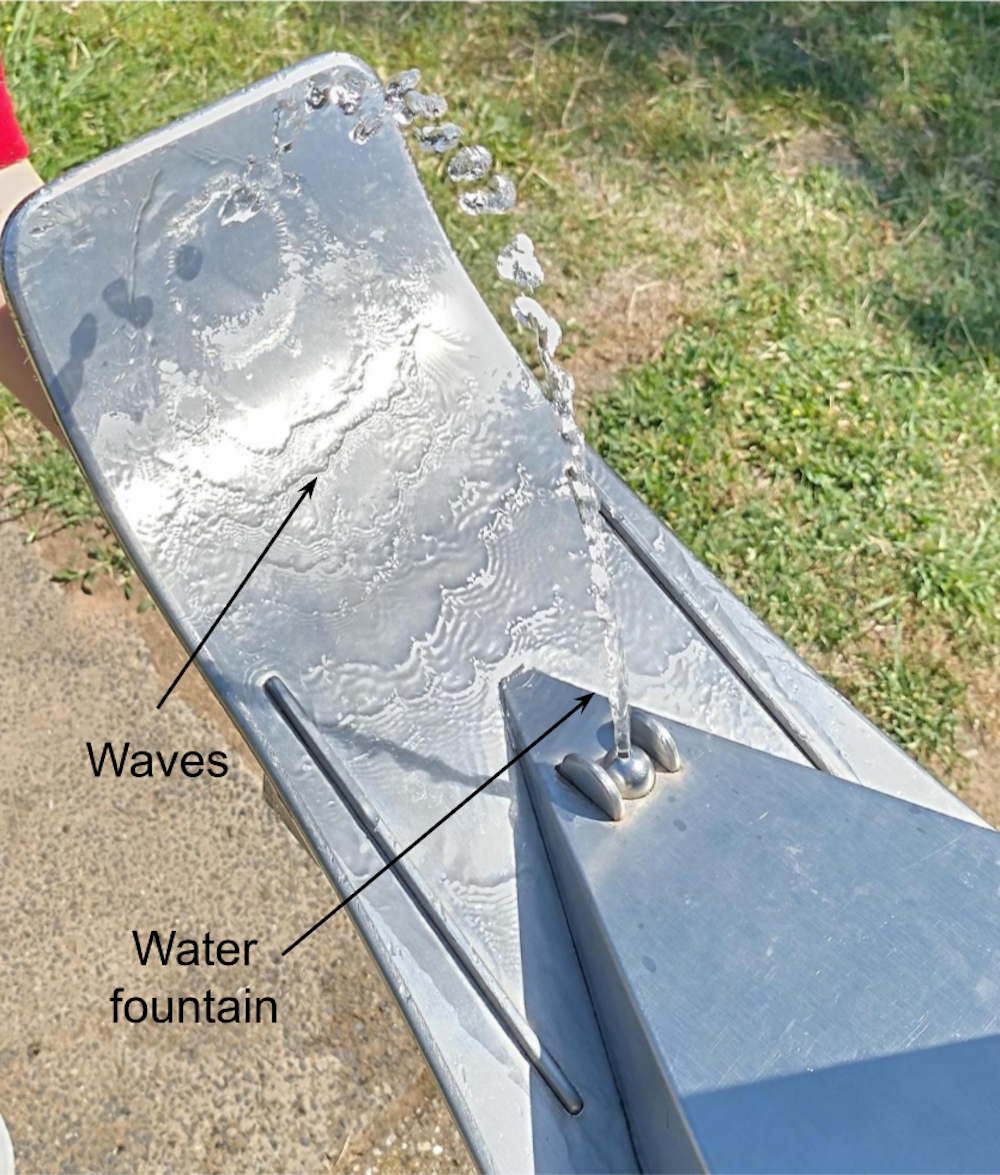
For our reservoir computer, we used compact soliton-like waves. You often see such waves in a bathroom sink or a drinking fountain.
In our computer, a thin layer of water flows over a slightly inclined metal plate. A small electric pump changes the speed of the flow and creates solitary waves.
We added a fluorescent material to make the water glow under ultraviolet light, to precisely measure the size of the waves.
The pump plays the role of falling stones in the game played by Alice and Bob, but the solitary waves correspond to the waves on the water surface. Solitary waves move much faster and live longer than water waves in a bucket, which lets our computer process data at a higher speed.
So, how does it perform?
We tested our computer’s ability to remember past inputs and to make forecasts for a benchmark set of chaotic and random data. Our computer not only executed all tasks exceptionally well but also outperformed a high-performance digital computer tasked with the same problem.
With my colleague Andrey Pototsky, we also created a mathematical model that enabled us to better understand the physical properties of the solitary waves.
Next, we plan to miniaturise our computer as a microfluidic processor. Water waves should be able to do computations inside a chip that operates similarly to the silicon chips used in every smartphone.
Read more: What was the first computer?
In the future, our computer may be able to produce reliable long-term forecasts in areas such as climate change, bushfires and financial markets – with much lower cost and wider availability than current supercomputers.
Our computer is also naturally immune to cyber attacks because it does not use digital data.
Our vision is that a soliton-based microfluidic reservoir computer will bring data science and machine learning to rural and remote communities worldwide. But for now, our research work continues.
Authors: Ivan Maksymov, Principal Research Fellow, Charles Sturt University


















