

scientists discover markedly different kangaroos on either side of Australia's dingo fence
- Written by: Vera Weisbecker, Associate Professor, Flinders University
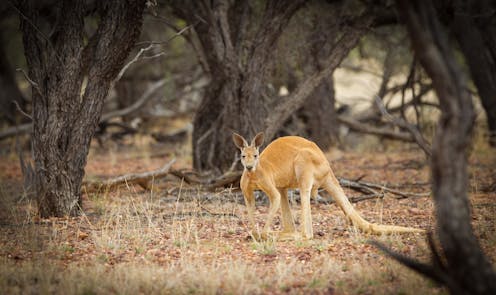
Australia’s dingo fence is an internationally renowned mega-structure. Stretching more than 5,600 kilometres, it was completed in the 1950s to keep sheep safe from dingoes. But it also inadvertently protects some native species.
This makes the fence an unintentional experiment in the relationship between predators and prey. Our new research examined how the fence affects a favourite prey of the dingo: red kangaroos.
We found young kangaroos on the side exposed to dingoes grew more quickly than their protected counterparts. This has potentially big repercussions for the health of these juveniles.
The merits of the dingo fence are hotly debated, and there have been calls to pull it down or move it. That’s why we must seek a better understanding of how the fence affects the animals that live along it.
‘Stressful’ lives
The dingo fence, formally known as the “wild dog barrier fence”, runs through Queensland, New South Wales and South Australia. It protects sheep and cattle to the southeast.
Extensive fencing can fragment habitats and disrupt ecosystems. Maintaining the fence costs about A$10 million per year. For these and other reasons, some have suggested the fence be pulled down.
But how would removing the fence affect kangaroos that have lived without dingoes for up to 70 years? Our research sought to answer this question.
We assessed 166 red kangaroos from two isolated populations on either side of the fence in far northwest NSW. We did this using data collected as part of a licensed shooting program. We compared population size, age structure, sex ratio, growth rate and skull shape.
We expected kangaroos north of the fence – those hunted by dingoes – to differ from their dingo-free cousins to the south. That’s because their lives are more stressful, especially for young kangaroos and females that are killed by dingoes more often than adult males.
Read more: Killing dingoes is the only way to protect livestock, right? Nope
What we found
As anticipated, we found more young and female kangaroos in the dingo-protected population south of the fence. But the story is more complex than that.
Young kangaroos south of the fence, up to about the age of four years, grew more slowly than those in the north. They were substantially smaller and lighter than their dingo-exposed counterparts.
This raises an exciting possibility: that the growth of kangaroos south of the fence has slowed in the absence of the dingo threat.
But maybe there was just more plant food available in the north, where there are fewer kangaroos compared to the south. Was this the reason the northern kangaroos grew more quickly?
As it turns out, no. We assessed the vegetation on each side of the fence using a decade of satellite measurements. We found there was probably less, not more, food overall for kangaroos in the north compared to the south.
More detailed investigation is needed into whether the types of plants differed on each side of the fence. But our results suggest the different growth rates were driven by predators, not food availability.
Read more: The dingo fence from space: satellite images show how these top predators alter the desert
This raises important questions
The differences between populations are even more striking considering the dingo fence in the area we studied was in disrepair until 1975. Before then, dingoes and kangaroos probably moved freely. So the changes we observed could have come about in as little as 17 kangaroo generations.
This would be unusually fast for an evolutionary adaptation. Instead, we suspect it’s the result of a more immediate response to the absence of dingoes, such as lower concentrations of stress-related hormones. These affect the health of mammals, and might have affected kangaroo growth rates in this case.
After about the age of four, the protected kangaroos had caught up and were the same size as their unprotected counterparts. But the unprotected kangaroos would have invested a lot more bodily resources into growing so quickly.
This would have left less energy for the animals to develop important functions such as their immune or reproductive systems. Or they might have had less fat reserves.
Conversely, protected kangaroos might have been healthier, or more fertile, because of their slower growth rates.
Read more: New DNA testing shatters 'wild dog' myth: most dingoes are pure
Understanding the mammal response
Our study involved only a single sample at one point in time. But it’s the first to comprehensively assess differences in a dingo prey species on either side of a fence.
Our results provide an insight into how prey populations might fare if the dingo fence is removed. But the implications are potentially even broader.
We must now investigate whether other native mammal species share similar differences across the fence. If so, this could help us predict how animals elsewhere in Australia are coping with rapid environmental change.
Authors: Vera Weisbecker, Associate Professor, Flinders University


















