

Want long-term contraception? There are more effective options than the pill. But they can be hard to find
- Written by: Deborah Bateson, Professor of Practice, University of Sydney
Australians’ access to a range of contraceptive options depends on where they live and how wealthy they are. A recent parliamentary inquiry recommends ways to end this “postcode lottery” for people who want to use long-acting reversible contraception.
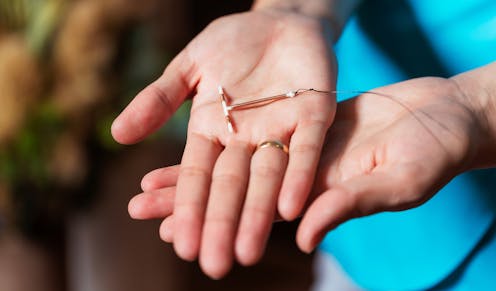
There are several types of long-acting reversible contraception: the hormonal contraceptive implant, the hormonal intrauterine devices (IUD) and copper IUDs.
With fewer than one in 100 users becoming pregnant in a year while using them (compared to up to seven in 100 contraceptive pill users) these are the most effective contraceptives available. Once they’re inserted into the body, you don’t need to remember to carry a condom, take a daily pill or fill a new script.
So why are they so hard to access in Australia? And what needs to change?
Read more: Australian women's access to abortion is a postcode lottery. Here's what needs to change
How do they work?
The contraceptive implant (known as Implanon NXT in Australia) is a small flexible rod, inserted just under the skin of the upper inner arm. It releases a progestogen hormone which prevents monthly egg release from the ovary for up to three years.
IUDs are small T-shaped devices which are inserted into the uterus. Hormonal IUDs contain a progestogen hormone and mainly work by thickening the cervical mucus and preventing sperm from swimming up into the uterus. There are two types of hormonal IUDs: Mirena and Kyleena. Both last up to five years. Kyleena is slightly smaller and contains a lower dose of hormone than Mirena.
Copper IUDs are hormone-free and last up to ten years. They work through their toxic effect on sperm and the egg to prevent fertilisation.
They have additional benefits for some users
As well as better protection from pregnancy, some long-acting reversible contraception methods have other benefits.
The hormonal IUD, Mirena, for example, reduces heavy menstrual bleeding. This can improve people’s quality of life and reduce the need for a hysterectomy.
Hormonal pills (containing estrogen) and the vaginal ring can’t be used by people with certain conditions, such as migraine with aura, or by people aged 35 years or older who smoke. This isn’t the case for long-acting reversible contraception methods, which most people can safely use.
Copper IUDs are an essential option for people who cannot or prefer not to use hormones. This includes people with hormone-driven cancers such as breast cancer, for whom any hormonal contraceptive would be considered unsafe.
Why aren’t they more available?
Access to long-acting reversible contraception is not universal in Australia.
Cost can be a considerable barrier to uptake for some people. While the implant and hormonal IUDs are subsidised by the Pharmaceutical Benefits Schedule (PBS), this is not the case for copper IUDs, which can cost up to A$120 for the device.
Out-of-pocket IUD insertion-related costs can also vary from zero to hundreds of dollars if people don’t have access to publicly funded services.
Read more: Considering an IUD but worried about pain during insertion? Here’s what to expect
On the supply side, too few health professionals provide these essential services.
Inadequate remuneration for insertion procedures act as a deterrent. An IUD takes 30 minutes of inserter and assistant time, and the equipment costs around A$25 per insertion. Yet the Medicare rebate is just A$72.05. Costs may be higher in rural areas, due to higher set-up costs and reduced access to things like sterilising services for procedural equipment.
Insertion and removal of long-acting reversible contraception also requires practical training. This can be costly for GPs and nurses, especially for IUD training, which also means taking around three days off work to achieve the necessary number of supervised IUD insertions. This can be even longer and more costly for rural practitioners, with additional travel time and accommodation costs.
This lack of trained inserters contributes to inequities for people who have chosen a long-acting reversible contraception but can’t find a local practitioner to insert their IUD or implant.
Nurses and midwives could ably fill this gap. There are multiple successful models of nurse-led long-acting reversible contraception services and postpartum insertion of implants by midwifes nationally and internationally.
However, most nurses aren’t able to access Medicare remuneration, which creates additional barriers for this highly skilled workforce to provide these services.
What are the recommendations for reform?
The Senate inquiry has recognised these barriers and recommends making contraception universally affordable, and specifically, subsidising copper IUDs.
It also recommends adequate remuneration through Medicare for GPs, nurses and midwives to provide long-acting reversible contraception insertion and removal, and collaborative efforts between the government and medical colleges to improve access to workforce training.
While the recommendations are welcome, they now need to be turned into actions through adequate funding.
The government also needs to fund every Primary Health Network (which plan services) across Australia to identify local gaps and ensure the contraceptive needs of the communities they serve are met equitably, affordably and transparently.
While one size does not fit all, and people must be provided with sufficient and accessible information to make an informed choice, no one who wants an IUD or implant should be denied this choice based on where they live and how much they can pay.
Read more: How effective is the pill?
Authors: Deborah Bateson, Professor of Practice, University of Sydney


















