

National’s housing u-turn promotes urban sprawl – cities and ratepayers will pick up the bill
- Written by: Timothy Welch, Senior Lecturer in Urban Planning, University of Auckland
By withdrawing its support for the Medium Density Residential Standards (MDRS) it helped introduce in the first place, the National Party has essentially only made a soft policy even softer.
Lauded by many as progress towards increasing urban housing supply and density, the MDRS allows land owners to develop up to three housing units, three storeys high, on most urban lots without seeking consent.
The standards and the law behind them stipulate no requirements for higher housing densities, nor do they apply additional restrictions on any other form of building. It was always unlikely the MDRS would contribute significantly to housing supply or density.
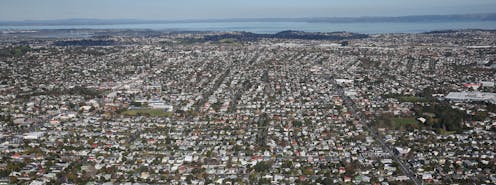
That’s because while the law enables more housing units, it does not fundamentally change how land is developed. Considering this already light approach, National’s change of heart will likely push future development even further into undeveloped “greenfield” land.
Encouraging urban sprawl
Undeveloped or very lightly developed land surrounding cities, greenfields are typically agricultural. But they can also include wetlands, forests, floodplains or any other location not yet swallowed up by urban expansion.
Developing low-density residential and commercial units on greenfields creates what is known as sprawl – something of an obscenity in urban planning circles.
Characterised by single-family, car-dominated suburbs, these developments may provide affordable housing for those willing to drive longer to work, school or shopping. But they are also extremely costly for cities and ratepayers.
Read more: NZ cities urgently need to become 'spongier' – but system change will be expensive
Sprawling suburbs require a lot of new infrastructure: roads, sewers, freshwater and stormwater pipes, power and broadband connections – and sometimes new schools, police and fire stations, and other social services. All this costs a lot.
This infrastructure is already well developed within the city, and often has extra capacity. Where there is an infrastructure deficit, such as in some parts of Auckland, the costs and benefits of adding and renewing infrastructure is spread across a large population.
Adding more users to existing infrastructure only reduces service and maintenance costs (providing it is sufficient, of course). A 200-unit apartment complex, for example, spreads the cost of all this infrastructure over many users and is unlikely to affect rates.
Read more: We’re building harder, hotter cities: it’s vital we protect and grow urban green spaces – new report
When the same infrastructure is used to service single-family units spaced half a hectare or more apart, the cost per user is exponentially higher. In many cases, it is subsidised by urban ratepayers while the infrastructure investment benefits only a few households.
The government’s recent budget committed billions of dollars to repair and strengthen existing road and rail networks. So it makes little sense to encourage development in places that will need even more potentially vulnerable infrastructure.
Increasing carbon emissions
Sprawl also makes public transport inefficient or entirely impossible. In a dense urban environment, a single train or bus stop can service hundreds or thousands of potential riders. Again, the cost per rider is much lower than in sprawling, remote suburbs.
The same can be said about active transport modes. The cul-de-sac development style that characterises many modern suburbs can make it challenging to walk or cycle anywhere.
Embracing greenfield development means we are making a conscious decision that future generations must rely on cars as a primary mode of transport.
Read more: Road to nowhere: why the suburban cul-de-sac is an urban planning dead end
Cars are a major source of carbon emissions in cities. In Auckland, vehicle emissions account for up to 35% of emissions. Pushing more housing out to the edges of the city means households will need more cars to drive longer distances more frequently.
Sprawl means locking ourselves into increased carbon emissions when the Zero Carbon Act has committed New Zealand to reduce emissions by 30% below 2005 levels by 2030, and make the country carbon neutral by 2050.
New Zealand’s largest city has committed to reduce transport emissions by 64% by 2030, primarily by shifting to public and active transport modes. None of this is possible if it continues to grow outward rather than upward.
The medium density standards aren’t perfect. They’re probably not even very useful as a tool to grow the housing supply. But they are better than encouraging continued outward urban expansion.
Urban growth boundaries
What is missing from the MRDS, and especially from sprawling greenfield development, is true medium-density housing. Outside New Zealand, this “missing middle” in the urban equation is characterised by townhouses, row houses, and three- to five-storey apartment buildings.
This type of development is critical to providing a more plentiful and affordable housing supply in places with good existing infrastructure serviced by public transport and active mode connections.
Read more: To get New Zealanders out of their cars we'll need to start charging the true cost of driving
Worldwide, cities are rapidly working towards creating more density and housing supply within existing urban areas. For decades, cities like Melbourne, Portland, Vancouver, Copenhagen and even Beijing have applied urban growth boundaries to help preserve undeveloped lands.
In the US, where sprawl has long dominated urban growth, cities have worked to increase density and housing supply by removing zoning requirements for single-family housing.
All in all, the MRDS could go much further. But throwing the baby out with the bathwater isn’t the answer. Greenfield development is more costly for everyone, while burdening future generations with car dependence and excess infrastructure.
Authors: Timothy Welch, Senior Lecturer in Urban Planning, University of Auckland


















