

We can't just walk away after the logging stops in Victoria's native forests. Here's what must happen next
- Written by: David Lindenmayer, Professor, The Fenner School of Environment and Society, Australian National University
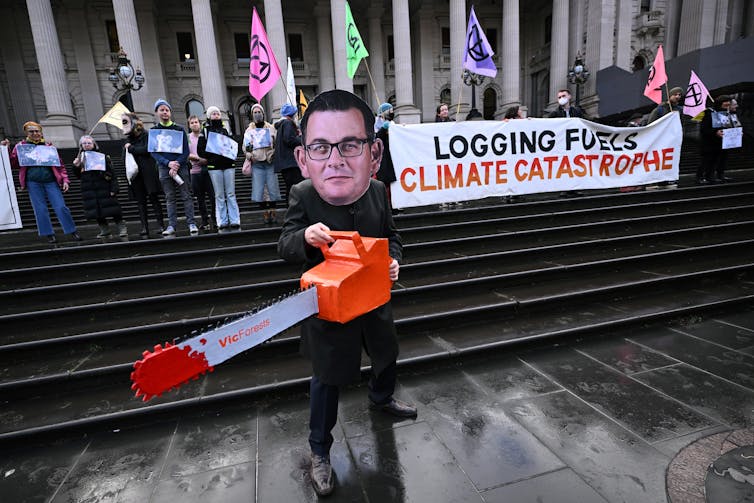
By the end of this year, native forest logging will cease in Victoria. Now begins a long and difficult process to recover vast areas of forest after more than 50 years of clearfelling and other destructive logging practices.
The supply of sawlogs in Victoria was close to being exhausted, and the state’s logging industry had long been financially unviable. Restoring the forest offers the opportunity to put something better in its place.
For many years, we’ve thought deeply about the problem of these degraded forests and the restoration needed. It’s a huge job, but it can be done. Here, we outline what’s needed.
The scale of the problem
Since the 1960s, clearcut logging has occurred across more than 300,000 hectares of Victoria’s forests. Aside from the direct destruction, the logging has left remaining forest ecosystems badly fragmented.
Much logging was concentrated in the most species-rich areas of the state. Logging removed critical habitat for threatened animals such as Leadbeater’s possum and the southern greater glider.
Young trees now dominate much of Victoria’s forest. It can take more than 120 years for trees to mature and form the hollows that animals require to breed, nest and shelter. Until then, artificial hollows such as nest boxes will be required. They must be designed, built and installed properly, and replaced as needed.
In many parts of Victoria, extensive stands of trees need to be re-established. Preliminary assessments suggest regeneration of tree cover has partially or completely failed in up to 30% of logged areas. In addition, large parts of a logging coupe can comprise cleared areas where trees were dragged, trimmed and loaded onto trucks.
It gets worse. Following successive major wildfires in many parts of Victoria, large areas of forest have failed to regrow. Vast amounts of seed must now be collected and sewn to re-establish forest.
And in many areas, logging has altered the mix of tree species. The leaves of trees that remain are often unsuitable as food for iconic animals such as the koala and southern greater glider. The right mix of tree species must now be restored.
Yet more challenges
The types of restoration methods used needs careful consideration. Forestry industry advocates have promoted activities such as industrial tree thinning, but this can make things worse.
We must be careful, too, about industrial-scale prescribed burning. When done badly, it can harm forests and their biodiversity. This recently occurred south of Perth, when a population of the endangered western ringtail possum was decimated by a prescribed burn.
Neither burning nor thinning on an industrial scale will be appropriate in some ecosystems. These include those dominated by mountain ash and alpine ash, where a lot of logging in Victoria was concentrated over the past few decades. Industrial-scale prescribed burning would likely lead to their collapse.
Yet another restoration challenge will be controlling feral animals such introduced deer, which do enormous damage. Major and sustained efforts will be needed to control exploding numbers of these pest animals.
Robust monitoring programs are essential to guide forest restoration. Collecting reliable data on a forest’s condition and biodiversity can help determine whether restoration activities should continue or be changed.
Victoria already has monitoring programs that can perform this task. They should be maintained and expanded. Monitoring programs will also be crucial to the federal government’s so-called “nature repair market”, in which investors pay for habitat restoration in exchange for tradeable certificates. Monitoring is needed to ensure the integrity of this scheme.
Restoration programs must be coupled with an expansion of national parks and other protected areas in Victoria. In particular, the Victorian government should honour its 2015 promise to create a Great Forest National Park. This park along with others must be developed with First Nations people.
Read more: HECS for farmers? Nature repair loans could help biodiversity recover – and boost farm productivity
First Nations empowerment is key
Restoring heavily logged forests will need an active workforce for many years to come. Meaningful and productive jobs will be available in areas such as tourism and forest management.
And First Nations people should now be given the opportunity to heal and manage Country. A Victorian government program to support Aboriginal jobseekers may be a way to support these activities.
First Nations people have already identified ways to heal and manage Country through self-determination and cultural practices. It’s involved a lot of work convening traditional knowledge-holders and working with government, including a Cultural Landscapes Strategy launched in 2021. The end to logging removes a key barrier to implementing the plan.
The First Peoples’ Assembly of Victoria is making serious headway towards powerful and practical statewide and local treaties. These would ensure First Nations people have the power to make decisions that affect Country.
However, the Federation of Victorian Traditional Owner Corporations says protection and restoration challenges must be urgently addressed, and land rights can’t wait for treaties.
Let’s get this right
Many parts of the world have successfully moved away from heavy extraction-based industries – both ecologically and economically. It is time for Victoria to do this in forests.
The decision to end native forest logging in Victoria came decades too late, but vast areas of badly damaged forest can be restored. And if it’s done right, people and the economy will benefit too.
Read more: Logged native forests mostly end up in landfill, not in buildings and furniture
Authors: David Lindenmayer, Professor, The Fenner School of Environment and Society, Australian National University


















