

5 incredible craters that will make you fall in love with the grandeur of our Solar System
- Written by: Helen Brand, Senior Beamline Scientist - Powder Diffraction, Australian Nuclear Science and Technology Organisation
Impact cratering happens on every solid body in the Solar System. In fact, it is the dominant process affecting the surfaces on most extraterrestrial bodies today.
On Earth, however, such craters are often lost over time by active geological processes, but elsewhere in the Solar System there are some truly majestic examples of impact craters preserved for all to see.
Here, we pick our highlights of what the Solar System has to offer.
1. South Pole–Aitken basin, the Moon
Our first crater is a big one: the biggest, deepest and oldest impact crater on the Moon. It is 2,500km diameter, 6.2 to 8.2km deep and formed roughly 4.2 billion years ago. As the name suggests, it is at the south pole on the far side of the Moon, although the crater rim can be seen from Earth as a dark mountain range, just on the border between the light and dark side of the moon.
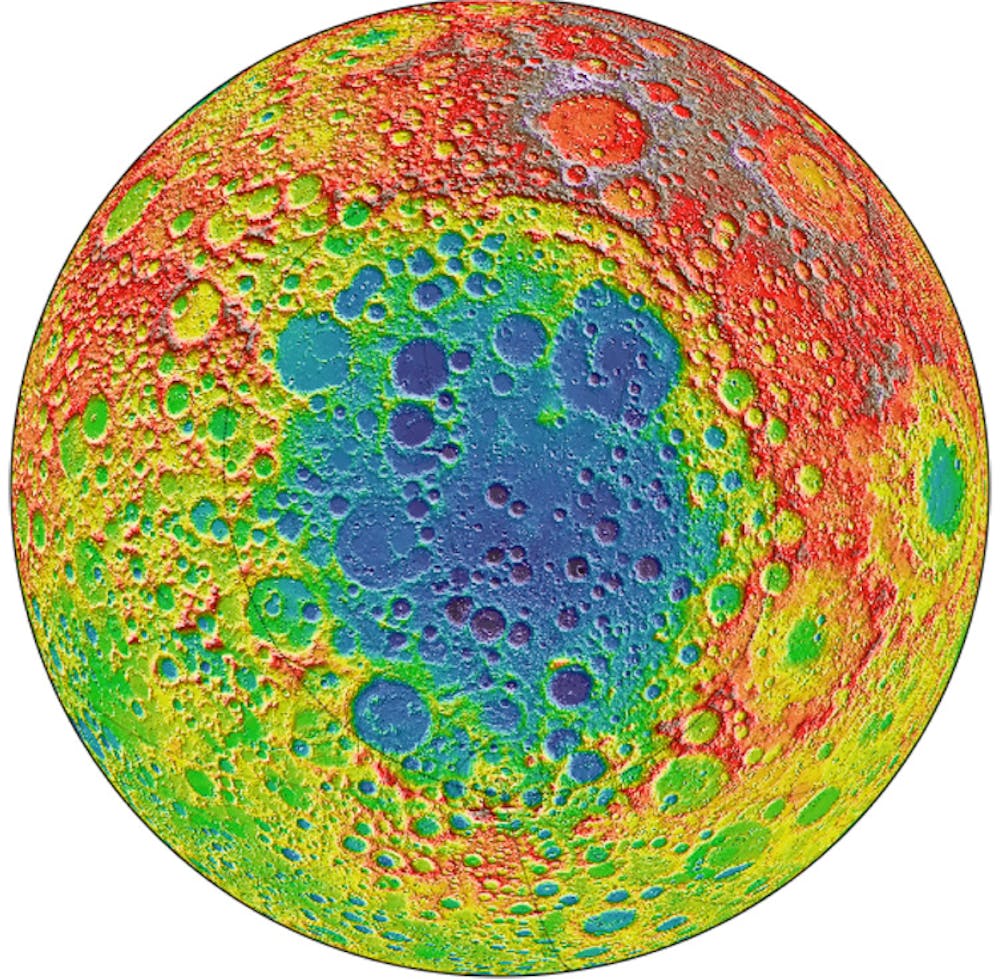
It is a prime site favoured by lunar scientists to visit and learn about our Moon’s geology. The depth excavated by the crater is almost as deep as the deepest ocean trenches on Earth. It gives us a unique view of the interior of the Moon’s crust, with 4.2 billion years of history exposed.
In 2019, a rover from the Chinese space agency, Chang'e 4, touched down in the basin and carried out the first scientific experiments there. One of the most interesting of these was the Lunar Micro Ecosystem, a collection of seeds and insect eggs designed to see if life could flourish in a tiny biosphere on the surface.
2. Unnamed Crater (S1094b), Mars
There are many famous craters on Mars, from the homes of Mars rovers (Gale Crater for Curiosity or Jezero for Perseverance) to the hypothesised source regions of Mars meteorites (Tooting or Mojave). But one of the newest craters on the red planet is actually quite a dramatic one.
While Mars rovers claim all the glory for exploring the Martian surface, the satellites orbiting Mars have been making discoveries of their own for decades. NASA’s Mars Reconnaissance Orbiter (MRO) was launched in 2005 but is still operational, and its 16+ years of Mars’s surface images allow us to make comparisons year on year, highlighting differences between data sets.
On Christmas Eve 2021, NASA’s InSight mission detected a large “Marsquake” on the red planet, which MRO data later helped to identify as a new impact on the other side of Mars.
The vibrant, fresh impact ejecta (“blankets” of material thrown aside by the impact) can be seen clearly from space using the context camera data aboard the orbiter, and thanks to InSight we even know what it sounded like.
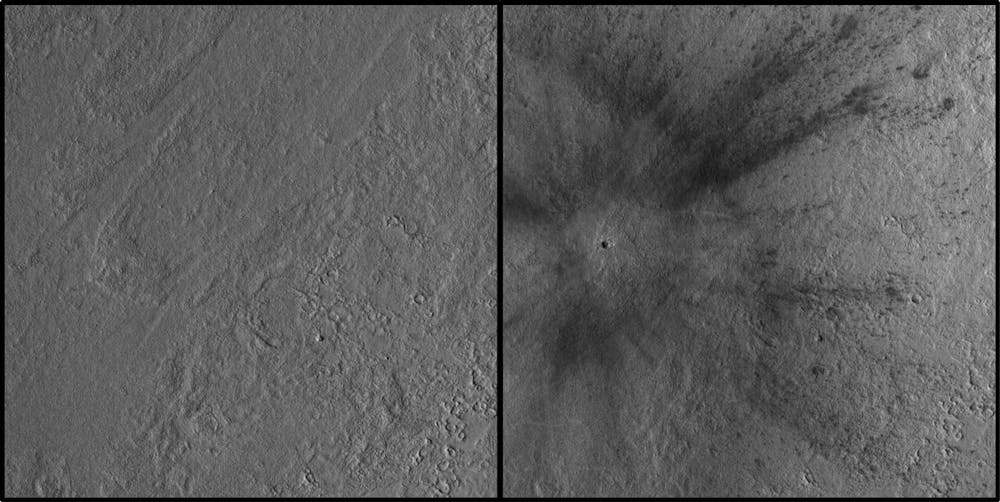 A before-and-after comparison of the location on Mars’s Amazonis Planitia where a meteoroid impacted on December 24 2021.
NASA/JPL-Caltech/MSSS
A before-and-after comparison of the location on Mars’s Amazonis Planitia where a meteoroid impacted on December 24 2021.
NASA/JPL-Caltech/MSSS
3. Enki Catena, Ganymede
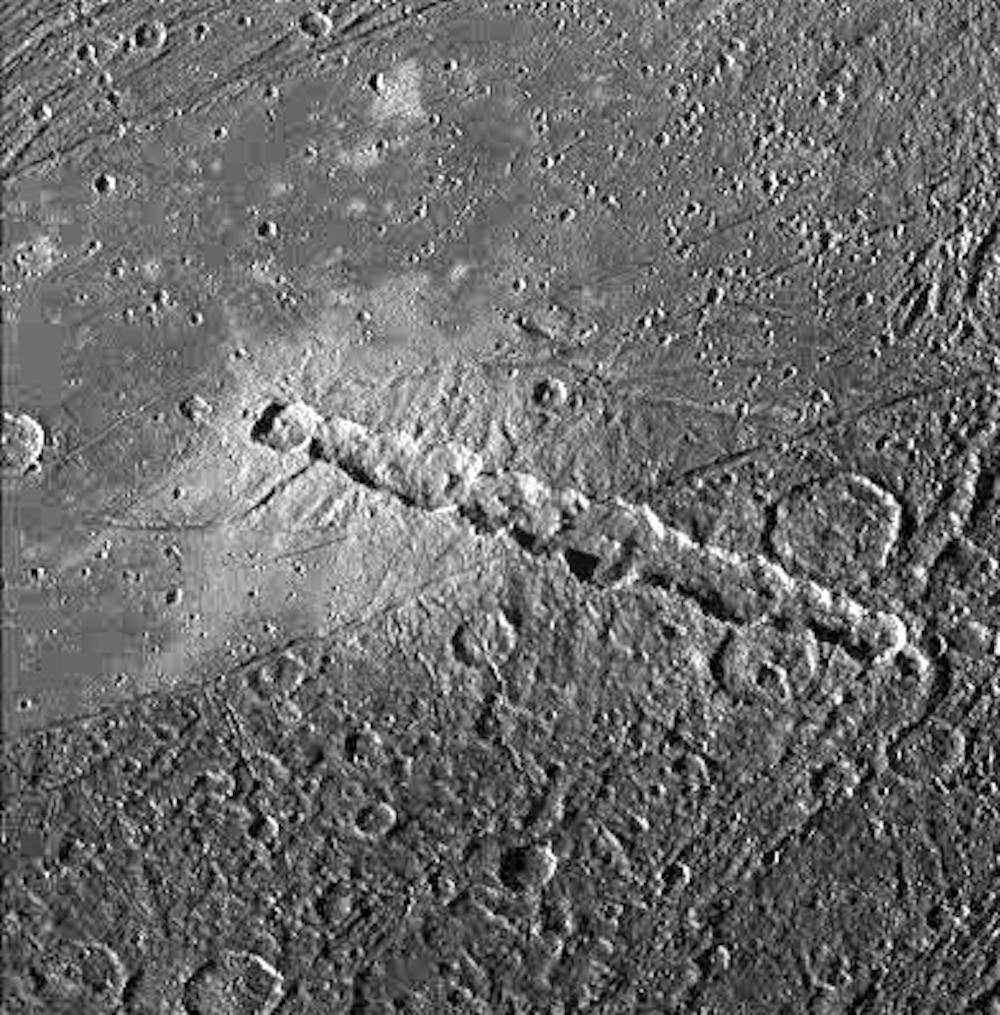
Enki Catena is a chain crater on Ganymede, one of the Galilean satellites of Jupiter. At latest count, Jupiter has more than 90 moons, a mini planetary system of its own.
Jupiter’s gravity creates tidal forces which shape the moons and give us some of the most interesting geological features we have yet found, from the volcanoes of Io to the subsurface ocean of Europa. There are also strings of craters found on two of the moons, Callisto and Ganymede.
These crater chains were first spotted when the Voyager 1 spacecraft gave us some of the first pictures of the surface of these moons in 1979. They were thought to potentially be collapsed lava tubes, features that have been observed on Mars and the Moon.
 Chain of impact craters Enki Catena on Ganymede.
NASA/JPL/Brown University
Chain of impact craters Enki Catena on Ganymede.
NASA/JPL/Brown University
However, their origin remained under debate until the Shoemaker-Levy 9 comet was observed as it smashed into Jupiter. The comet was seen breaking into multiple pieces and this gave an idea as to how these chains might form – the gravity from Jupiter pulls apart objects into many pieces that all impact close together.
Enki Catena is a chain of 13 craters which crosses from an area of dark to bright terrain on Ganymede. It is 162km in length and about 10km wide.
The European Space Agency’s Juice mission will visit the Jovian system in the 2030s and allow us to see the surfaces in greater detail than ever before. We might even find more of these crater chains.
Read more: The much-anticipated JUICE mission to Jupiter launches today. Here's what it might discover
4. Occator Crater, Ceres
Ceres is the largest body in the main asteroid belt between Mars and Jupiter. It is large and round enough to be considered a “dwarf planet” (along with Pluto and three less famous examples, Eris, Makemake and Haumea).
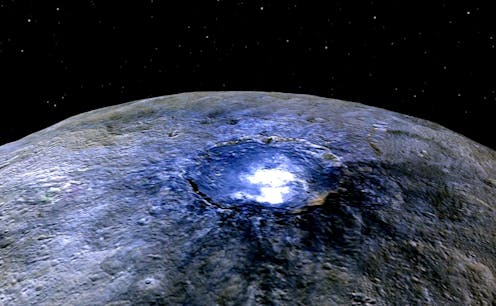
The Occator crater on Ceres is impressive because it contains a bright spot in the centre that has been observed both from space, and from Earth at Mauna Kea Observatory, Hawaii.
 Occator crater with its bright spots as imaged by the Dawn mission.
NASA
Occator crater with its bright spots as imaged by the Dawn mission.
NASA
NASA’s Dawn mission entered an orbit around Ceres in 2015, and imaged the bright spot in Occator crater known as “Spot 5”. It’s a three kilometre wide dome covered in bright salts on the crater floor, likely resulting from hydrothermal activity.
Occator crater itself is 92km in diameter and 3km deep. Simulations indicate that the impactor (the space rock that created the crater) was rougly 5km across, striking Ceres between 20–25 million years ago.
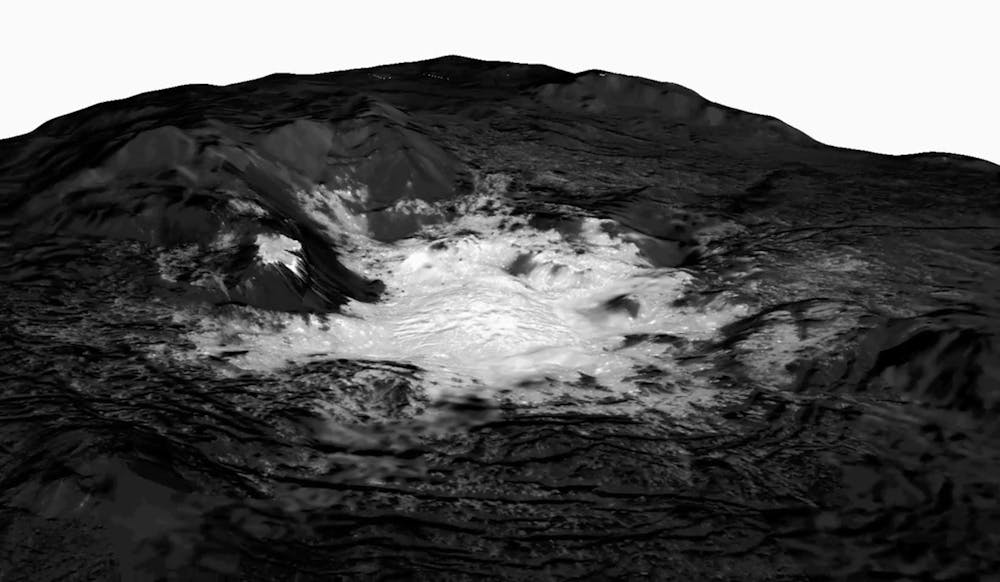 This mosaic from NASA’s Dawn spacecraft combines images obtained from altitudes as low as 22 miles (35 km) above Ceres’ surface.
NASA/JPL-Caltech/UCLA/MPS/DLR/IDA/PSI
This mosaic from NASA’s Dawn spacecraft combines images obtained from altitudes as low as 22 miles (35 km) above Ceres’ surface.
NASA/JPL-Caltech/UCLA/MPS/DLR/IDA/PSI
5. Aurelia, Venus
Venus is sometimes called Earth’s twin. It is when it comes to size, but the surface images we have of Venus show the planets have very different features.
The best such images were taken in the 1990s by NASA’s Magellan spacecraft. Venus has a thick cloudy atmosphere, and visible-light cameras can’t see through to the surface. Magellan was equipped with a radar which can “see” the surface – but the images can be harder to interpret.
In radar, dark terrain is very smooth and bright terrain is very rough. This makes impact craters stand out really well in radar images. The ejecta are very rough, especially against the surrounding volcanic plains, so they appear bright in the images.
This is Aurelia, a 32km impact crater on Venus.
 Aurelia crater on Venus, imaged by Magellan in 1996.
NASA/JPL
Aurelia crater on Venus, imaged by Magellan in 1996.
NASA/JPL
You can see it stands out against the grey plains that surround it. The black terrain on the edges of the bright white ejecta are smooth flows of rock that melted when the impact hit.
Speaking of volcanoes on Venus, recently a group from the University of Alaska Fairbanks used this Magellan data to find the first active volcano on Venus
NASA has three Venus missions in development over the next 10 years, so hopefully soon we will know much more about our enigmatic twin.
Read more: These 5 spectacular impact craters on Earth highlight our planet's wild history
Authors: Helen Brand, Senior Beamline Scientist - Powder Diffraction, Australian Nuclear Science and Technology Organisation

















