

Treated wastewater in Victoria is still contaminated, study finds. So are we and the environment safe?
- Written by: Mark Patrick Taylor, Victoria's Chief Environmental Scientist, EPA Victoria; Honorary Professor, School of Natural Sciences, Macquarie University
Wastewater is a by-product of humanity produced all day, every day. At home, wastewater is the used water that disappears when you flush the toilet, empty the sink or drain the washing machine.
Industrial processes also produce wastewater. Around the world, 359 billion cubic metres of wastewater is produced each year – equal to 144 million Olympic-sized swimming pools.
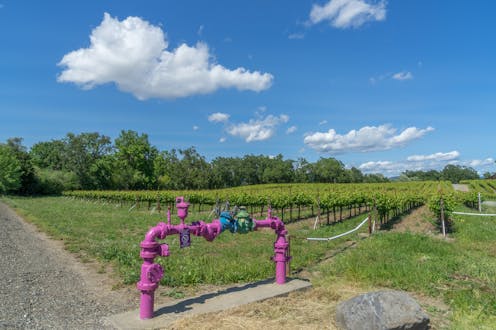
In Australia, some of this water is treated and reused. This so-called “recycled” water is used, for example, to wash cars, water crops and gardens. Treated water is also released back into rivers as “discharge”, which is regulated under an operator’s licence.
So is treated wastewater safe? Our research, published today, found wastewater treatment removes a lot of particles, but some contaminants remain. While it’s not enough to affect human health, effects on the environment are less clearly established.
Read more: We now treat half the world's wastewater – and we can make inroads into the other half
Making the most of our water
Water is a precious, finite resource. There is no such things as “new” water. Our planet’s water dates back 4.5 billion years and is constantly recycled by Earth’s systems.
As Earth’s population grows and the climate dries, we need all the water we can get.
In light of this challenge, the state of Victoria has a plan to better use treated wastewater. Other Australian states and territories have similar plans.
Read more: Where to find more water: eight unconventional resources to tap
Wastewater comes from homes, businesses, industrial sites and farms, as well as any stormwater or groundwater that enters the sewer system.
Specialised treatment plants process this wastewater. A combination of technologies is used to achieve the treatment objectives, based on the character of raw wastewater and use of the treated wastewater. These processes include primary, secondary and tertiary treatment.
Wastewater treatment seeks to remove:
organics (proteins, hydrocarbons, oils and fats)
suspended solids (small particles)
bacteria (such as E. coli).
In Victoria, as elsewhere in Australia, wastewater must meet strict standards. Water corporations achieve this by implementing stringent procedures and processes, and monitoring water quality.
But even after treatment, some contaminants can remain. These can be divided into “emerging” and “legacy” contaminants.
Emerging contaminants include pharmaceuticals, pesticides, phthalates (used to make plastic more durable), industrial chemicals and chemicals in personal care products.
They’re described as “emerging” because of the limited information we have about them, the risks they pose and the dose-response effects, especially at low, ultra-trace concentrations.
Legacy contaminants include, for example, PFAS, trace metals and insecticides such as DDT.
So should we be concerned about contaminants in treated wastewater? Our new research examined this question.
Read more: PFAS for dinner? Study of 'forever chemicals' build-up in cattle points to ways to reduce risks
What did the study find?
EPA scientists partnered with the Victorian Department of Energy, Environment and Climate Action and 13 state water corporations to investigate emerging contaminants in wastewater. As a science-based regulator, EPA undertakes problem-based research on pollution and waste to protect the health of Victoria’s community and environment. It uses data and evidence from studies like these to guide future actions.
We collected 230 samples of treated and untreated water at a range of wastewater treatment plants. We analysed these for the presence of 414 emerging and legacy contaminants.
We detected 180 contaminants in treated and untreated water. These included:
- 48 chemicals found in pharmaceuticals and personal care products
- 5 endocrine-disrupting chemicals
- 21 per- and polyfluoroalkyl substances (PFAS)
- 34 herbicides
- 8 insecticides
- 7 fungicides
- 12 industrial compounds
- 7 phenols
- 28 disinfection byproducts.
None of the contaminant levels in treated water exceeded human health guidelines for drinking water and water used for recreation.
As you might expect, concentrations of most emerging contaminants were lower in treated than untreated water. However, some contaminants remained in treated water. Examples included antidepressant venlafaxine and anticonvulsant medication carbamazepine.
Read more: A fishy problem: How antidepressants may impact the health of our aquatic ecosystems
So which treatment method is best? Based on our study, it’s one that combines all of the following:
an “activated sludge” process, which can be aerobic or anaerobic – if aerobic, air is needed and is introduced into the “mixed liquor” by aeration devices or by natural diffusion
extended aeration using a mechanical device to aerate the water
disinfection with ultraviolet light, which uses UV radiation to break down the DNA of pathogens
microfiltration, a membrane process that removes particles larger than 0.1 micron
reverse osmosis, which is another membrane process and removes most of the salt and large molecules, producing water with very low dissolved content
disinfection with chlorination, zonation or UV disinfection.
But treatment that combines all the above processes is relatively rare. It’s used by only four out of 200 wastewater treatment plants in Victoria. These plants produce the highest grade of recycled water.
What does this mean for the environment?
None of the contaminants we detected in treated wastewater breached human health guidelines. However, we should not forget the environment.
Pharmaceutical pollution, in particular, is a pressing global issue. A recent study detected pharmaceuticals in 258 rivers in 104 countries across all continents. Pharmaceutical chemicals break down quickly in the environment, but are continually being replenished.
According to the World Health Organization, trace quantities of pharmaceuticals in drinking water are very unlikely to pose risks to human health. But information about the potential environmental effects remains limited.
Read more: 80% of household water goes to waste – we need to get it back
You can make a difference
Environmental authorities regulate how businesses and industry use, store and dispose of their waste. However, your actions at home – no matter how small – can mean fewer contaminants make it to wastewater treatment plants.
Actions you can take include:
take medicines only as directed and return unwanted and expired medicines to a pharmacy
choose chemical-free cleaning products
minimise pesticide use in your garden and bug sprays in your home
if you have a wastewater management system at home, such as for greywater or blackwater, maintain it regularly and avoid using powerful chemicals.
Next steps
Further research is under way involving the Victorian EPA, water corporations and research institutions. It aims to build our understanding of what, if and how emerging contaminants are present in soil and taken up by crops irrigated with recycled water.
Ultimately, the work will reduce the potential risks to people and the environment posed by wastewater, by ensuring official advice is current and evidence-based.
The report’s authors are EPA Scientists Minna Saaristo, Simon Sharp, Shanli Zhang and Mark P. Taylor.
Authors: Mark Patrick Taylor, Victoria's Chief Environmental Scientist, EPA Victoria; Honorary Professor, School of Natural Sciences, Macquarie University

















