

World politics explainer: The Great War (WWI)
- Written by: Romain Fathi, Lecturer, History, Flinders University
This is the first in a series of explainers on key moments in the past 100 years of world political history. In it, our authors examine how and why an event unfolded, its impact at the time, and its relevance to politics today.
In October 1918, a young man was temporarily blinded on the Western Front and evacuated to hospital. For four long years, he had served in the German Army alongside 11 million men.
Whether his blindness came from a gas attack or a sudden bout of nerves is still being debated. But it is clear that, like hundreds of millions of people at the time, his wartime experience shaped the rest of his life.
This was during the first world war – the foundational event of the violent 20th century – and that young man was Adolf Hitler.
What happened?
Sparked in the Balkans as a result of European nationalism and imperial rivalries, the first world war raged from July 1914 to November 1918. It pitted the 48 million soldiers of the Allies – led by the French, British and Russian empires – against the 26 million soldiers of the Central Powers – led by the German, Austro-Hungarian and Ottoman empires, who lost the war.
It was a truly global conflict fought on battlefields across the world, but also on the home front – in people’s living rooms, fields and factories.
Read more: Flies, filth and bully beef: life at Gallipoli in 1915
The impact of the Great War
Over four long years, the world collapsed in what was then the largest industrial war ever fought. The conflict left over 10 million soldiers and 6 million civilians dead.
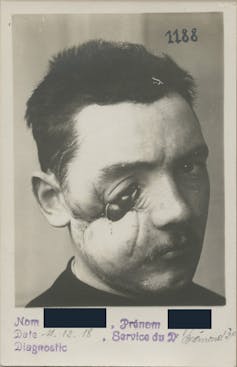 A wounded soldier.
BIU Santé (Paris)
A wounded soldier.
BIU Santé (Paris)
Over 20 million men were wounded – both physically and mentally – rendering them unable to resume civilian life. What’s more, the war facilitated the spreading of the Spanish flu pandemic, which killed at least 50 million people in 1918-19.
And for what?
The Allies’ “victory” in 1918 did not result in a safer and better world, and the first world war failed to become the “war to end all wars”.
Conflict raged on in the Middle East and colonial outposts right through the 1920s. For many, war did not stop with the Armistice of November 11, 1918.
In fact, given the scale of devastation across Europe, it is not clear who won what.
“Winners” and “losers” alike lost population, resources and infrastructure. Yes, there were marginal gains here and there for some, but most countries came out of the bloodshed crippled financially. Some were politically crippled, too.
Perhaps one clear winner did emerge from the conflict, however: the United States.
The US sold materials and lent money to the Allies during the war and, as a result, amassed gold reserves that underpinned its post-war global economic dominance, while other countries were gripped in an inflationary spiral.
To a lesser extent, Japan, too, benefited from the conflict. Fighting on the same side as the Allies fuelled the country’s militarisation and imperial ambitions in Asia.
Another outcome of the war was the disintegration of the centuries-old Austro-Hungarian, Russian and Ottoman empires, alongside the more recently-formed German empire, forever transforming the world’s political landscape.
The first world war also prompted the Russian Revolution, which further altered the course of the 20th century.
The “winners” were not immune from turbulence, either. France and Britain were confronted to various challenges in the colonies that had supported them throughout the conflict, in Africa or in India for instance. Local populations demanded more autonomy and at times even rebelled against their colonial masters.
The new world that emerged from this global conflict was one filled with hope, but riven by unrest, revolutions and ethnic conflicts.
A series of peace treaties, the most memorable one being the Treaty of Versailles of June 1919, endeavoured to secure and build a global peace, laying the basis for new international institutions such as the League of Nations. Its role was to prevent future wars through conflict resolution and diplomacy. But the treaty also required the demilitarisation of Germany, demanded that Germany acknowledge its responsibility for causing the war, and inflicted severe war reparations on the country.
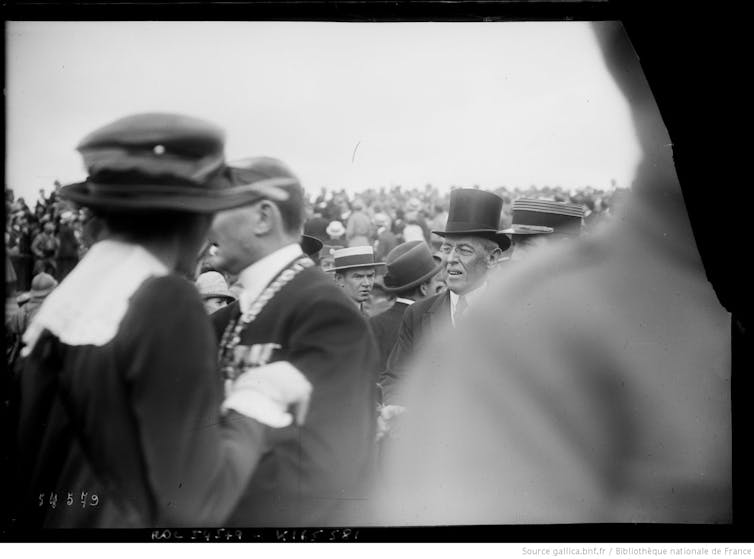 President Woodrow Wilson at Versailles, 1919.
BNF France
President Woodrow Wilson at Versailles, 1919.
BNF France
The end of the fighting also brought more challenges. Tens of millions of soldiers were demobilised and returned home, prompting issues related to public health, unemployment and domestic violence. Hitler, for example, returned to Munich with no family, no career prospects and no place to stay. He would resent the Treaty of Versailles his whole life, and claim that Germany was not defeated on the battlefield, but stabbed in the back by internal enemies – the Jews, the left and the republicans.
But let it not be said that the first world war caused the second, nor that it made Hitler who he subsequently became. In the late 1920s, Germany was doing pretty well under the Weimar Republic – so well that this period was dubbed “the Golden Age”. Pacifism was a strong bipartisan force in 1930s France, Britain and Belgium. Another future was entirely possible.
Contemporary relevance
Yet, in the inter-wars years, the repercussions of the first world war remained omnipresent.
Old empires had left a vacuum for new states like Poland, Yugoslavia and Czechoslovakia to form, and the borders of those new states were soon contested.
Even the 1929 financial crash was partly related to the first world war. This was because states accumulated debt to finance the conflict, and their debt increased even more as they continued borrowing to pay war reparations after the war had ended. This contributed to global inflation and financial insecurity, two factors of the 1929 crash. The first world war – or rather, its consequences – seemed endless.
And it is those consequences which undeniably created some of the conditions which set the second global conflict ablaze. Not least through armament, such as tanks, military aviation, submarines, chemical weapons – all of which became weapons of choice during the first world war and played a crucial role in the second.
But the second world war had its own intrinsic causes not directly related to the first world war. These included the development of new totalitarian ideologies, mass media, anti-Semitism, and the failures of the League of Nations as well as liberal democracies to oppose dangerous regimes.
Interestingly, some historical actors and historians believe that the two world wars cannot be separated, and form, in fact, a Thirty Years’ War.
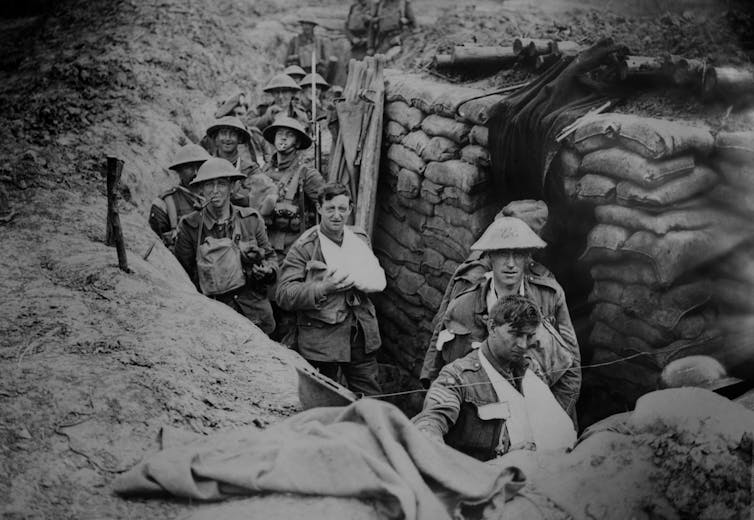 Injured WWI soldiers in a battlefield trench, 1915-1918.
Shutterstock
Injured WWI soldiers in a battlefield trench, 1915-1918.
Shutterstock
Certainly, the repercussions of the first world war are still being felt today. Intergenerational grief and family history spurs hundreds of thousands of people to engage in digital commemorations or commemorative tourism at former battlefields.
The land, too, remains deeply affected. In Belgium and France, for instance, war-time explosive devices continue to kill people, and will still be found for hundreds of years to come.
In some places, the soil is so contaminated by chemical agents from the first world war that nothing has grown there since.
Finally, much of the geopolitical struggles of modern times date back to the first world war. The Middle East is a case in point. Decisions taken during and after the war laid the basis for ongoing conflicts due to contested boundaries and spheres of influences in the region.
The end of the war was not the victory the Allies claimed it was. But politicians and military leaders had to justify the dead and the enormous sacrifices they had demanded from their people. Thinking back, the most chilling part of the vain bloodbath is that the citizens of the belligerent nations did support the war and its sacrifices for years, some until the breaking point of revolt.
The first world war was a turning point in history as it irremediably altered political, economic, social and cultural life around the globe. First world war studies remain one of the most active fields of historical research today precisely because of the relevance of the conflict throughout the 20th and 21st centuries.
Understanding the first world war is thus an exercise in comprehending the depth of human commitment to destruction, violence and resilience at a scale never experienced before 1914. But it also reminds us of the fragility of peace, and of our duty as citizens to remain vigilant of nationalism.
Authors: Romain Fathi, Lecturer, History, Flinders University
Read more http://theconversation.com/world-politics-explainer-the-great-war-wwi-100462
?highlight=WyJwYW5kZW1pYyJd&media=https://www.modernaustralian.com/https://images.theconversation.com/files/230504/original/file-20180803-41354-18h9w54.jpg?ixlib=rb-1.1.0&q=45&auto=format&w=237&fit=clip&description=World%20politics%20explainer:%20The%20Great%20War%20(WWI) "Pin It")

















