

Fungi and their 'necromass' absorb one-third of the carbon emitted by burning fossil fuels every year
- Written by: Adam Frew, Lecturer and ARC DECRA Fellow, Western Sydney University
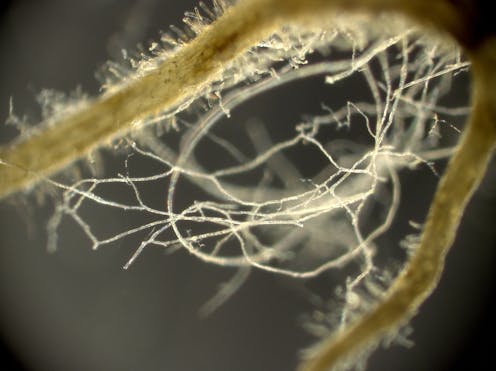
Beneath our feet, remarkable networks of fungal filaments stretch out in all directions. These mycorrhizal fungi live in partnership with plants, offering nutrients, water and protection from pests in exchange for carbon-rich sugars.
Now, new research shows this single group of fungi may quietly be playing a bigger role in storing carbon than we thought.
How much bigger? These microscopic filaments take up the equivalent of more than a third (36%) of the world’s annual carbon emissions from fossil fuels – every year.
As we search for ways to slow or stop the climate crisis, we often look to familiar solutions: cutting fossil fuel use, switching to renewables and restoring forests. This research shows we need to look down too, into our soils.
This fungi-plant partnership is 400 million years old
Mycorrhizal fungi are hard to spot, but their effects are startling. They thread networks of microscopic filaments through the soil and into the roots of almost every plant on earth.
But this is no hostile takeover. They’ve been partnering with plants for more than 400 million years. The length of these complex relationships has given them a vital role in our ecosystems.
Sometimes fungi take more than they give. But often, these are relationships of mutual benefit. Through their network, the fungi transport essential nutrients and water to plants, and can even boost their resistance to pests and disease.
In return, plants pump sugars and fat made by photosynthesis in their leaves down through their roots to the fungi. These compounds are rich in carbon, taken from the atmosphere.
How do these fungi fit into the carbon cycle?
On land, the natural carbon cycle involves a delicate balance. Plants take CO₂ from the atmosphere through photosynthesis, while other organisms emit it back into the atmosphere.
Now we know the carbon transfer from plants to mycorrhizal fungi isn’t a side note – it’s a substantial part of this equation.
By analysing almost 200 datasets, the researchers estimate the world’s plants are transferring a staggering 3.58 billion tonnes of carbon per year to this underground network. That’s the same as 13.12 billion tonnes of CO₂ – more than a third of the world’s 36.3 billion tonnes of CO₂ emitted yearly by burning fossil fuels.
Read more: Do trees really stay in touch via a 'wood-wide web'? Here's what the evidence says
To be clear, fungal carbon doesn’t present a climate solution by itself. It’s a missing piece in the carbon cycle puzzle.
We still have big gaps in data from particular ecosystems and geographic regions. For instance, this study didn’t have any data of this kind from Australia or Southeast Asia – because it doesn’t yet exist.
What does this mean for the climate?
We already know mycorrhizal fungi help soils retain carbon by releasing specific chemical compounds. These compounds contain carbon and nitrogen. Once in the soil, these compounds can be used by other soil microorganisms, such as bacteria. When this happens it helps to form a highly stable soil carbon store that is more resistant to breakdown, and this store can accumulate more than four times faster in the presence of mycorrhizal fungi.
When these fungi die, they leave behind “necromass” – a complex scaffold of dead organic material which can be stored in soil, and often inside clumps of soil particles. The carbon inside these clumps can stay in the soil for close to a decade without being released back to the atmosphere.
In fact, other studies suggest this fungal necromass might contribute more to the carbon content of soil than living fungi.
But these fungi also naturally cause carbon to escape back to the atmosphere by decomposing organic matter or changing water and nutrient availability, which influences how other organisms decompose. Mycorrhizal fungi also release some carbon back into the atmosphere, though the rate this happens depends on many factors.
What does this mean for climate change? While atmospheric CO₂ concentrations keep rising, it doesn’t necessarily mean fungi are storing more of it. Recent research in an Australian woodland found higher atmospheric CO₂ did see more carbon sent below the ground. But this carbon wasn’t stored for long periods.
To date, mycorrhizal fungi have been poorly represented in global carbon cycle models. They aren’t often considered when assessing which species are at risk of extinction or promoting successful restorations.
Protecting our fungal networks
When we cut down forests or clear land, we not only disrupt life above the ground, but underground as well. We need to safeguard these hidden fungal networks which give our plants resilience – and play a key role in the carbon cycle.
As we better understand how these fungi work and what we’re doing to them, we can also develop farming methods which better preserve them and their carbon.
As global and Australian initiatives continue to map the diversity of mycorrhizal fungi, scientists are working to understand what shapes these communities and their roles.
We’ve long overlooked these vital lifeforms. But as we learn more about how fungi and plants cooperate and store carbon, it’s well past time for that to change.
Read more: The secret life of fungi: how they use ingenious strategies to forage underground
Authors: Adam Frew, Lecturer and ARC DECRA Fellow, Western Sydney University

















