

How India's 'slum-free' redevelopment fails residents by ignoring their design insights and needs
- Written by: Kali Marnane, Honorary Associate Lecturer in Architecture and Urban Design, The University of Queensland
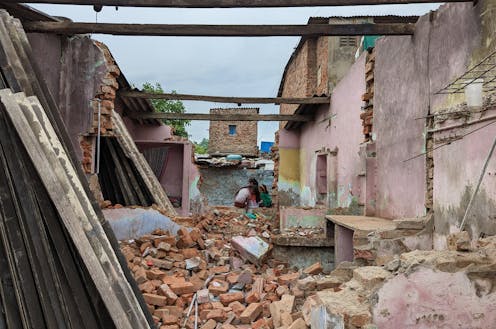
I’m in Ahmedabad, India, standing where families once built their homes under the shade of large trees. Today, those houses are a flattened dust bowl at the edge of a construction site. Apartment buildings are replacing the low-rise, high-density settlement called Ramapir No Tekro, the city’s biggest informal settlement.
I’m feeling the inevitability of political forces intent on shaping the city in a new image. Walking through the community, I see shops closed and homes reduced to rubble. It’s hard to reconcile these images with the once-vibrant streets I remember.
The 8,500 homes that housed 150,000 people in Ramapir No Tekro are being redeveloped as the government aims to achieve a “slum-free” India.
Although the stated aim of providing affordable housing to bring people out of poverty gives me hope, I feel heartbreak and frustration as residents continue to be short-changed. They receive poor compensation, the underlying reasons people build informal housing are not addressed, and authorities refuse to see value in the informal architecture that the residents created. Apartment designs lack key features of the settlement that our recent study identified as improving residents’ lives.
Read more: Indians promised benefits of 100 smart cities, but the poor are sidelined again
One size does not fit all
Residents will receive a new apartment if they can prove they have lived here since 2010. To do this, they must have original documents such electricity bills, government survey, or birth certificates. Those who qualify for an apartment will get compensation to cover rent while construction is completed but they must dismantle their home before relocating.
Renters, more recent arrivals and those who lack the required paperwork are ineligible. They must relocate permanently at their own expense, often far from community support networks, livelihoods and schools.
Even for those who do qualify for new housing, nearby rental accommodation is hard to find due to high rents and/or caste discrimination. When residents return, their new apartment will consist of one room with a small entry space, kitchen and bathroom – regardless of the size of their family or of their previous house.
As an incentive for developers, height and setback restrictions have been eased. This allows more apartments to be sold for profit.
How suitable design improves lives
In a recent study, Kelly Greenop and I examine the design of the “slum” I now stand in, before it was demolished. We identify four features that help improve living conditions:
houses are located near work, schools, healthcare and family
residents have control over design and construction, upgrading only when affordable, which creates a sense of ownership that means residents are more likely to invest in and maintain common areas, and also can give priority to spending on children’s education
houses are clustered in groups that connect neighbours, and designs typically feature an entry porch, which allows activities from small dwellings to spill into common areas and fosters social connection
neighbourhoods have a clear hierarchy and scale of shared spaces: from private house, to semi-private porch, to semi-public common area, to public street. Spending time in shared spaces directly outside the home helps to build strong community bonds.
Read more: Ghana's informal residents show how social innovation can solve urban challenges
What makes a house adequate?
To understand what aspects of informal housing design work (or not), we compared the information we gained from interviews with women residents and detailed house and neighbourhood drawings against the United Nations’ Adequate Housing Criteria. The criteria state that housing must:
- provide secure tenure
- provide essential infrastructure, such as water and electricity
- be affordable
- be habitable, providing adequate space, structural stability and protection from the elements
- be accessible
- be located close to services, such as health, employment and education, and support networks, including extended family
- enable the expression of cultural identity.
By definition, informal houses do not meet the first criterion. However, houses in Ramapir No Tekro often met three to six of the other criteria, with some exceptions performing poorly.
Read more: What sort of 'development' has no place for a billion slum dwellers?
Are slum redevelopments adequate?
Research by Uchita Vaid on housing quality before and after redevelopment reports that new apartments provide security of tenure (meeting criterion 1) and essential infrastructure (meeting criterion 2).
But the new buildings fail to meet other criteria. They suffer from substandard structural quality and lack of maintenance (failing criterion 4). They lack shared space for neighbourly interaction, resulting in more social isolation (failing criterion 6). And more time spent inside leads to higher electricity bills (failing criterion 3).
Apartments are inaccessible to household goats and chickens, and are too small for multi-generational living or common employment types (failing criterion 5). They do not reflect household identity or allow for cultural expression (failing criterion 7).
It’s difficult and expensive to correct such faults in apartments after they’re built. Ramit Debnath and colleagues have shown that discomfort from poor redevelopment design causes some residents to move back into informal settlements.
Community-based design matters
Housing design alone cannot change the persistent structural inequality facing low-caste and low-income residents of “slums”. But good design can improve wellbeing, opportunities for social connection and residents’ daily lives in general.
In Ramapir No Tekro, residents could and did create solutions adapted to their challenging circumstances. Instead of starting from scratch – risking the introduction of new problems – housing interventions should engage with and learn from residents by enhancing what already works, even in so-called “slums”.
Authors: Kali Marnane, Honorary Associate Lecturer in Architecture and Urban Design, The University of Queensland

















