

Giant tree-kangaroos once lived in unexpected places all over Australia, according to major new analysis
- Written by: Gavin Prideaux, Professor, Flinders University
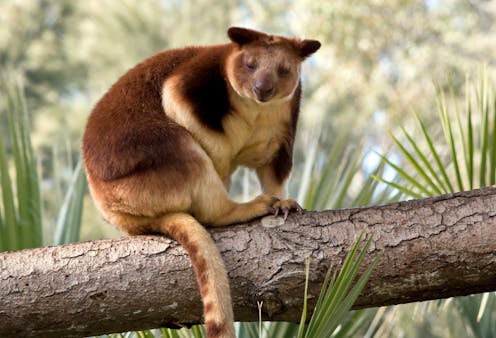
Kangaroos are an enduring symbol of Australia’s uniqueness. To move, they do what no other large mammals do: they hop along on oversized hind legs. So you may be surprised to learn that some kangaroos live in trees, and are among the most endearing and threatened of all marsupials.
Today, biologists recognise ten tree-kangaroo species, all in the genus Dendrolagus. Two species inhabit tropical forest in far northern Queensland. The other eight live in New Guinea.
Studying them is difficult because their habitats are hard to access, they live high in trees and are increasingly rare due to human impacts.
The evolutionary history of tree-kangaroos is even more obscure. In a new study published today in Zootaxa, we pull together all the evidence on fossil tree-kangaroos and show giant tree-kangaroo species were widespread across Australia, and lived in habitats that were a long way from tropical forest – their modern-day home.
Tree-kangaroos from the Treeless Plain
In 2002, a team of explorers found three new caves in the middle of the arid Nullarbor Plain of south-central Australia. The cave floors were littered with the bones of the extinct marsupial “lion” Thylacoleo carnifex and short-faced kangaroos, as well as those of several mammals, birds and reptiles that still live in drier parts of Australia.
Given the high diversity of herbivores, we concluded the Nullarbor had to have been more than just arid shrubland some 200–400 thousand years ago, even if it was still very dry. This is because a few shrubs would not have been enough for such a range of herbivores to live on.
Read more: We found out when the Nullarbor Plain dried out, splitting Australia's ecosystems in half
In this light, it was hard to believe when we discovered partial skeletons of two new species of giant tree-kangaroo in 2008 and 2009. They belong to the extinct genus Bohra, first named in 1982 on the basis of leg bones found in the Wellington Caves in New South Wales.
Like the picture on a jigsaw box, we used the Nullarbor skeletons as a guide to search for isolated pieces in museum collections. We discovered more than 100 teeth and bones belonging to a total of at least seven species of extinct tree-kangaroos.
These come from fossil sites extending from southern Victoria to central Australia to the New Guinea highlands, and range in age from 3.5 million (late Pliocene) to a few hundred thousand years old (middle Pleistocene).
A big leap forwards – and then upwards
Anatomical and molecular evidence shows that, among living marsupials, kangaroos are most closely related to possums. No one is sure exactly when the kangaroo ancestor made the descent to the forest floor, due to big gaps in the Australian fossil record.
Similarly, we do not know whether the distinctive “bipedal” hopping mode of locomotion originated in the trees or on the ground – but we do know it became the enduring hallmark of the kangaroo family. They have longer hind legs and longer feet than their possum ancestors, and the foot bones lock together in such a way as to limit sideways foot movement.
Combined with high tendon elasticity and a large muscular tail, these adaptations make kangaroos among the most energy-efficient movers on the planet.
The foot bones of tree-kangaroos reveal three stages in the evolutionary “reversal” of these adaptations. Pliocene species of Bohra evolved a broader heel bone and upper ankle joint, allowing them greater mobility. Later, Pleistocene species of Bohra evolved a smoother joint at the front of that heel bone, giving them the ability to roll the soles of their feet inward to wrap around tree trunks and limbs.
As well as shorter feet, modern tree-kangaroos (Dendrolagus) have shorter hindlimbs, in conjunction with powerful forelimbs and claws for grasping and climbing. They can even walk with their hind legs while climbing, whereas ground-dwelling kangaroos only move their hind legs alternately while swimming.
Why return to the trees?
As Australia dried out over the past 10 million years, more open vegetation became widespread. This trend was interrupted by a greenhouse phase 5–3.5 million years ago. We speculate that the temporary expansion of forest habitats during this period would have opened new ecological niches that early tree-kangaroos evolved to exploit.
By the time climatic drying returned, tree-kangaroos had become established members of the Australian fauna, with species adapting to expanding woodland and savannah habitats.
As some larger monkeys do today, species of Bohra probably divided their time between living in trees and on the ground, whereas modern tree-kangaroos spend most of their time in the canopy.
So, although we might now think of tree-kangaroos as quintessential rainforest animals, this is because the Bohra species that lived in other habitats have become extinct.
Despite everything we can learn about evolution from studies of modern species, the fossil record holds the potential to flip the script with one discovery.
Authors: Gavin Prideaux, Professor, Flinders University


















