

Warm is the new norm for the Great Barrier Reef – and a likely El Niño raises red flags
- Written by: Scott F. Heron, Associate Professor in Physics, James Cook University
The Bureau of Meteorology this week declared a 70% chance of an El Niño developing this year. This raises concern for the health of the Great Barrier Reef, which is under continuing threat from climate change.
Recent summers have shown the devastating damage heat stress can wreak on the reef. We must act urgently to protect this underwater marvel – through this likely El Niño, and beyond.
We are coral reef and climate scientists, and policy experts. We’ve seen how the Great Barrier Reef is nearing its tipping point. After this point, it will become unrecognisable as a functioning ecosystem.
But the scale of climate threat is beyond the tools currently used to manage the Great Barrier Reef. New measures and sustained effort are needed – at local, national, and international scales – if we’re serious about saving this natural wonder.
International treasure under threat
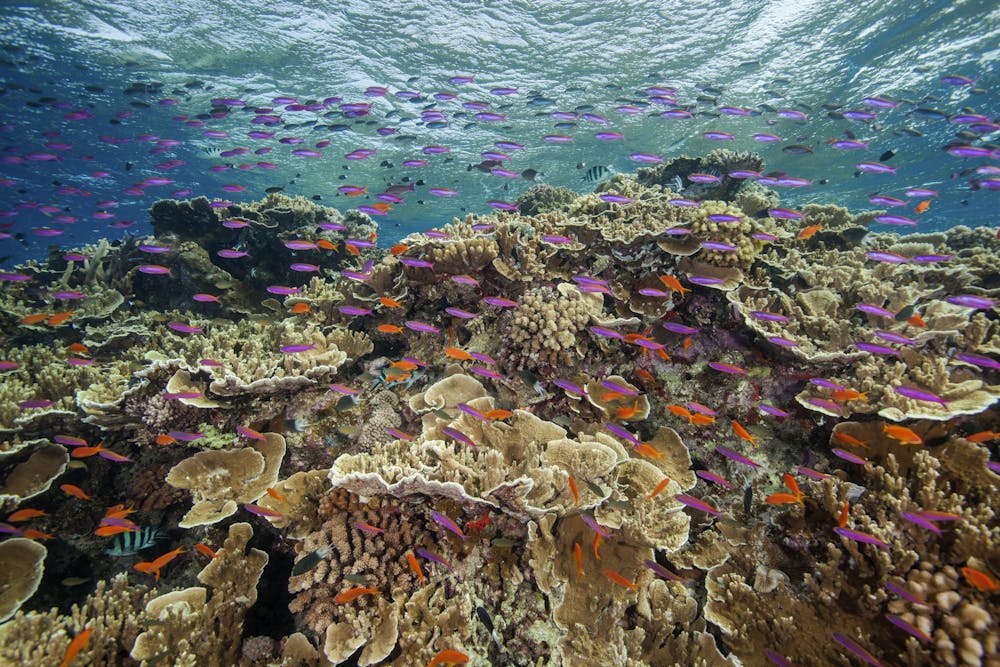
The Great Barrier Reef is internationally renowned for its biodiversity, including more than 450 species of coral, 1,600 species of fish and 6,000 species of molluscs.
It is also an economic workhorse, contributing about A$6 billion to the Australian economy and providing some 64,000 full-time jobs. Many industries and coastal communities in Queensland rely on a healthy Great Barrier Reef.
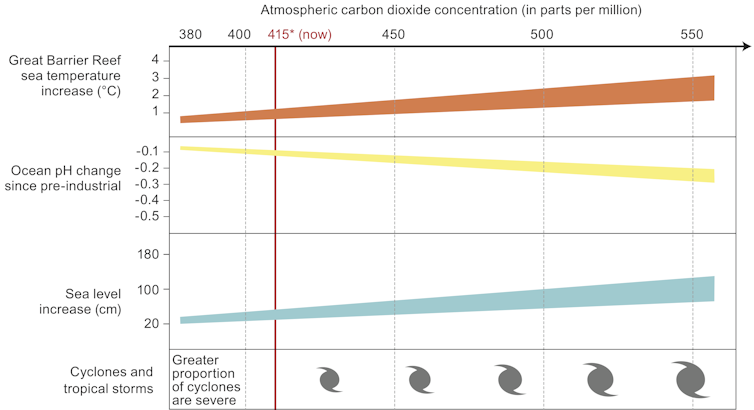
But Australia’s reefs are in trouble and climate change is the biggest threat – bringing heatwaves, severe cyclones and more acidic oceans.
The background temperature of the Great Barrier Reef has warmed by 0.8℃ since 1910. This warming can couple with ocean temperature variability, such as from El Niño and its counterpart, La Niña. But because the Great Barrier Reef is already struggling under climate change, an El Niño could mean even more pressure.
Read more: What the next Australian government must do to save the Great Barrier Reef
The bathtub is filling
We hope this analogy helps explain the situation.
Imagine a bathtub. The water inside it represents global sea-surface temperature. When the bathtub was only half-full, temporary heat variability (from El Niño) caused splashes, but they were contained in the tub.
Now fast-forward to the present day. For more than a century, humans have been heating the planet by burning fossil fuels. The background temperature has risen and the bathtub is now almost filled to the brim. Add a splash of heat from El Niño and the bath spills over.
These splashes bring consequences: more mass bleaching of coral and, in severe cases, widespread coral death.
El Niño and La Niña have become more variable in recent decades. This has meant more frequent and stronger events – bigger splashes in the bathtub – that pose a grave threat to the Great Barrier Reef’s health and biodiversity.
All the while, the bathtub keeps filling.
The World Meteorological Organisation reported that the next five years will be the warmest since records began. And 2023 will almost certainly be among the ten warmest years on record.
Earth’s average temperature is predicted to exceed 1.5℃ of warming in at least one of the next five years. This would produce a big splash – but it doesn’t represent the bathtub level reaching the brim.
Under the global climate accord known as the Paris Agreement, nations are pursuing efforts to limit the average global temperature increase to 1.5℃ above pre-industrial levels. Background warming beyond 1.5℃ is widely considered by climate scientists as dangerous. We’re entering an era in which hot and more frequent splashes are imminent – and the survival of coral reefs is becoming increasingly threatened.
Clearly, the global warming we’re seeing now is unprecedented. We must turn off the tap.
An inadequate tool kit
Unless global emissions are drastically reduced, frequent severe bleaching is projected this century for all 29 World Heritage-listed coral reefs.
This would cause untold ecological damage. It would also reduce the reefs’ ability to support human communities that depend on them.
Coral bleaching is not the only threat to the Great Barrier Reef. Other pressing problems include poor water quality from land-based runoff, crown-of-thorns starfish and unsustainable fishing and coastal development.
So how do we deal with all of this? A range of management actions exists.
Banning fishing in some areas and limiting exploitation elsewhere has benefited conservation, while also enhancing fisheries.
But other actions have had mixed success. And not all available tools are being applied effectively.
For example, “special management areas” were intended to restrict human use of the Great Barrier Reef for conservation or management purposes. But their use has been limited. And emergency implementations of these areas, allowed under the law, have never been used.
Crucially, none of the available actions were designed to respond to climate threats. The reality is, the scale of climate disturbance is beyond the available management tools.
Read more: We all know the Great Barrier Reef is in danger – the UN has just confirmed it. Again
Source: Australian Academy of Science.What are we waiting for?
The scientific evidence is unequivocal. We must work at local, national, and international scales to help the Great Barrier Reef better cope with climate change. The likely arrival of an El Niño makes this task ever more urgent.
Australian and international governments must take immediate and decisive action on emissions reduction. This includes banning new coal and gas projects and rapidly shifting to renewable energy. Communities reliant on fossil-fuel industries should be helped to transition to new livelihoods.
Reef management agencies need to tackle climate threats more effectively – at a scale commensurate with the problem. This requires a new way of managing key areas. That could mean, for example, temporarily closing off parts of the Great Barrier Reef affected by coral bleaching to give them a reprieve from other stressors such as fishing and tourism.
And individuals must also ensure our everyday choices – in transport, consumption and elsewhere – help tackle the climate threat.
It’s time for us all to double-down and ensure the survival of the Great Barrier Reef, and the planet. There is no room for complacency. So what are we waiting for?
Authors: Scott F. Heron, Associate Professor in Physics, James Cook University


















