

why recycling food waste is so much better than sending it to landfill
- Written by: Susanne Schmidt, Professor - School of Agriculture and Food Science, The University of Queensland
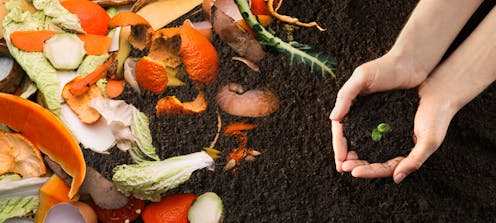
Most food and garden waste in Australia comes from homes. Australian households waste 3.1 million tonnes of food each year. That’s more than five kilograms each household per week.
Over half of all household waste is food organics and garden organics, also known as “FOGO”. These scraps and clippings take up space in landfill and, when they rot, emit dangerous greenhouse gases.
The federal government’s National Waste Policy Action Plan aims to increase the organic waste recycling rate from 47% to 80% by 2030 and halve the amount sent to landfill. This won’t happen on its own - we need investment and action.
Food and garden waste can be captured and turned into compost. Composting is no longer just the domain of the home gardener or eco-warrior. It’s happening at commercial scale, through services such as council collection from homes.
A federal government fund is building new composting facilities and supporting other food and garden organics recycling projects. The South Australian government has invested in council trials of weekly green bin collection and fortnightly rubbish collection.
But more must be done. Recycling food waste into high-quality compost is a win-win solution, for people and the planet. Here, we explain why.
Scrap Together is a community education program from EPA NSW helping councils harvest FOGO.Compost is a winner for the climate
When food rots in landfill, in the absence of oxygen, the process releases a potent greenhouse gas called methane.
Composting is different because the microbes can breathe. In the presence of oxygen, they transform waste into valuable organic matter without producing methane. They recycle organic carbon and nutrients into compost, which can be used to improve soil health and productivity.
This process also captures and stores carbon in the soil, rather than releasing it as carbon dioxide (CO₂) to the atmosphere.
In Australia, organics recycling (including food and garden organics, biosolids and tree wastes) saves an estimated 3.8 million tonnes of CO₂ from entering the atmosphere each year. That’s equivalent to planting 5.7 million trees or taking 877,000 cars off the road.
Soils can profit from compost because globally an estimated 116 billion tonnes of organic carbon has been lost from agricultural soils. This has contributed to rising CO₂ levels in the atmosphere.
Promisingly, compost can restore soil organic carbon while also boosting health and fertility. Compost improves soil structure and water retention. It’s also a source of essential nutrients that reduces the demand for costly fertilisers.
The opportunity presented by soils to draw down atmospheric CO₂ levels was brought to global awareness in the 2015 global Paris Agreement, via the “4-per-mille” initiative.
Translated from French, it means increasing the organic carbon stored in global soils by 0.04% each year (4 per 1000) would neutralise increases in atmospheric CO₂. In other words, CO₂ would remain constant rather than continue to increase. That would make a substantial contribution to mitigating climate change.
Introducing the international “4 per 1000” Initiative.Read more: Soil carbon is a valuable resource, but all soil carbon is not created equal
Farming with precision
Our research has investigated how compost can benefit global agriculture.
We found that in most cases where compost is applied as a generic product to agricultural land, the benefits are not fully realised. But if suitable composts and application methods were aligned with target crops and growth environments, crop yields can be increased and organic carbon in soils replenished.
We call this a “precision compost strategy”. Using a data-driven approach, we estimate global application of this strategy has potential to increase the production of major cereal crops by 96.3 million tonnes annually. This is 4% of current global production and twice Australia’s annual cereal harvest.
Of great relevance for Australia’s farms, precision compost has the strongest effects in dry and warm climates, boosting yield by up to 40%. We now need to develop this strategy for the specific needs of farms.
Compost has the potential to restore 19.5 billion tonnes carbon in cropland topsoil, equivalent to 26.5% of current topsoil soil organic carbon stocks in the top 20 cm.
Give FOGO a go-go
The amount of food and garden waste in Australia is growing at a rate six times faster than Australia’s population and 2.5 times faster than GDP.
But less than a third of Australian households have access to food waste collection services. A national rollout has been pushed back from 2023 to the end of this decade so there is time to overcome some roadblocks. This includes uptake by community and high quality composting.
This waste stream offers a huge opportunity for landfill diversion and compost production. The cost benefit alone is compelling: councils can save up to A$4.2 million a year on landfill levies by diverting 30,000 tonnes of waste (based on A$74 to 140 per tonne of waste, with levies increasing).
Preventing food in the home from being wasted should be top priority. But for unavoidable food waste, turning it into high-quality compost makes perfect sense.
Read more: What can go in the compost bin? Tips to help your garden and keep away the pests
us
Authors: Susanne Schmidt, Professor - School of Agriculture and Food Science, The University of Queensland


















