

We're in another COVID wave. But it’s not like the others
- Written by: James Wood, Professor, epidemiological modelling of infectious diseases, UNSW Sydney
Each Omicron wave so far in Australia has had distinguishing features – the sharp rise and fall of BA.1, the widespread transmission among children and families in BA.2, a shift to more infections in older people with BA.5, then the confusing variant mix in the summer wave of 2022-23.
Now Australia is in its fifth Omicron wave, which has been brewing since February. But it has grown so slowly that many people may have not realised it until recent months.
Why has this most recent wave been so drawn out? And what has its real impact been on our health and health systems?
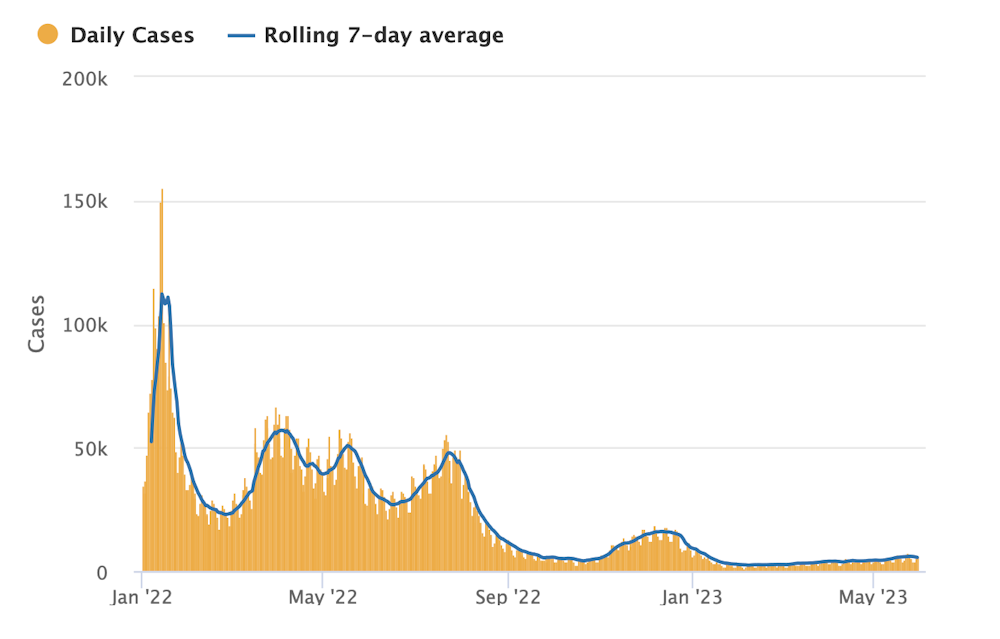
Slower spread, less testing
With most people in Australia now having been vaccinated against COVID, infected or both, we expect the virus to spread more slowly through the population.
This means the overall number of infections in the current wave should be fewer than in previous ones. Infections should also occur over a longer period of time.
But we also know people are mixing and socialising more than in previous waves. So it is easier for viruses such as SARS-CoV-2 (the virus that causes COVID) to be transmitted.
While these two factors counter each other, overall we expect to see reduced health impacts compared with previous waves.
 We expect fewer people with COVID going to hospital at this stage of the pandemic.
etsir/Shutterstock
We expect fewer people with COVID going to hospital at this stage of the pandemic.
etsir/Shutterstock
We are already seeing fewer people with confirmed infections and fewer people who are unwell requiring hospitalisation.
We also know from weekly surveys that people are less likely to test for COVID and report their results at this stage of the pandemic. So reported cases are now a smaller fraction of all infections than in previous waves.
Read more: Flu or COVID? You can now test for both at home with a single swab. Here's what you need to know
New sub-variants are likely the cause
The slow and drawn out nature of the current wave is most likely due to the sequential emergence and spread of new Omicron sub-variants. The current wave started with XBB.1.5, then shifted to XBB.1.9.1 and XBB.1.9.2, then most recently XBB.1.16.
Each sub-variant has been able to spread where the previous one could not. But the competitive advantage of each has been minor. So we have only seen a progressive increase in infections as new sub-variants emerge, rather than the dramatic surges in infections and health impacts associated with previous variants.
Are we at the peak of the current wave?
There is some debate about whether New South Wales has reached the peak of its wave. However, forecasts for most other jurisdictions suggest declines have begun or are imminent.
But as always, there is uncertainty in how the wave will develop, and we cannot exclude the possibility of sustained epidemic activity over a longer period.
Hospitalisations for those infected with COVID may stay elevated for a while longer. This is due both to the lag between infection and hospitalisation and we are seeing a shift in infections to older people as the wave progresses.
Thankfully, we do not expect the health system to come under the pressure from COVID seen during the BA.5 wave in winter 2022. This is good news.
However, for the first time in Australia, the SARS-CoV-2 wave may coincide almost completely with influenza and RSV (respiratory syncytial virus) waves. This certainly appears likely in NSW. The combined impact of these three viruses may be significant.
Looking ahead, this combined threat will need careful attention. Surveillance systems need to be (re-)designed to detect, anticipate and forecast the combined burden of acute viral respiratory infections.
We expect COVID to contribute to the increased burden of seasonal respiratory diseases over the next few years, and perhaps well beyond.
Read more: I need a flu shot and a COVID booster. Can I get them at the same time?
How about future waves?
Future COVID waves are likely to become much more predictable, and coincide with winter. While this is somewhat speculative, it is consistent with how other respiratory viruses behave.
What might this look like? In the United Kingdom all COVID indicators have seen a major decline after winter. We see similar patterns in other temperate northern hemisphere countries, such as the United States.
Although there are other contenders, internationally, it is likely that the next wave of COVID will also be caused by a sub-variant of XBB.
Without a clear successor to XBB.1.16 identified at present, a new wave will likely only form as genetic mutations accumulate during the next northern winter.
During that time (our Australian summer) people will travel between Australia and the northern hemisphere, re-importing these newer variants into Australia. As conditions in Australia change (next autumn) and the risk of transmission increases, a new wave may develop, peaking in the winter of 2024.
Alpha, Delta, Omicron waves
Of course, we have seen COVID behave very differently to this over the past three years. The Alpha, Delta and then Omicron variants appeared and spread across the globe causing large and often devastating waves.
But they occurred at a fundamentally different period of the pandemic, where small changes in the virus had dramatic consequences for transmission and our health.
Recent changes to the virus have provided far less advantage, suggesting such transformative events are now far less likely.
Still, we should maintain sufficient surveillance to keep an eye on emerging sub-variants (genomics), case numbers and hospitalisations – all essential if we are to protect our health and wellbeing.
Authors: James Wood, Professor, epidemiological modelling of infectious diseases, UNSW Sydney
Read more https://theconversation.com/were-in-another-covid-wave-but-its-not-like-the-others-206493


















