
The atomic bombings of Hiroshima and Nagasaki
- Written by: Amy Maguire, Senior Lecturer in International Law and Human Rights, University of Newcastle
This is the second in a series of explainers on key moments in the past 100 years of world political history. In it, our authors examine how and why an event unfolded, its impact at the time, and its relevance to politics today.
On August 6, 1945, the United States dropped an atomic bomb on the city of Hiroshima, Japan. Three days later, on August 9, 1945, the US dropped a second atomic bomb on Nagasaki. These remain the only two instances of nuclear weapons being used in warfare to this day.
The second world war commenced in 1939. While the war in Europe ended on May 8, 1945, the war in the Pacific only ended with Japan’s unconditional surrender to the Allies on August 15, 1945.
The atomic bombing of Japan was a hugely significant final act of the most destructive global conflict in human history. Simultaneously, it signalled the dawn of the atomic age, the arms race between the US and the Soviet Union and - before too long - the cold war.
What is an atomic bomb?
To answer this question, it is helpful to define some central chemical principles.
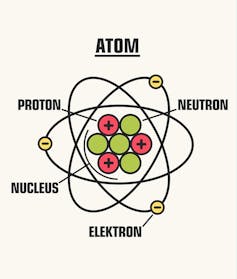 Labelled atom.
Shutterstock
An atom is the basic unit of matter. The nucleus of an atom is made of smaller particles called protons and neutrons. Other atomic particles called electrons surround the nucleus.
Elements are the simplest chemical substances and consist of atoms that all have the same number of protons.
In the 1930s, scientists showed that nuclear energy could be released from an atom, either by splitting the nucleus (fission) or fusing two smaller atoms to form a larger one (fusion).
As the second world war erupted, intense research focused on how to artificially induce nuclear fission by firing a free neutron into an atom of radioactive uranium or plutonium. Through their efforts, scientists found a way to induce a chain reaction within a bomb that would generate an unprecedented amount of energy.
A quick explainer on nuclear fission.The impact of the bombs
An atomic bomb causes massive destruction through intense heat, pressure, radiation and radioactive fallout. At the hypocentre (centre of the blast), the heat is so intense, it vaporises people and buildings.
Between 60,000-80,000 people were killed instantly when the bomb detonated over Hiroshima and an estimated 140,000 died from acute effects of the bomb before the end of the year. The death toll increased to over 200,000 people in subsequent decades, as people died from cancers and other diseases linked to radiation poisoning.
Warning: the video below includes graphic imagery
Cartoon depicting the horrors of the Hiroshima bombing on the city’s residents.In addition to the human toll, almost 63% of Hiroshima’s buildings were destroyed and a further 29% damaged by the bomb. The Genbaku (Atomic Bomb) Dome was the only building left standing near the hypocentre. Today, it is preserved at the Peace Memorial Park and the city has been rebuilt around it.
The total death toll in Nagasaki was lower in comparison, as parts of the city were shielded by mountains. Still, at least 75,000 people died there in total.
Nagasaki receives less attention in analysis of the bombings, despite being the last place a nuclear weapon was used in warfare. Hibakusha - the Japanese term for explosion-affected people - continue to campaign for Nagasaki to retain its sad distinction.
Why did the US use the bomb?
Few historical questions are subject to such enduring controversy as this one. It is impossible to properly address the competing perspectives in this article. I recommend this episode of the History of Japan podcast by historian Isaac Meyer for an airing of the conflicting arguments for and against the use of the bombs.
Briefly, “traditionalist” accounts of the bombings have argued that the bombs were necessary to force Japan’s surrender. They also claim that a land invasion of Japan by US and Soviet forces would have taken many more lives than the bombs did.
Read more: World politics explainer: The Great War (WWI)
Some have noted that the fire-bombing of Tokyo and other Japanese cities during the war also inflicted devastating casualties. Questions of moral distinction between atomic and other types of bombings have therefore been raised.
In contrast, “revisionist” accounts have claimed that Japan’s surrender could have been secured if the US had guaranteed that Emperor Hirohito would be allowed to remain on the throne. They suggest Japan was more compelled to surrender by the Soviet invasion of Manchuria in the same week of August 1945 than by the atomic bombings.
Perhaps, some revisionists argue, the US actually wanted to prove its superior military capacity to the Soviet Union and was determined to use the atomic bombs for that purpose.
Either way, the wartime alliance between the US and USSR soon dissolved into intense rivalry, which continues to influence global relations seven decades on.
Early in the 21st century, historian John Clare exposed this key enduring legacy of the bombings:
When I first started teaching, we just taught that the atomic bomb brought the war to an end. Only recently have we come to appreciate that the last shot of the second world war was also the opening scene of the cold war – that the bomb was a cause as much as a conclusion.
Memorialising the impacts of the atomic bombings
In June, I visited the Hiroshima Peace Memorial Museum. It was an overwhelming and emotional experience, not least because the park and museum were filled with Japanese schoolchildren paying respect to the dead and learning about the consequences of nuclear warfare.
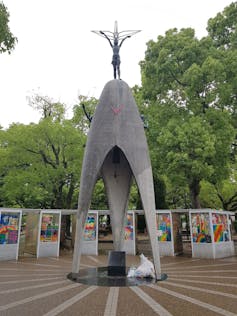 Children’s peace memorial, Hiroshima.
Amy Maguire, Author provided
The film, The Twinkling Stars Know Everything, is showing throughout 2018 in a memorial hall at the park. It shows a collection of memoirs by parents of junior high school students killed by the bomb.
The Peace Memorial Museum reveals the scale of instant destruction as the bomb detonated. The museum also traces, through a series of confronting exhibits, the pain and terror of those who died slowly from horrific burns and the effects of radiation. Visitors learn about the lingering impacts of radiation exposure on victims and their descendants, including pregnancy loss, birth defects and untold psychological damage.
Read more: Ban the bomb: 70 years on, the nuclear threat looms as large as ever
The most famous child victim, Sadako Sasaki, was two years old when the bomb fell in Hiroshima. She was apparently uninjured by the blast, but was exposed to toxic “black rain” as she fled the city with her family. Nine years later, Sadako developed radiation-induced leukaemia and died soon after at the age of 12. She had famously folded more than 1,000 paper cranes in the hope of recovery.
I saw schoolchildren honouring Sadako and all the lost children at the Children’s Peace Memorial. Each day, thousands more paper cranes are delivered to honour their memory and as a call for peace.
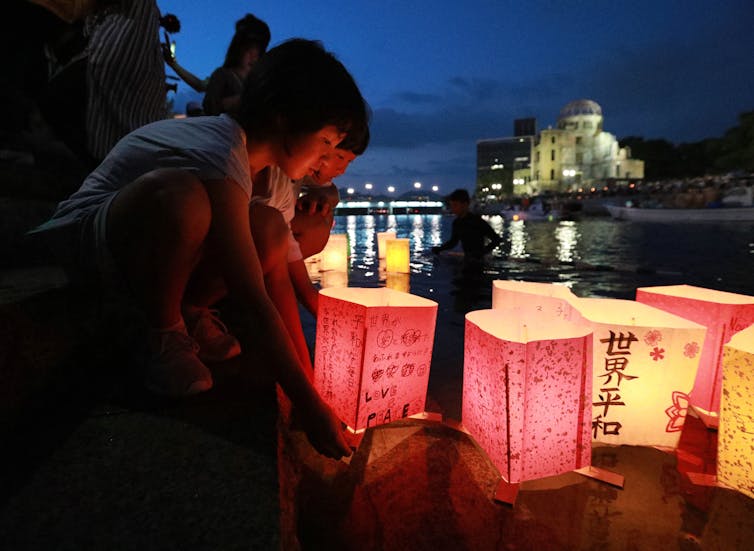 A young girl floats a paper lantern to remember the victims of the Hiroshima bombing on the anniversary last month.
Jiji Press/EPA
Contemporary relevance: the agenda of denuclearisation
The Peace Memorial Museum, and Mayors for Peace project, share the dual aims of informing people about the impacts of nuclear warfare and calling for denuclearisation.
Nuclear weapons are depicted as so inhumane as to justify global prohibition of their production, retention or use. Any future nuclear warfare is predicted to have far more severe humanitarian and environmental consequences than the 1945 strikes on Japan.
Denuclearisation advocacy has also been taken up globally in recent years. In 2017, the Nobel Peace Prize was awarded to ICAN - the International Campaign to Abolish Nuclear Weapons – which successfully lobbied the UN General Assembly to hold a conference to negotiate a treaty banning nuclear weapons.
The text of the Treaty on the Prohibition of Nuclear Weapons was adopted by 122 states in 2017. States that wish to become parties to the treaty must commit to the total elimination of nuclear weapons. As of today, 60 states have signed the treaty, and of those, 13 have ratified it. Thirty-seven more ratifications are needed to make the treaty binding.
However, none of the nine nuclear powers (United States, Russia, United Kingdom, France, China, India, Pakistan, Israel and North Korea) support the ban.
Australia’s refusal to endorse the ban is tied to this political reality. It is one of 30 “nuclear-weapon-endorsing-states” who rely on the nuclear “protection” of allies. The government argues for a “building blocks” approach instead, favouring incremental steps towards nuclear disarmament.
Read more: Australia must sign the prohibition on nuclear weapons: here's why
However, the global nuclear weapons stockpile still stands at over 14,000 warheads, despite decades of disarmament efforts. 92% of these weapons are held by the US and Russia. The people of Japan, very recently, have had legitimate cause to fear the nuclear threat posed by North Korea.
The cities of Hiroshima and Nagasaki continue to work hard to ensure that the consequences of the atomic bombings are not lost to history. The Peace Memorial Museum reminds all who visit of the devastation that nuclear weapons could unleash if used again. Our shared humanity demands a denuclearised future.
Authors: Amy Maguire, Senior Lecturer in International Law and Human Rights, University of Newcastle