

new evidence pushes back the timing of human arrival in Southeast Asia
- Written by: Kira Westaway, Associate Professor, School of Natural Sciences, Macquarie University

In 2009, when our team first found a human skull and jaw bone in Tam Pà Ling Cave in northern Laos, some were sceptical of its origin and true age.
When we published a timeline in 2012 for the arrival of modern humans in mainland Asia around 46,000 years ago based on the Tam Pà Ling evidence, the sceptics remained.
In short, the site was given a bad rap. One of the most interesting caves in mainland Southeast Asia was frequently overlooked as a possible route on the accepted path of human dispersal in the region.
However, in new research published today in Nature Communications, we report more human remains found in Tam Pà Ling – and a more detailed and robust timeline for the site. This shows humans reached the region at least 68,000 years ago, and possibly as long as 86,000 years ago.
Plenty of evidence, but hard to date
Our team of Laotian, French, US and Australian researchers has been excavating at Tam Pà Ling for many years. You can see a detailed, interactive 3D scan of the site here.
As we dug, we found more and more evidence of Homo sapiens at earlier and earlier times.
First there was a finger bone, then roughly 2.5 metres deeper, a chin bone, then part of a rib. In total, eight pieces were found in only 4.5 metres of sediment – which may not sound like a lot, but is huge in archaeological terms.
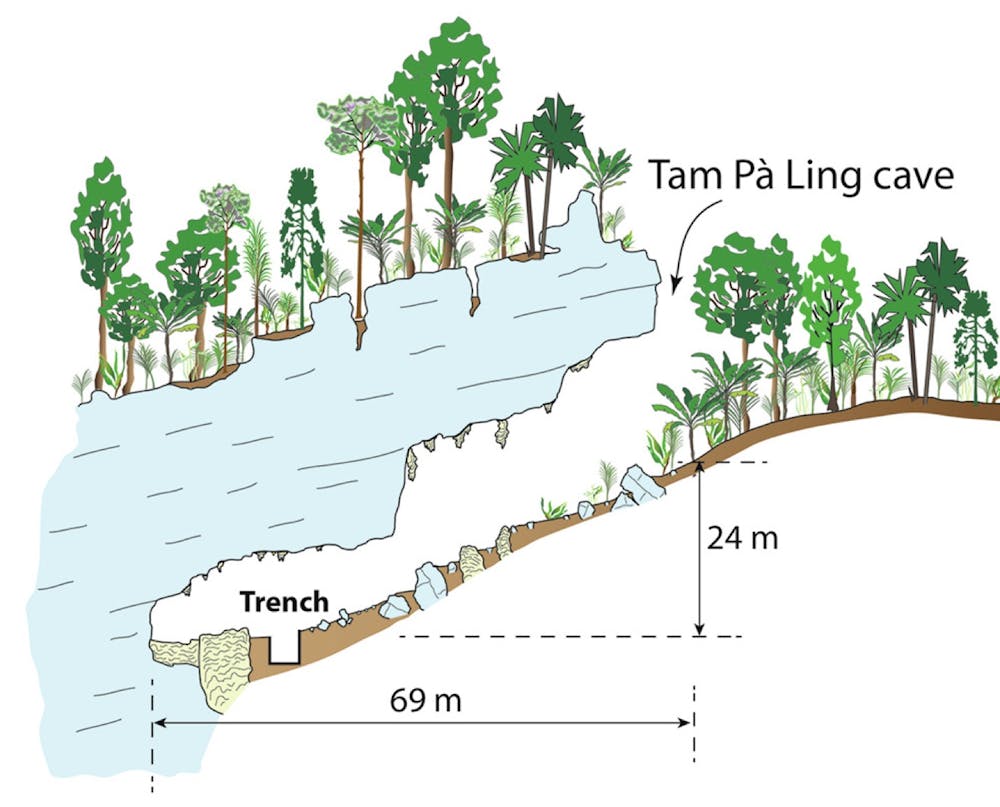
Surely, we thought, this would be enough for Tam Pà Ling to take its place among the early human arrival sites in Southeast Asia.
But a hurdle remained: the cave is hard to date. This has prevented its significance being recognised, and without a convincing timeline the cave’s evidence will not be included in the debate over early human movements.
Many common dating methods can’t be used
There are a few difficulties with dating Tam Pà Ling.
First, the human fossils cannot be directly dated as the site is a world heritage area and the fossils are protected by Laotian laws.
Second, there are very few animal bones and no suitable cave decorations, either of which might be used for dating.
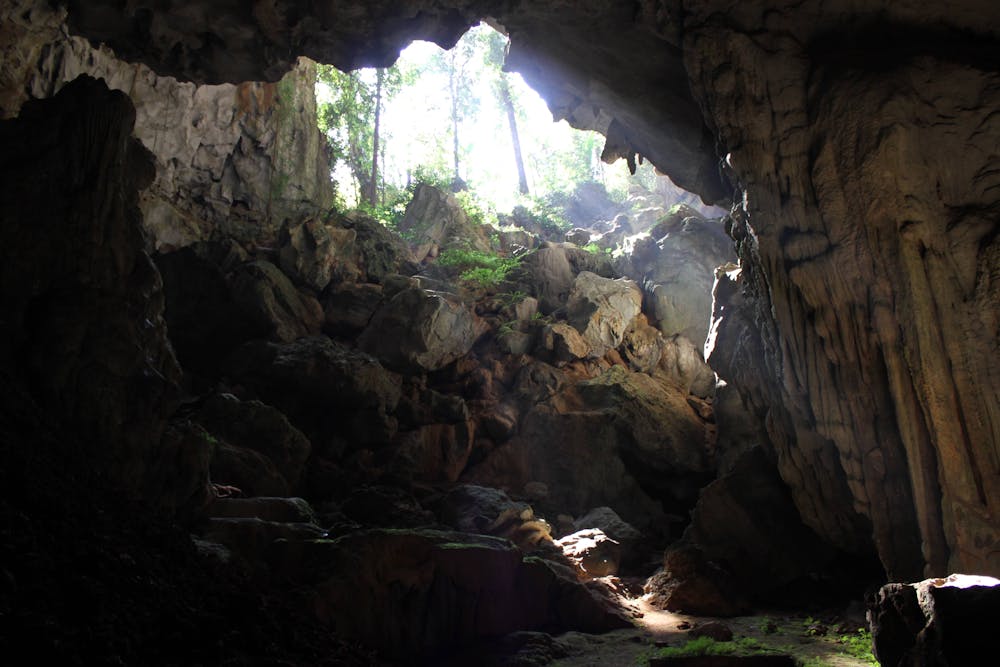 The wide, steep entrance to Tam Pà Ling channelled sediments and fossils into the cave over a long time period.
Kira Westaway
The wide, steep entrance to Tam Pà Ling channelled sediments and fossils into the cave over a long time period.
Kira Westaway
And third, the entrance of the site is wide and steep. This means any charcoal found in the cave, which is useful for dating, may well have come from outside – so it has little relation to the age of the sediment inside.
This means the backbone of the timeline must be established by the dating of the sediment itself, using techniques such as luminescence dating.
Signals in buried minerals
Luminescence dating relies on a light-sensitive signal that builds up in buried sediment, resetting to zero when it is exposed to light.
This technique mainly uses two minerals: quartz and feldspar.
Quartz can only be used in the younger levels as it is limited by how much signal it can hold. In the deeper layers it can often underestimate the age, so in Tam Pà Ling we only used quartz to date the top three metres of the sediment.
For the lower levels (four to seven metres), we had to switch to dating using feldspar to fill in the gap in the age profile. Below six metres the feldspar grains started to weather and we had to resort to fine-grain dating, using tiny mineral grains all mixed together.
Dating teeth
Tam Pà Ling is relatively poor in animal evidence. Yet, eventually two teeth from a cow-like animal were unearthed at 6.5 metres deep that could be dated using two distinct techniques.
Uranium series dating works by measuring uranium, and the elements into which it transforms via radioactive decay, within the tooth. Electron spin resonance dating relies on measuring the number of electrons in tooth enamel.
Read more: Old teeth from a rediscovered cave show humans were in Indonesia more than 63,000 years ago
Each technique offers an individual numerical age for the fossil. By combining the two, we obtained robust direct dates, which can complement the luminescence chronology.
A closer look at sediment
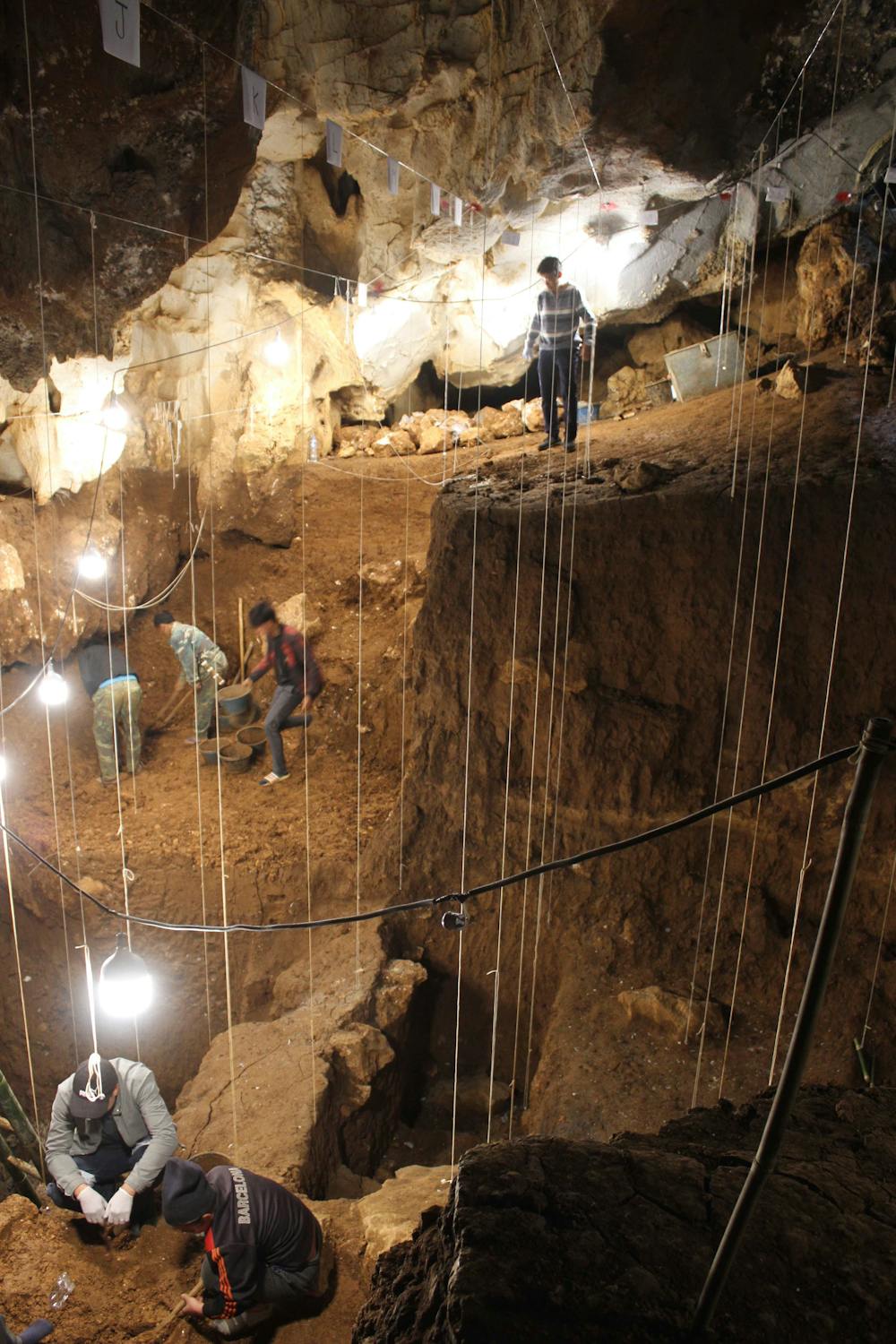 Archaeologists have returned to Tam Pà Ling regularly, steadily accumulating more evidence from a deep 7 m excavation.
Kira Westaway
Archaeologists have returned to Tam Pà Ling regularly, steadily accumulating more evidence from a deep 7 m excavation.
Kira Westaway
To make the dating as strong as possible, we used every technique we could, such as applying uranium series dating to a stalactite tip that had been buried in sediment.
We also began to support all our dating evidence with a very detailed analysis of the sediments to assess the origin of the fossils.
Micromorphology is a technique that examines sediments under a microscope to establish the integrity of the layers that buried the fossils.
This is a key component of the new chronology, as it helped establish that there was a fairly consistent accumulation of sediment layers over a long period.
By 2022, we had amassed an array of dating evidence that could be modelled to determine the exact age of each layer and the fossils they buried.
A stop on the route of human dispersal
Our updated chronology revealed humans were present in the vicinity of Tam Pà Ling Cave for roughly 56,000 years. It also confirmed that, far from reflecting a rapid dump of sediments, the site contains sediments that accumulated steadily over some 86,000 years.
The age of the lowest fossil, a fragment of a leg bone found seven metres deep, suggests modern humans arrived in this region between 86,000 and 68,000 years ago.
The evidence from Tam Pà Ling has pushed back the timing of Homo sapiens arrival in Southeast Asia. This suggests the mainland, along with the coastal and island locations, may have also been a viable dispersal route.
Read more: A fossil tooth places enigmatic ancient humans in Southeast Asia
Tam Pà Ling is just a stone’s throw from Cobra Cave, where we found a tooth some 150,000 years old belonging to a Denisovan, the now-extinct human relatives otherwise known only from remains found in Siberia and Tibet. This suggests the site may lie on a previously used dispersal route among hominins.
Tam Pà Ling continues to reveal pieces of the puzzle of the ancient human journey across the world. Only time will tell how many more it has in store.
Authors: Kira Westaway, Associate Professor, School of Natural Sciences, Macquarie University


















