

Scientists have created synthetic human embryos. Now we must consider the ethical and moral quandaries
- Written by: Kathryn MacKay, Senior Lecturer in Bioethics, University of Sydney
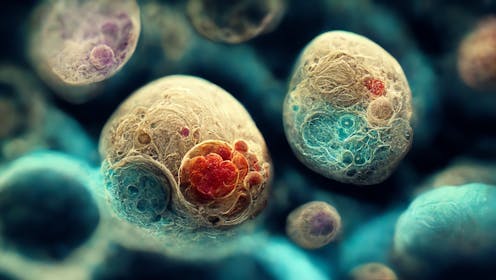
Researchers have created synthetic human embryos using stem cells, according to media reports. Remarkably, these embryos have reportedly been created from embryonic stem cells, meaning they do not require sperm and ova.
This development, widely described as a breakthrough that could help scientists learn more about human development and genetic disorders, was revealed this week in Boston at the annual meeting of the International Society for Stem Cell Research.
The research, announced by Professor Magdalena Żernicka-Goetz of the University of Cambridge and the California Institute of Technology, has not yet been published in a peer-reviewed journal. But Żernicka-Goetz told the meeting these human-like embryos had been made by reprogramming human embryonic stem cells.
So what does all this mean for science, and what ethical issues does it present?
Read more: World's first 'synthetic embryo': why this research is more important than you think
What did the researchers do?
Each of these synthetic human embryos is created from a single stem cell. Żernicka-Goetz described how her team grew the synthetic embryos to a stage of development called “gastriculation”, which is a stage just beyond the 14-day developmental mark for a human embryo.
The current legal limit to how long a human embryo can be permitted to develop in a lab is 14 days.
This is approximately the length of time from fertilisation of the egg to implantation in the uterine wall, if conception has taken place within a human womb.
So, synthetic embryos have – for the first time – been allowed to develop past this point.
Initially, the 14-day rule was both a moral and a practical limit; scientists didn’t have the technology to keep embryos alive longer than this.
But the International Society for Stem Cell Research’s 2016 guidelines also suggested the 14-day limit was morally appropriate, as past this point the cells within the embryo begin to differentiate to form important body systems like the gut, brain and lungs.
The International Society for Stem Cell Research’s updated 2021 guidelines now say we should reconsider the 14-day rule, via public debate, to perhaps allow research on embryos later into development in some cases.
From what has been reported about Żernicka-Goetz and her team’s research, the creation of synthetic human-like embryos is a significant advance.
It’s further remarkable they seem to behave, in terms of development, like a human embryo would in some ways.
Żernicka-Goetz reported the human-like embryos began to develop placenta and yolk sacs, but not a beating heart or the beginning of a brain.
Despite the role of the placenta in pregnancy, and its importance to the health of mother and fetus, we know surprisingly little about this vital but temporary organ.
If it was possible to observe placenta in a lab via these synthetic embryos, this could yield valuable knowledge.
Moral quandaries
However, just as there are real possibilities for gaining knowledge from synthetic human-like embryos, there are also real moral quandaries.
One of these quandaries arises around whether their creation really gets us away from the use of human embryos.
Robin Lovell-Badge, the head of stem cell biology and developmental genetics at the Francis Crick Institute in London UK, reportedly said that if these human-like embryos can really model human development in the early stages of pregnancy, then we will not have to use human embryos for research.
At the moment, it is unclear if this is the case for two reasons.
First, the embryos were created from human embryonic stem cells, so it seems they do still need human embryos for their creation. Perhaps more light will be shed on this when Żernicka-Goetz’s research is published.
Second, there are questions about the extent to which these human-like embryos really can model human development.
At the moment, animal models of similar synthetic embryos suggest they are not capable of developing into a full living being. Studies in mice and monkeys have so far shown that the synthetic embryos die a short while after being implanted into a female’s womb, which means they are not viable.
There could be significant limits to the usefulness of these synthetic embryos for learning about human developmental issues, if human-like synthetic embryos aren’t capable of developing into full human babies and do not form important body structures like a beating heart and a brain.
One of the reasons researchers want to use these embryos is for research into miscarriage and developmental anomalies. This is very important, but will these synthetic embryos be “close enough” to real human embryos to reveal useful answers?
Scientists may still rely on the use of human embryos if we do need human embryos for the creation of these models, or there are research questions that these synthetic embryos can’t address.
Is it morally permissable?
This leaves us with the important moral question about whether it is permissible to use human embryos for research.
Further, if the human-like synthetic embryos are capable of developing into full living beings, then we must consider whether it is morally permissible to create them just for research.
It could be that they are not currently capable of developing much further than the 14-day mark.
Scientists might decide that this is a problem that needs to be fixed, partly for practical reasons about the limits to their usefulness. Scientists might then fix these synthetic embryos so that they could continue to develop. However, this would create a huge moral quandary.
We should think carefully about whether it is ethical to create living human-like beings only to conduct research on them.
Read more: Researchers have grown 'human embryos' from skin cells. What does that mean, and is it ethical?
Authors: Kathryn MacKay, Senior Lecturer in Bioethics, University of Sydney


















