

English philosophers thought they had sloughed off the dead weight of history, but history suggests otherwise
- Written by: Andrew Milne, Lecturer in Philosophy, The University of Western Australia
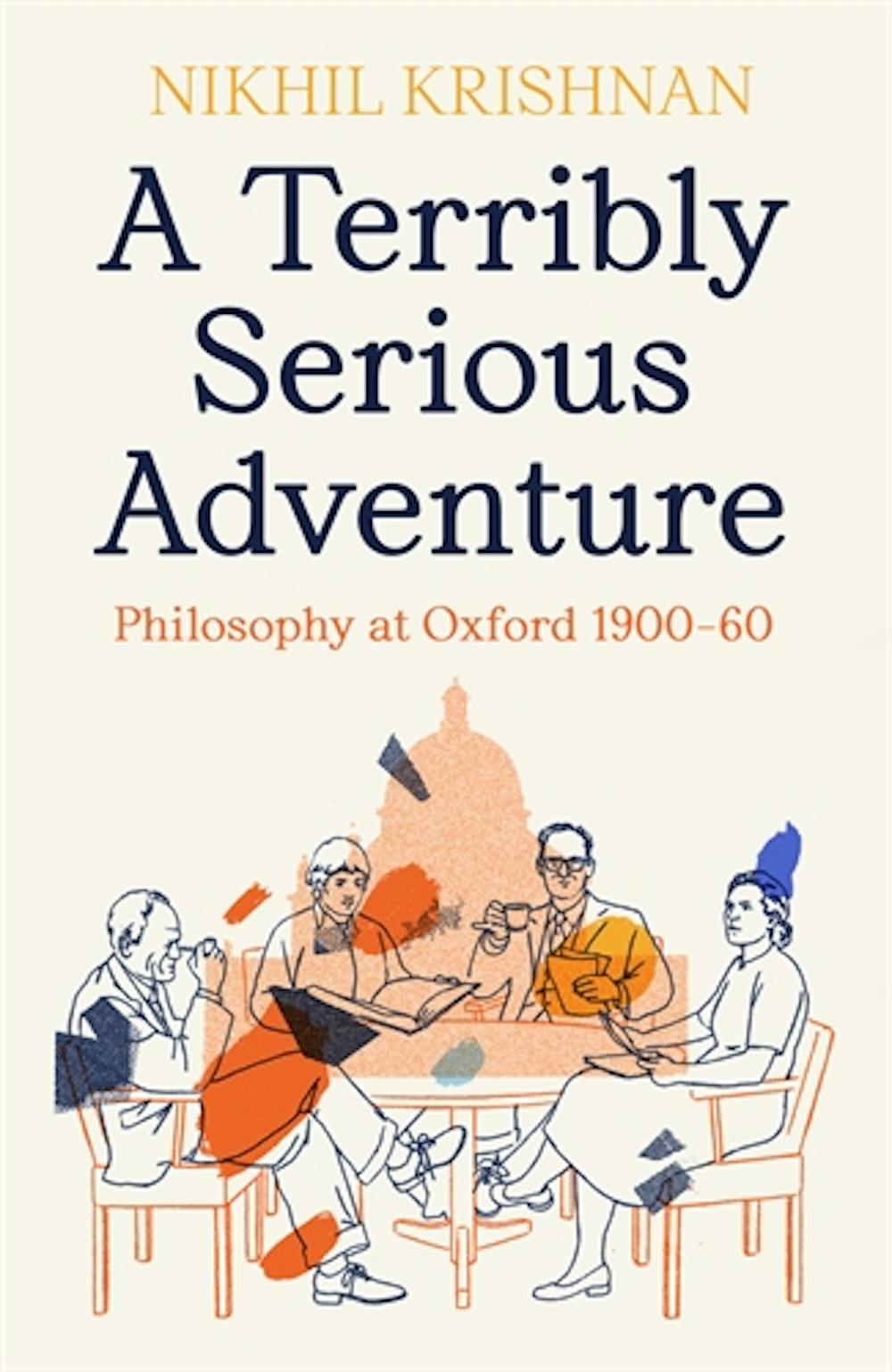
Nikhil Krishnan’s intriguing and charming history, A Terribly Serious Adventure: Philosophy at Oxford 1900-60, is organised around anecdotes rather than arguments. Krishnan is interested not only in “what people thought but what they were like”.
The two questions are not as separate as many assume: a penetrating portrait of a philosopher can do much to illuminate their thought.
Review: A Terribly Serious Adventure: Philosophy at Oxford 1900-60 – Nikhil Krishnan (Profile Books)
The range of thinkers surveyed is quite broad. Krishnan’s history includes R.G. Collingwood, Gilbert Ryle, Isaiah Berlin, A.J. “Freddie” Ayer, J.L. Austin, Elizabeth Anscombe, Iris Murdoch, Peter Strawson and Bernard Williams. The portraits are for the most part sympathetically drawn, though naturally some of these philosophers have captured Krishnan more than others, Ryle and Austin especially.
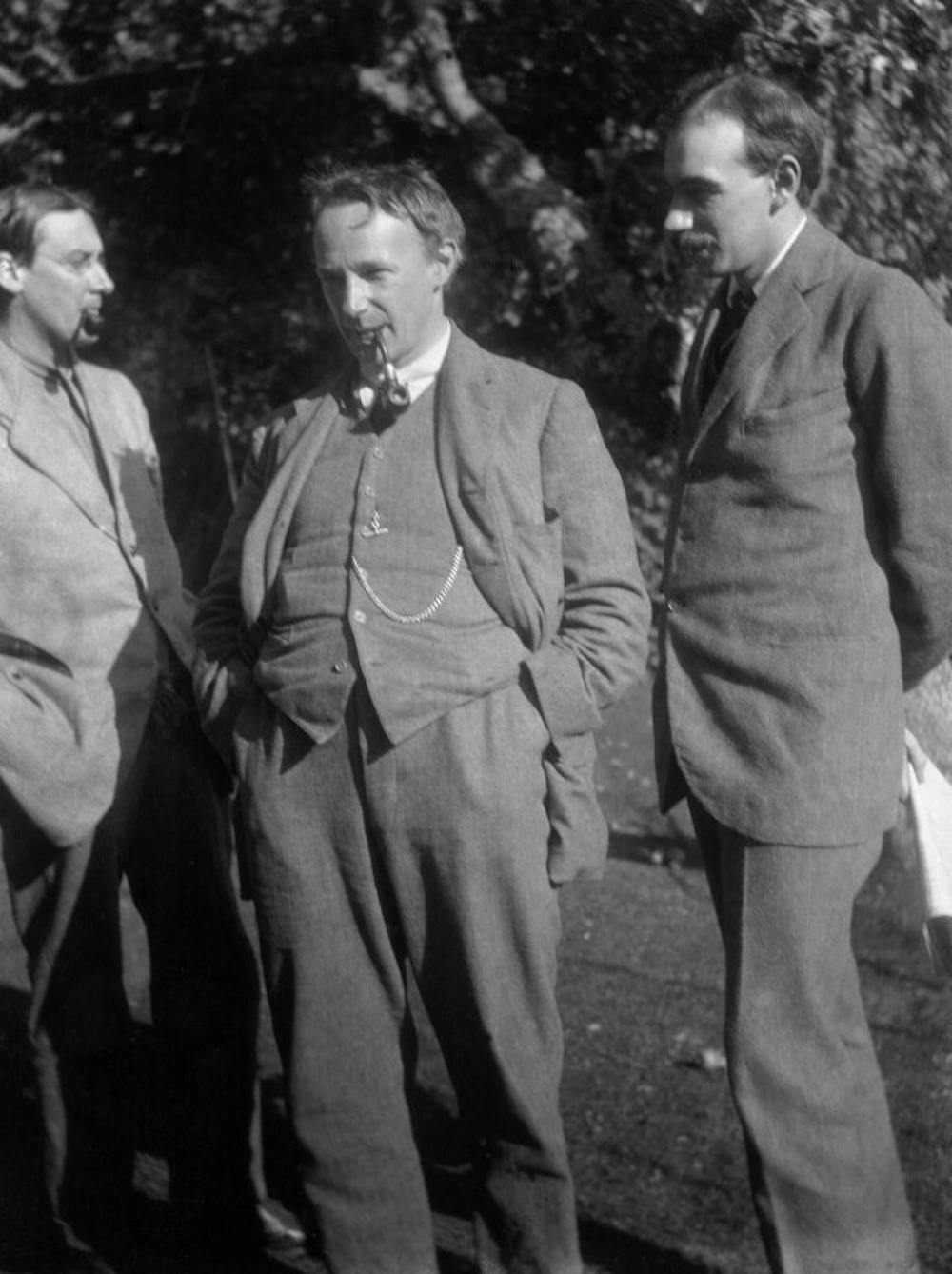 Lytton Strachey’s brother Oliver, G.E. Moore and J.M. Keynes (1914).
Some of those at Cambridge, like Maynard Keynes, spoke of the conversion in religious terms. But Moore’s new method was embraced not as a re-conditioning, but a de-conditioning. Converts thought they were now unencumbered by any particular way of seeing. In the words of Leonard Woolf, Moore had “suddenly removed from our eyes an obscuring accumulation of scales, cobwebs, and curtains, revealing for the first time to us, so it seemed, the nature of truth and reality”.
This desire to strip back the encrustation of traditional assumptions and reach bare nature is a recurring theme in philosophical history. The two best known examples are Socrates and Descartes. Moore’s followers thought he had finally pulled off this coup. Lytton Strachey wrote to Moore of his book Principia Ethica (1903):
It has not only wrecked and shattered all writers on ethics from Aristotle and Christ to Herbert Spencer and Mr. Bradley, it has not only laid the true foundation of Ethics, it has not only left all Modern Philosophy bafouée – these seem to me small achievements compared to the establishment of that Method which shines like a sword between the lines […] The truth, there can be no doubt, is really now upon the march. I date from October 1903 the beginning of the Age of Reason.
What was that method? In short, it was a matter of avoiding muddles. According to Woolf, all Moore demanded of his followers was “to make quite certain that we knew what we meant when we made a statement”.
This emphasis on explicitness and precision were, and remain, two defining traits of analytic philosophy.
Read more:
Hegel is considered the hardest philosopher, but his views aren’t actually that outlandish
Plain common sense
Woolf wrote that while McTaggart “seemed to have entirely left the earth for the inextricably complicated cobwebs and O altitudos of Hegelianism”, Moore had his feet firmly planted on the ground and spoke with the “divine voice of plain common-sense”.
The intellectual sobriety, the return from the spiritual heights, was admired as a gritty, secure way forward. Under Moore’s influence, Cambridge philosophy became deeply suspicious of anything loose and lofty; its task was to proceed at a testudineous pace on solid ground. Though it took some time to spread, this sensibility would eventually breach the “dreaming spires” of Oxford.
J.L. Austin, who is given the most space of any thinker in Krishnan’s history, declared “Moore’s my man”. His work refined and extended Moore’s project.
Lytton Strachey’s brother Oliver, G.E. Moore and J.M. Keynes (1914).
Some of those at Cambridge, like Maynard Keynes, spoke of the conversion in religious terms. But Moore’s new method was embraced not as a re-conditioning, but a de-conditioning. Converts thought they were now unencumbered by any particular way of seeing. In the words of Leonard Woolf, Moore had “suddenly removed from our eyes an obscuring accumulation of scales, cobwebs, and curtains, revealing for the first time to us, so it seemed, the nature of truth and reality”.
This desire to strip back the encrustation of traditional assumptions and reach bare nature is a recurring theme in philosophical history. The two best known examples are Socrates and Descartes. Moore’s followers thought he had finally pulled off this coup. Lytton Strachey wrote to Moore of his book Principia Ethica (1903):
It has not only wrecked and shattered all writers on ethics from Aristotle and Christ to Herbert Spencer and Mr. Bradley, it has not only laid the true foundation of Ethics, it has not only left all Modern Philosophy bafouée – these seem to me small achievements compared to the establishment of that Method which shines like a sword between the lines […] The truth, there can be no doubt, is really now upon the march. I date from October 1903 the beginning of the Age of Reason.
What was that method? In short, it was a matter of avoiding muddles. According to Woolf, all Moore demanded of his followers was “to make quite certain that we knew what we meant when we made a statement”.
This emphasis on explicitness and precision were, and remain, two defining traits of analytic philosophy.
Read more:
Hegel is considered the hardest philosopher, but his views aren’t actually that outlandish
Plain common sense
Woolf wrote that while McTaggart “seemed to have entirely left the earth for the inextricably complicated cobwebs and O altitudos of Hegelianism”, Moore had his feet firmly planted on the ground and spoke with the “divine voice of plain common-sense”.
The intellectual sobriety, the return from the spiritual heights, was admired as a gritty, secure way forward. Under Moore’s influence, Cambridge philosophy became deeply suspicious of anything loose and lofty; its task was to proceed at a testudineous pace on solid ground. Though it took some time to spread, this sensibility would eventually breach the “dreaming spires” of Oxford.
J.L. Austin, who is given the most space of any thinker in Krishnan’s history, declared “Moore’s my man”. His work refined and extended Moore’s project.
 Oxford philosopher J.L. Austin (1911-1960).
Wikimedia Commons
Rather than deferring to common sense, Austin directs our attention to common language. In particular, he argued that we should distrust distinctions dreamed up by philosophers and instead pay attention to our “common stock of words”. He thought that while ordinary language was not an infallible guide to reality, it was much more likely to be truth-tracking than the jargon of academics.
Moore’s influence was exerted through his personal example, but also through his editorship of the premier philosophy journal Mind. When Oxford philosophers created the journal Analysis, it was modelled on Mind, only with a focus on even tighter, more honed papers. A paradigmatic Analysis essay is Edmund Gettier’s Is Justified True Belief Knowledge? (1963), which claims to debunk a long-held analysis of the concept of knowledge in just three pages.
Considering only those questions which admit precise formulation and clear answers requires setting aside many of the traditional humanistic concerns of philosophy. But Krishnan is keen to establish that this is not (or not merely) a shift to the scientistic. He argues that the rigour of this philosophical approach has a deeply edifying aspect.
Bringing people down to earth can be for their own good. It frees them from the seductions of apparent profundities, which lurk unquestioned behind a veil of ineffability. On Krishnan’s reading, the deflationary approach creates a kind of freedom within the constraint of careful, stepwise reasoning.
This is quite true, and Krishnan is right to emphasise it, given that “the fear of depth produced a culpable failure to appreciate what was deep in the Oxford tradition itself”. The apparent impersonality of analytic philosophy has concrete effects on its practitioners – here, too, philosophy is a way of life.
Many of the tradition’s major figures realised this. Austin, for example, wrote that “we are using a sharpened awareness of words to sharpen our perception of, though not as the final arbiter of, the phenomena”.
But the point was generally left unstated, and Krishnan’s view is that the analytical tradition has proved edifying precisely because it has not overtly tried to be.
Read more:
Sex, lies and Hegel: did the intimate lives of philosophers shape their ideas?
Accents of infallibility
There was also a less attractive side to the analytical tradition. To his credit, Krishnan attends to it in some detail.
Keynes, who had seen the Moorean revolution as “the beginning of a renaissance, the opening of a new heaven on a new earth”, wrote that its upshot was quite different. “In practice,” he observed, “victory was with those who could speak with the greatest appearance of clear, undoubting conviction and could best use the accents of infallibility.” He recalled Moore responding to remarks
with a gasp of incredulity – Do you really think that, an expression of face as if to hear such a thing said reduced him to a state of wonder verging on imbecility, with his mouth wide open and wagging his head in the negative so violently that his hair shook. Oh! He would say, goggling at you as if either you or he must be mad; and no reply was possible.
Austin, too, mastered the “accents of infallibility”. Stuart Hampshire observed that it was a feature of analytical philosophy that ideas should always be discussed in a way that was
very quiet and if possible ironical or at any rate unexcited and unrhetorical […] Austin carried this to an extreme. Even the most solemn questions, solemn in their associations, had to be disinfected by a very calm, committee man’s tone of voice.
This is a little misleading. Constraint of one’s emotional register is as much a part of classical rhetoric as giving it free rein. The ability to affect a “committee man’s tone of voice” is a rhetorical skill; it enables one to make others appear absurd for any show of pathos.
Austin’s mastery of his “calm and measured” voice was so acute, according to Krishnan, that he was able to wield it to similar effect as “the birch on the insubordinate young”. To chasten, to subdue, to silence were among the many things Austin knew how to do with words.
Oxford philosopher J.L. Austin (1911-1960).
Wikimedia Commons
Rather than deferring to common sense, Austin directs our attention to common language. In particular, he argued that we should distrust distinctions dreamed up by philosophers and instead pay attention to our “common stock of words”. He thought that while ordinary language was not an infallible guide to reality, it was much more likely to be truth-tracking than the jargon of academics.
Moore’s influence was exerted through his personal example, but also through his editorship of the premier philosophy journal Mind. When Oxford philosophers created the journal Analysis, it was modelled on Mind, only with a focus on even tighter, more honed papers. A paradigmatic Analysis essay is Edmund Gettier’s Is Justified True Belief Knowledge? (1963), which claims to debunk a long-held analysis of the concept of knowledge in just three pages.
Considering only those questions which admit precise formulation and clear answers requires setting aside many of the traditional humanistic concerns of philosophy. But Krishnan is keen to establish that this is not (or not merely) a shift to the scientistic. He argues that the rigour of this philosophical approach has a deeply edifying aspect.
Bringing people down to earth can be for their own good. It frees them from the seductions of apparent profundities, which lurk unquestioned behind a veil of ineffability. On Krishnan’s reading, the deflationary approach creates a kind of freedom within the constraint of careful, stepwise reasoning.
This is quite true, and Krishnan is right to emphasise it, given that “the fear of depth produced a culpable failure to appreciate what was deep in the Oxford tradition itself”. The apparent impersonality of analytic philosophy has concrete effects on its practitioners – here, too, philosophy is a way of life.
Many of the tradition’s major figures realised this. Austin, for example, wrote that “we are using a sharpened awareness of words to sharpen our perception of, though not as the final arbiter of, the phenomena”.
But the point was generally left unstated, and Krishnan’s view is that the analytical tradition has proved edifying precisely because it has not overtly tried to be.
Read more:
Sex, lies and Hegel: did the intimate lives of philosophers shape their ideas?
Accents of infallibility
There was also a less attractive side to the analytical tradition. To his credit, Krishnan attends to it in some detail.
Keynes, who had seen the Moorean revolution as “the beginning of a renaissance, the opening of a new heaven on a new earth”, wrote that its upshot was quite different. “In practice,” he observed, “victory was with those who could speak with the greatest appearance of clear, undoubting conviction and could best use the accents of infallibility.” He recalled Moore responding to remarks
with a gasp of incredulity – Do you really think that, an expression of face as if to hear such a thing said reduced him to a state of wonder verging on imbecility, with his mouth wide open and wagging his head in the negative so violently that his hair shook. Oh! He would say, goggling at you as if either you or he must be mad; and no reply was possible.
Austin, too, mastered the “accents of infallibility”. Stuart Hampshire observed that it was a feature of analytical philosophy that ideas should always be discussed in a way that was
very quiet and if possible ironical or at any rate unexcited and unrhetorical […] Austin carried this to an extreme. Even the most solemn questions, solemn in their associations, had to be disinfected by a very calm, committee man’s tone of voice.
This is a little misleading. Constraint of one’s emotional register is as much a part of classical rhetoric as giving it free rein. The ability to affect a “committee man’s tone of voice” is a rhetorical skill; it enables one to make others appear absurd for any show of pathos.
Austin’s mastery of his “calm and measured” voice was so acute, according to Krishnan, that he was able to wield it to similar effect as “the birch on the insubordinate young”. To chasten, to subdue, to silence were among the many things Austin knew how to do with words.
 The Austinian superego
Austin’s need to dominate and win arguments conflicted with his ostensibly anti-authoritarian philosophical project. Krishnan writes of the “absence of adversarialism” in Austin’s Saturday-morning discussion group. But he also makes it clear that this was only so long as everyone agreed with Austin.
Invitations were handed out to those of “relative youth and juniority (professors were pointedly not invited)”. Krishnan presents this as liberating, but it could equally have been to preserve Austin’s dominance. One participant said of these Saturday meetings that “it was always just a little as if the headmaster were present”.
Austin could only admit he was wrong “once he had had the chance to sleep on it and could point it out himself, in his own way, without any concession that anyone else had got one over on him”.
To say that Austin “really should have been better at conceding a point” is a mild censure. His method of rule was that of the manager, rather than the magus or maestro. Krishnan never contrasts Austin’s philosophical views with Wittgenstein’s in any detail, but he does frequently contrast their manner of teaching. Whereas Austin had a “co-operative ideal of philosophy”, Wittgenstein created a “stifling atmosphere”, in which students acted as if they were in the presence of a “candidate for canonisation”. They learned to imitate the “accents of agony” of their “mage-like” master:
young men from across the oceans, born decades after he died, have been observed clutching their skulls in poses of agony, combing the vintage shops for open-necked shirts in just the right 1940s style, and cultivating the slightest hint of a Viennese cadence.
No one, by contrast, has found much inspiration in Austin’s “liking for sound preparation and [his] disapproval of sloppy work and lazy efforts”.
This is a little facile, and contradicted by Krishnan’s claim that “an entire generation of philosophers spoke in [Austin’s] voice”. His discussion of Austin is far from hagiography, but it does elide an issue that is both deep and of enduring relevance.
Read more:
Wittgenstein tried to solve all the problems of philosophy in his Tractatus Logico-Philosophicus – but he didn't quite succeed
Bernard Williams observed that Austin’s “terrible voice” was internalised by those around him. Krishnan alludes to this when he says that the Oxford philosophers’ “intellectual consciences” came to speak in Austin’s voice, but he does not take up Williams’ (I think profound) criticism here. Williams claimed that this “Austinian superego” – and in particular its mania for precision – has “killed more philosophical talents at this university than you’ve had hot dinners”. People birched themselves with Austin’s voice.
Williams’ point is that there are legitimate ways of doing philosophy that are silenced by a voice that always demands “what precisely do you mean by that?” For many, the practical upshot was that “the pen fell flaccidly from [their] hand and nothing was created”.
Williams was discussing his close friend Isaiah Berlin. He argued that Berlin’s decision to quit philosophy in favour of the history of ideas was the result of Austin’s influence. Berlin claimed he was convinced by Henry Sheffer that the only areas of philosophy capable of progress were logic and psychology. According to Williams, it was really because Berlin was, like others, “unduly terrorised by Austin”.
Krishnan touches on this, saying that the reason Berlin “left philosophy” was that he “was never entirely at home in the sorts of things Oxford philosophy was increasingly about”. In truth, Berlin left neither Oxford nor philosophy. He kept doing what he had long been doing; he just stopped calling it “philosophy”. It was the conception of what counted as philosophy that had narrowed.
The Austinian superego
Austin’s need to dominate and win arguments conflicted with his ostensibly anti-authoritarian philosophical project. Krishnan writes of the “absence of adversarialism” in Austin’s Saturday-morning discussion group. But he also makes it clear that this was only so long as everyone agreed with Austin.
Invitations were handed out to those of “relative youth and juniority (professors were pointedly not invited)”. Krishnan presents this as liberating, but it could equally have been to preserve Austin’s dominance. One participant said of these Saturday meetings that “it was always just a little as if the headmaster were present”.
Austin could only admit he was wrong “once he had had the chance to sleep on it and could point it out himself, in his own way, without any concession that anyone else had got one over on him”.
To say that Austin “really should have been better at conceding a point” is a mild censure. His method of rule was that of the manager, rather than the magus or maestro. Krishnan never contrasts Austin’s philosophical views with Wittgenstein’s in any detail, but he does frequently contrast their manner of teaching. Whereas Austin had a “co-operative ideal of philosophy”, Wittgenstein created a “stifling atmosphere”, in which students acted as if they were in the presence of a “candidate for canonisation”. They learned to imitate the “accents of agony” of their “mage-like” master:
young men from across the oceans, born decades after he died, have been observed clutching their skulls in poses of agony, combing the vintage shops for open-necked shirts in just the right 1940s style, and cultivating the slightest hint of a Viennese cadence.
No one, by contrast, has found much inspiration in Austin’s “liking for sound preparation and [his] disapproval of sloppy work and lazy efforts”.
This is a little facile, and contradicted by Krishnan’s claim that “an entire generation of philosophers spoke in [Austin’s] voice”. His discussion of Austin is far from hagiography, but it does elide an issue that is both deep and of enduring relevance.
Read more:
Wittgenstein tried to solve all the problems of philosophy in his Tractatus Logico-Philosophicus – but he didn't quite succeed
Bernard Williams observed that Austin’s “terrible voice” was internalised by those around him. Krishnan alludes to this when he says that the Oxford philosophers’ “intellectual consciences” came to speak in Austin’s voice, but he does not take up Williams’ (I think profound) criticism here. Williams claimed that this “Austinian superego” – and in particular its mania for precision – has “killed more philosophical talents at this university than you’ve had hot dinners”. People birched themselves with Austin’s voice.
Williams’ point is that there are legitimate ways of doing philosophy that are silenced by a voice that always demands “what precisely do you mean by that?” For many, the practical upshot was that “the pen fell flaccidly from [their] hand and nothing was created”.
Williams was discussing his close friend Isaiah Berlin. He argued that Berlin’s decision to quit philosophy in favour of the history of ideas was the result of Austin’s influence. Berlin claimed he was convinced by Henry Sheffer that the only areas of philosophy capable of progress were logic and psychology. According to Williams, it was really because Berlin was, like others, “unduly terrorised by Austin”.
Krishnan touches on this, saying that the reason Berlin “left philosophy” was that he “was never entirely at home in the sorts of things Oxford philosophy was increasingly about”. In truth, Berlin left neither Oxford nor philosophy. He kept doing what he had long been doing; he just stopped calling it “philosophy”. It was the conception of what counted as philosophy that had narrowed.
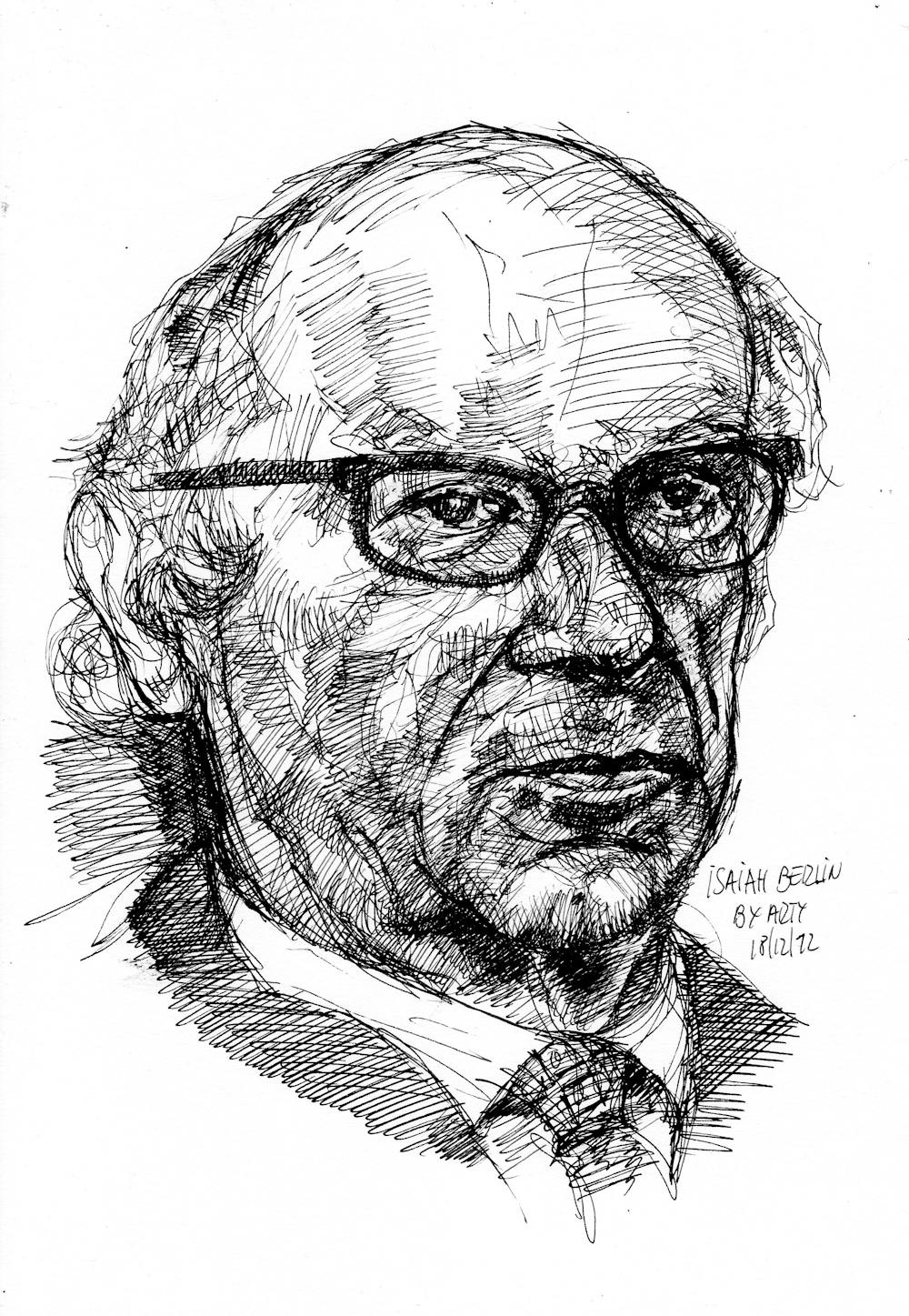 Isaiah Berlin.
Arturo Espinosa/Flikr, CC BY
Krishnan takes Berlin at his word, but fails to consider the internal evidence against it. Take, for instance, one of only two works by Berlin that Krishnan mentions: his famous essay Two Concepts of Liberty. Krishnan calls the essay “a masterpiece of Cold War rhetoric”, and summarily dismisses its central distinction between “postive” and “negative” liberty. More importantly, he overlooks that it is a piece of meta-philosophy.
At the outset, Berlin reproves philosophers who “neglect the field of political thought” because “its unstable subject-matter, with its blurred edges, is not to be caught by the fixed concepts, abstract models and fine instruments suitable to logic or to linguistic analysis”. He criticises the demand for “a unity of method in philosophy”, which leads people to “reject whatever the method cannot successfully manage”.
To look only at that which admits of precision is to court naivety about many phenomena which remain intractably vague.
Krishnan also overlooks that the essay praises the political thought of, among others, T.H. Green and F.H. Bradley – that is, the work of those apparently slain Idealist bogies of Oxford’s past.
The upshot of Berlin’s sense of incommensurable values is, as Krishnan says, that “not all good things come together”. Our habits of attention, our ways of looking, affect what we see. To look at things historically is to reveal a very different world than to look at them analytically. Berlin’s argument for pluralism is not merely in favour of liberal democracy, but liberal philosophy.
Williams argued that Austin worked in the manner he did “because that was what he was good at doing.” It was a matter of sensibility.
Berlin knew he did not have the constitution to be a “first-rate” analytic philosopher; he equally knew he was not a first-rate historian. He was far too little the careful scholar and pedant for the latter, and far too worldly for the former. He was also, in a sense, too unoriginal. As Krishnan puts it, Berlin was “dependent on the provocations of earlier writers to set his pen going”.
On this view, the “true philosopher” is one whose ideas are not born of historical understanding, however perspicuous that understanding might be. Yet the quality of Berlin’s thought is obvious, even if it is difficult to say exactly what he was first-rate at.
I am tempted to reach for Wittgenstein’s phrase “that kind of understanding which consists in ‘seeing connections’.” But no doubt that just won’t do.
Read more:
Tourists in our own reality: Susan Sontag's Photography at 50
A historical turn
All sensibilities have their limits. As Nietzsche put it, none of us can “look around our own corner”.
However broad his intellectual tastes, Berlin could not see much value in studying Nietzsche. Similarly, Krishnan struggles to see the philosophical appeal of Berlin – a thinker whose style of speech he describes as “allusive and incontinent”. Though he maintains an impartial tone throughout this book, Krishnan has shown his hand elsewhere, arguing that Berlin’s “sentences, for all their rhetorical virtues, left behind at most a mood”.
Krishnan is right when he says that how people react to a thinker “mark[s] a deep difference between temperaments”. But it is complacent to present the difference here as between those seduced by “rhetoric” and those unimpressed with the arguments.
Berlin belongs to (and influenced) a group of philosophers that includes Bernard Williams, Alasdair MacIntyre and Charles Taylor. Each member of this group was to some extent influenced by Collingwood, another Oxford thinker given short shrift by Krishnan.
Perhaps because Collingwood is presented as a throwback to the Oxford Idealist past, Krishnan fails to see that Collingwood has been instrumental to an increased awareness of the importance of history within analytical philosophy itself. Some have even claimed the tradition has undergone a “historical turn”.
I hope this is true, though the number of “turns” scholars have described of late make the tradition sound like a whirling dervish. From my own experience, a historical interest continues to be regarded by most professional philosophers as somewhere between a tolerably mild eccentricity and an unhealthy diversion.
Given the historical nature of Krishnan’s book, it is something of a surprise to find echoes of anti-historical sentiment:
There is no defense for ignorance and porcine insensitivity, except those things can be, unwittingly, agents of intellectual emancipation from the weight of tradition. It was perhaps a shame that Oxford undergraduates weren’t required to read [Plato, Aquinas, Spinoza, Pascal, Leibniz, Comte, Hegel, Schelling, Fichte, Schopenhauer, Marx, Nietzsche and Kierkegaard]. But how much of a shame it was depended on the value of what they were reading instead and, more generally, what they were doing other than reading.
There is a customary lauding of novelty here. The Oxford philosophers were doing something other than reading – that is, they were thinking, writing, talking. In other words, they were actually doing philosophy.
But to read well is to think. While tradition is certainly a weight, shirking it is not a virtue. It is not an obstacle but a precondition of originality. As Berlin’s bête noire George Steiner put it, “originality is antithetical to novelty”. That, at least, is how it appears from here.
Authors: Andrew Milne, Lecturer in Philosophy, The University of Western Australia
Isaiah Berlin.
Arturo Espinosa/Flikr, CC BY
Krishnan takes Berlin at his word, but fails to consider the internal evidence against it. Take, for instance, one of only two works by Berlin that Krishnan mentions: his famous essay Two Concepts of Liberty. Krishnan calls the essay “a masterpiece of Cold War rhetoric”, and summarily dismisses its central distinction between “postive” and “negative” liberty. More importantly, he overlooks that it is a piece of meta-philosophy.
At the outset, Berlin reproves philosophers who “neglect the field of political thought” because “its unstable subject-matter, with its blurred edges, is not to be caught by the fixed concepts, abstract models and fine instruments suitable to logic or to linguistic analysis”. He criticises the demand for “a unity of method in philosophy”, which leads people to “reject whatever the method cannot successfully manage”.
To look only at that which admits of precision is to court naivety about many phenomena which remain intractably vague.
Krishnan also overlooks that the essay praises the political thought of, among others, T.H. Green and F.H. Bradley – that is, the work of those apparently slain Idealist bogies of Oxford’s past.
The upshot of Berlin’s sense of incommensurable values is, as Krishnan says, that “not all good things come together”. Our habits of attention, our ways of looking, affect what we see. To look at things historically is to reveal a very different world than to look at them analytically. Berlin’s argument for pluralism is not merely in favour of liberal democracy, but liberal philosophy.
Williams argued that Austin worked in the manner he did “because that was what he was good at doing.” It was a matter of sensibility.
Berlin knew he did not have the constitution to be a “first-rate” analytic philosopher; he equally knew he was not a first-rate historian. He was far too little the careful scholar and pedant for the latter, and far too worldly for the former. He was also, in a sense, too unoriginal. As Krishnan puts it, Berlin was “dependent on the provocations of earlier writers to set his pen going”.
On this view, the “true philosopher” is one whose ideas are not born of historical understanding, however perspicuous that understanding might be. Yet the quality of Berlin’s thought is obvious, even if it is difficult to say exactly what he was first-rate at.
I am tempted to reach for Wittgenstein’s phrase “that kind of understanding which consists in ‘seeing connections’.” But no doubt that just won’t do.
Read more:
Tourists in our own reality: Susan Sontag's Photography at 50
A historical turn
All sensibilities have their limits. As Nietzsche put it, none of us can “look around our own corner”.
However broad his intellectual tastes, Berlin could not see much value in studying Nietzsche. Similarly, Krishnan struggles to see the philosophical appeal of Berlin – a thinker whose style of speech he describes as “allusive and incontinent”. Though he maintains an impartial tone throughout this book, Krishnan has shown his hand elsewhere, arguing that Berlin’s “sentences, for all their rhetorical virtues, left behind at most a mood”.
Krishnan is right when he says that how people react to a thinker “mark[s] a deep difference between temperaments”. But it is complacent to present the difference here as between those seduced by “rhetoric” and those unimpressed with the arguments.
Berlin belongs to (and influenced) a group of philosophers that includes Bernard Williams, Alasdair MacIntyre and Charles Taylor. Each member of this group was to some extent influenced by Collingwood, another Oxford thinker given short shrift by Krishnan.
Perhaps because Collingwood is presented as a throwback to the Oxford Idealist past, Krishnan fails to see that Collingwood has been instrumental to an increased awareness of the importance of history within analytical philosophy itself. Some have even claimed the tradition has undergone a “historical turn”.
I hope this is true, though the number of “turns” scholars have described of late make the tradition sound like a whirling dervish. From my own experience, a historical interest continues to be regarded by most professional philosophers as somewhere between a tolerably mild eccentricity and an unhealthy diversion.
Given the historical nature of Krishnan’s book, it is something of a surprise to find echoes of anti-historical sentiment:
There is no defense for ignorance and porcine insensitivity, except those things can be, unwittingly, agents of intellectual emancipation from the weight of tradition. It was perhaps a shame that Oxford undergraduates weren’t required to read [Plato, Aquinas, Spinoza, Pascal, Leibniz, Comte, Hegel, Schelling, Fichte, Schopenhauer, Marx, Nietzsche and Kierkegaard]. But how much of a shame it was depended on the value of what they were reading instead and, more generally, what they were doing other than reading.
There is a customary lauding of novelty here. The Oxford philosophers were doing something other than reading – that is, they were thinking, writing, talking. In other words, they were actually doing philosophy.
But to read well is to think. While tradition is certainly a weight, shirking it is not a virtue. It is not an obstacle but a precondition of originality. As Berlin’s bête noire George Steiner put it, “originality is antithetical to novelty”. That, at least, is how it appears from here.
Authors: Andrew Milne, Lecturer in Philosophy, The University of Western Australia 

















