

The world's fish are shrinking as the climate warms. We're trying to figure out why
- Written by: Timothy Clark, Associate Professor - Animal Ecophysiology, Deakin University
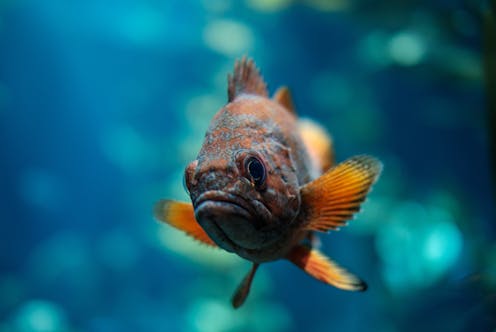
Fish are the most diverse group of vertebrates, ranging from tiny gobies and zebrafish to gigantic tunas and whale sharks. They provide vital sustenance to billions of people worldwide via fisheries and aquaculture, and are critical parts of aquatic ecosystems.
But fish around the world are getting smaller as their habitats get warmer. For example, important commercial fish species in the North Sea have declined in size by around 16% in the 40 years to 2008, while the water temperature increased by 1–2℃. This “shrinking” trend is forecasted to significantly exacerbate the impacts of global warming on marine ecosystems.
The link between warmer water and smaller size is well known, but poorly understood. Our experiments keeping fish in warmer water offer some crucial clues – and may help us learn how to prepare for a warmer future with smaller fish.
The temperature–size rule
Fisheries are a potential confounding factor when studying the effect of warmer waters on fish, because fisheries often target large fish. Removing these larger fish from the population benefits the survival of fish that mature quickly and reproduce at a younger age, when they are smaller.
This trait of maturing early can be passed through fish generations. Indeed, it can lead to a phenomenon known as “fisheries-induced evolution”, where the exploited species tends to decrease in size over time.
How do we tell the difference between the impacts of climate warming and those of fisheries?
One way is to examine the body size trends in fish species that are not targeted by fisheries. Several fish species in French rivers, for example, are not exploited by fisheries but have decreased in size over several decades while their environment has grown warmer.
Another way is to examine fish under controlled conditions, by manipulating water temperature and studying the impact on fish size. Such experiments have shown that fish do indeed end up smaller in body size when kept under warm conditions, and the trend is so common it has been given a name: the “temperature–size rule”.
We also know that smaller fish produce proportionally fewer offspring. And if fish are shrinking, fisheries that base their catch quotas on weight will be taking a larger number of individual fish.
So shrinking fish means each fish will have fewer offspring, and more fish being caught. This is likely to have substantial ecological and commercial ramifications.
Supply and demand
Warmer water means smaller fish, but why?
The most popular current theories suggest the cause is due to a mismatch between how much oxygen a fish needs (to sustain its body’s metabolism) and how much it can get (via its gills).
The argument is that fish gills do not grow at the same pace as the rest of their bodies. Once a fish reaches a certain body size, its gills can only supply enough oxygen to keep its body running – there is no oxygen left over for growth.
Read more: How is climate change affecting fishes? There are clues inside their ears
What does this have to do with warming? The next step of the argument says fish use more oxygen in warmer water – but their gills don’t get any bigger. So fish reach the limit of their growth at a smaller size, leading to the temperature–size rule.
This “oxygen mismatch” theory has sparked heated debate among global scientists, largely because insufficient data exist to confirm or refute it.
Oxygen supply can keep up with demand
To get some data, we have carried out long-term experiments keeping fish under warmer water conditions than normal. We also tried providing extra oxygen, to see if it benefited their growth.
We have regularly taken metabolic measurements, and quantified the gill surface area of the fish to understand how well they can transport oxygen from the water into the body.
Our results show the “oxygen mismatch” theory doesn’t hold up. While the metabolism of fish does increase with warming of the water, we found the gills grow sufficiently to keep up with the increased oxygen demand as fish increase in size.
So, why then are fish shrinking as the climate warms?
Is reproduction the key?
We know that fish tend to grow faster in warmer conditions and reach reproductive maturity at an earlier age and smaller size. It is possible that once fish start reproducing, energy is channelled into reproduction rather than further growth.
Evidence for this comes from a population of fish living in a Swedish lagoon that gives us an eye to a warmer future, as the lagoon receives warm (non-contaminated) water from a nearby nuclear power plant.
Fish in the warm lagoon grow faster and reach reproductive maturity earlier, then they tend to die at a younger age and at a smaller body size than their counterparts living in adjacent, cooler waterways. “Live fast, die young”, as the saying goes.
While this idea seems to be broadly applicable, some conflicting findings point to the need for more focused research attention.
Fish can’t keep shrinking forever
As our understanding of the relationship between temperature and fish size increases, we would also like to know whether we can do anything about it.
In our latest research, we explored differences in growth rates between individual fish of the same species.
One thing we wanted to know was whether particular physiological traits may allow some individuals to get around the temperature–size rule and be impacted less by climate warming. We found there is significant variability across individual fish, but we don’t know how this variability could be harnessed to future-proof fish populations.
Read more: Warming oceans are changing Australia's fishing industry
As our work continues, we also look to the future and think about the ramifications to fish and the industries that rely on them.
Fish cannot keep shrinking forever. There is a minimum size that each species must reach in order to maintain a viable population.
If species reach their specific thermal limits in particular locations, they will not be able to reproduce and they will cease to exist in those locations. If their entire habitat range becomes too warm, the species will become extinct.
These considerations of smaller fish and shifting thermal habitats will be critical for the sustainability of fisheries and aquaculture industries as we continue into a future with a warmer, more extreme climate. Our efforts to quantify and forecast the impacts will help resource managers and industries prepare for climate-linked disruption.
Authors: Timothy Clark, Associate Professor - Animal Ecophysiology, Deakin University


















