

Why Australia should invest in paying early childhood educators a liveable wage
- Written by: Karen Thorpe, Professor, Deputy Director, Institute for Social Science Research, The University of Queensland
Today, across the nation, educators who work in long day care centres are walking off the job for the fourth time in 18 months. In February this year, an attempt to bring a pay equity case through the Fair Work Commission was dismissed.
Read more: Low-paid 'women's work': why early childhood educators are walking out
Early childhood educators are seeking improved wages and recognition of the value of their work in early childhood education and care. Without a liveable wage many of these educators will be compelled to walk out the door of these centres – not just today, but forever.
This comes at a high cost to Australia’s aspiration for world-class, high quality education for its youngest children.
Educators frequently leave their centre
Many of those working in the early childhood education and care sector earn little above the minimum wage. Yet all are required to hold a vocational qualification and work to regulated professional standards to promote the learning, development and wellbeing of Australia’s youngest citizens. Even those with a four-year teaching degree are paid on average A$10,000 less per year than those working in the schools sector – without the long holiday breaks.
Additionally, they have few opportunities for non-contact time to undertake the significant demands of planning each child’s education program and recording their learning. Caring for multiple young children is physically and emotionally demanding, but not recognised in liveable rates of pay. A liveable rate of pay would enable them to afford the basic costs of housing, food, health and transport.
While most educators say they love their work, continued participation in the workforce often comes at a significant personal cost. Low wages restrict workers’ abilities to live self-sufficient lives.
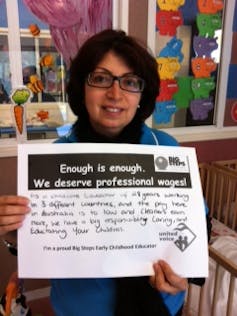 Early childhood educators will walk off the job for the fourth time in a year and a half. United Voice/flickr, CC BY-ND
For example, younger educators discuss their inability to leave home. Partnered educators remain dependent on the income of their spouse or even a former spouse, to cover basic living expenses. Those who don’t have additional financial support live precariously under persistent financial stress which impacts on their emotional well-being.
Under these circumstances it’s not surprising staff frequently leave their centre, or the sector entirely. Our recent study of early childhood education and care centres in metropolitan, regional and remote Australia found a turnover rate of 37% a year, with rates in remote areas at 45%. International comparisons suggest these turnover rates are high.
Where do the educators go?
Our study suggests educators pursue a range of options. The degree-qualified move up to the few better paid administrative roles within the sector or move out to the schooling sector where pay, conditions and status are higher.
Diploma and Certificate trained educators may move around within the sector looking for marginal gains in pay or conditions. Such “churn” is enabled by significant under-supply of qualified early childhood educators. Others move to less demanding work outside the sector.
Read more: Early childhood educators rely on families to prop up low income, research finds
In our study, about half of those leaving the sector expressed a high level of dissatisfaction with their pay and conditions.
Losing skilled, experienced educators takes its toll
High turnover represents unnecessary loss and significant personal and economic cost. Most noticeable is the loss of skilled and experienced educators in the sector.
In our study, 40% were Certificate trained, 26% held a Diploma and 16% held a degree. Many were undertaking further study and all participated in ongoing professional development.
The loss of educators also takes its toll on children’s development, well-being and learning experiences. Turnover causes significant disruptions to attachment relationships with children and partnerships with parents.
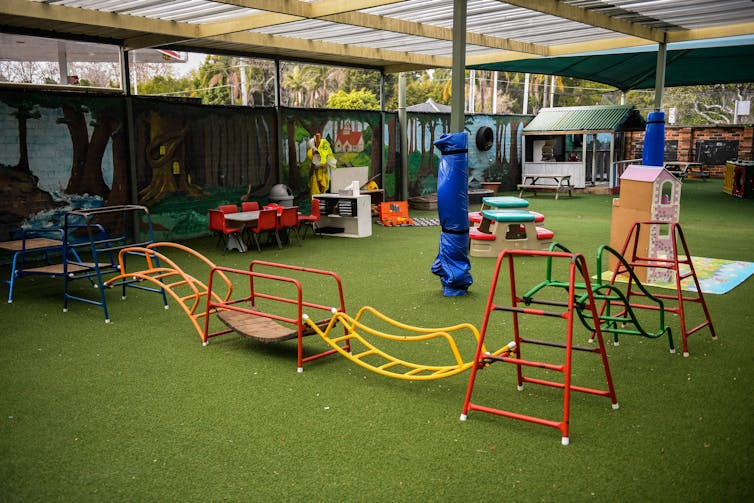 High turnover in the sector comes at a great cost to workers, children in their care, and society. Brendan Esposito/AAP
Even more concerning is that turnover is highest in areas of greater socioeconomic disadvantage where the role of early childhood education and care is especially important in supporting school readiness and ongoing educational progress.
Turnover has a societal cost
There is compelling evidence for the value of high quality early childhood education and care in supporting positive life outcomes for children, enabling parents to participate in the workforce, and yielding long-term economic growth for the nation. Yet, Australia has largely taken the significant contributions of the people who design and deliver early education programs for the 1.57 million Australian children who attend long day care in Australia each week for granted.
Three decades of neuroscience, developmental science and economic modelling tells us this work is not merely unskilled or instinctive. Rather, it’s crucial to the opportunities and life course outcomes of each child.
Read more: What outcomes parents should expect from early childhood education and care
Valuing the skills and contributions of our skilled educators and reversing the high rates of turnover is critical and can only be achieved through fair pay and rewards.
As educators walk out today, they’re supported by the many families who use early childhood education and care. Politicians who focus on the cost of early childhood education and care rather than its quality should take heed of this support. Compared with many OECD nations Australian parents foot a higher proportion of the child care bill.
Authors: Karen Thorpe, Professor, Deputy Director, Institute for Social Science Research, The University of Queensland


















