

NZ's geothermal wells offer a cheap way of storing carbon permanently -- equivalent to taking 600,000 cars off the road
- Written by: David Dempsey, Senior lecturer, University of Canterbury
We know putting carbon dioxide (CO₂) into the atmosphere is bad for the climate. But should we be reversing some of the damage by removing greenhouse gases that were emitted decades ago?
The Intergovernmental Panel on Climate Change (IPCC) seems to think so. Its latest report highlights CO₂ removal as an essential activity if society wants to avoid warming the climate by 2℃ or more.
This is not carbon capture and sequestration, which tries to neutralise the burning of fossil fuels. Nor is it limited to the removals you get by planting – and never harvesting – new forests. Carbon dioxide removal includes all kinds of land- and engineering-based practices that extract the gas from the atmosphere and lock it away permanently.
But it is not an excuse to avoid emissions cuts. Decarbonisation – society’s shift away from fossil fuels – remains essential, and we’re not doing it fast enough.
Atmospheric CO₂ removal – basically, negative emissions – can buy us time to decarbonise by walking back some of the centuries of build-up. And we think New Zealand could be a leader in this effort.
Considering our geothermal and forestry resources, we estimate New Zealand could remove up to three million tonnes of CO₂ from the atmosphere each year – the equivalent of taking 600,000 cars off the road.
Putting CO₂ into geothermal systems
When CO₂ is pumped from our cars and smokestacks, it immediately disperses at an extremely low concentration across the vast atmosphere. For every 2,400 molecules making up our air, just one is CO₂ (~420 ppm), which makes it hard to filter them back out again.
Trees extract the few CO₂ molecules from air for photosynthesis. The oceans are also good at removing CO₂ but this makes them more acidic, which is not great for coral reefs.
Scientists have been developing their own technologies for atmospheric CO₂ removal. Most are currently expensive to do in practice. But we think New Zealand could be doing CO₂ removal cheaper than anywhere else in the world, taking advantage of our well developed geothermal and forestry industries.
Read more: How NZ could become a world leader in decarbonisation using forestry and geothermal technology
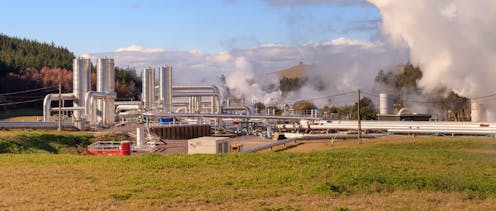
Over the past 60 years, we’ve perfected how to extract hot water from several kilometres underground, use it to generate electricity and then put the cooled water back down again. What’s more, the geothermal industry has already done the hard (and expensive) part to figure out how to capture CO₂ that comes up with the geothermal water and inject it back underground.
Unfortunately, geothermal systems cool down over time. Unless new wells are drilled, they deliver less electricity with each decade they’re in use. We can make up the decline by burning logs or forestry waste to further heat the geothermal water and generate more power.
This biomass is a good fuel because it is carbon neutral: any CO₂ it emits came from the atmosphere, not underground. And the forestry industry is already there – a supply of logs, transport logistics and know-how – which all helps keep the costs down.
But instead of letting CO₂ from the burned wood go back into the atmosphere, we could dissolve it in the geothermal water before sending it underground. Unlike in fossil-fuel carbon-capture projects, which inject pure CO₂ that might later rise and leak out, the carbonated water is slightly heavier.
It’s an involved process, but at the end you can turn a geothermal system into a carbon sink that also generates renewable electricity.
Decarbonisation on a budget
When tackling an enormous problem like climate change, governments have to weigh up how much they think voters will let them spend to cut emissions. For this, it is helpful to measure decarbonisation costs.
Mostly, emissions reduction is a choice to switch to a newer, cleaner technology. One study on abatement costs estimates that the switch from a petrol to an electric car equates to paying US$700 for each tonne of CO₂ kept out of the atmosphere.
We have recently calculated the decarbonisation costs for different geothermal technologies. We found switching from natural gas to geothermal electricity costs about US$250 for each tonne of CO₂ not emitted. When you boost geothermal with extra bioenergy and add CO₂ removal, this drops to US$150 a tonne. And if you’ve already paid for the geothermal plant and wells – an advantage we have here in Aotearoa – then it could drop as low as US$55 a tonne.
In terms of buying ourselves out of an emissions liability, geothermal carbon removal is one of the cheapest options out there.
The government may need to pay billions of dollars between now and 2030 to meet targets under the Paris agreement. A homegrown carbon-removal industry could end up as a strategic strength, particularly as social licence for clear-felling forestry continues to be eroded.
Challenges for CO₂ removal
The main barrier right now is cost. Citing its economic uncertainty, a key UN climate panel has come out against engineering-based carbon removals.
But there is cause for optimism here: the recent history of wind energy and solar power shows costs can fall dramatically as technology uptake grows. With our low-cost advantages, New Zealand has an opportunity to accelerate the rest of the world along the CO₂ removal learning curve.
Another concern is that a narrow focus on offsetting emissions could let heavy climate polluters off the hook. This is the tension between gross and net emission reductions. The government is addressing this issue by reviewing the Emission Trading Scheme, but the world will still need billions of tonnes of CO₂ removal to undo historic damage.
Read more: Does carbon capture and storage hype delay emissions cuts? Here's what research shows
Others argue land availability and competition with food crops will limit how much biomass can be made available for carbon removal. While true in a narrow sense, New Zealand currently harvests tens of millions of tonnes of timber each year while producing enough food for 40 million people.
The critics are right to point out this is not a miracle technology. If we’re to undo the climate legacy of centuries of carbon-hungry activity, it’s going to take all kinds of carbon removal.
Other research projects are underway, including the use of a rock known as Dunite, which can be spread on farmland to lock up carbon as it weathers, direct capture of CO₂ from the air with the common mineral Olivine, and enhancement of the carbon-storage capacity of marine sediments, especially in Fiordland.
Read more: Blue carbon: could a solution to the climate challenge be buried in the depths of fiords?
A key unknown right now is whether the public wants this. It’s easy to kick the can down the road, and it’s true that international carbon trade is a curly issue that needs rigorous study. But CO₂ removal is not science fiction decades away from maturity. It’s here now.
Authors: David Dempsey, Senior lecturer, University of Canterbury


















