

how a scientist set out to sing the story of our origins
- Written by: Jenny Graves, Distinguished Professor of Genetics and Vice Chancellor's Fellow, La Trobe University
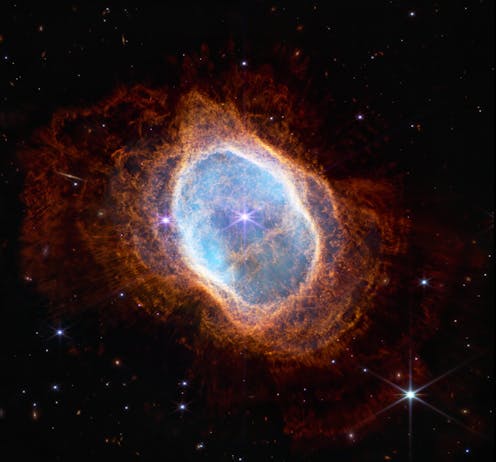
At the close of the 18th century, the Austrian composer Joseph Haydn wrote one of his masterpieces: an oratorio – a large concert piece for orchestra, choir and solo singers – entitled The Creation, with a libretto based on the biblical story of the creation of the world.
More than 200 years later, our understanding of how our world began has changed spectacularly. As both a scientist and a chorister, I have waited for decades for someone to write a new oratorio that tells of the origin of the Universe, of life, of species, and of humanity, based on science.
But nobody ever did, although composer Alan Williams, librettist Philip Goulding and astrophysicist Tim O'Brien wrote an oratorio called Wonder for the International Year of Astronomy in 2009 that reflected scientific understanding of the birth of the Universe.
So – with the help of a poet colleague, a composer and the choir I sing in – I set out to tell this story of origins with music and beautiful words and images from cosmology, molecular biology, evolutionary genetics, ecology and anthropology.
Science is beautiful
Rereading my old books by the masters of these fields brought back to me the awe and wonder inspired by the discoveries of the past century.
What could be more awesome than the creation of a universe from nothing? Or the creation of the molecules of life in a warm pond or hydrothermal vent?
What could be more beautiful than the origin of species of increasing complexity, including our own? What could be more important than conserving our planet and understanding ourselves and our place in the Universe?
Read more: Did life evolve more than once? Researchers are closing in on an answer
So why isn’t the general public in love with science? When I lived in a commune 50 years ago, the very smart sociologists, psychologists and teachers I lived with would deride my passion. Science is hard and boring. Science is downright dangerous. Science is only good for inventing gadgets.
In 1959, the English novelist and chemist C.P. Snow wrung his hands at the existence of “two cultures” that don’t talk to each other. Despite the explosion of scientific advances, I’m not sure we have advanced much in the integration of science into our culture.
My early experiences began a lifelong search for ways to express the beauty and simplicity of science. What could touch us more profoundly than music?
We are what we sing
Humans of all ages and cultures have sung their deepest desires, hopes and fears. There’s even a theory that song evolved before language.
Religion uses music to foster community and bring comfort and certainty to our uncertain lives. For centuries, beliefs have been fostered and reinforced by constant repetition of a credo in one form or another.
As a chorister, I have sung dozens of masses, requiems and oratorios, by Bach, Brahms, Mozart, Berlioz, Faure, Britten and more. I think these classics are the most gorgeous music in the world, and I love singing them.
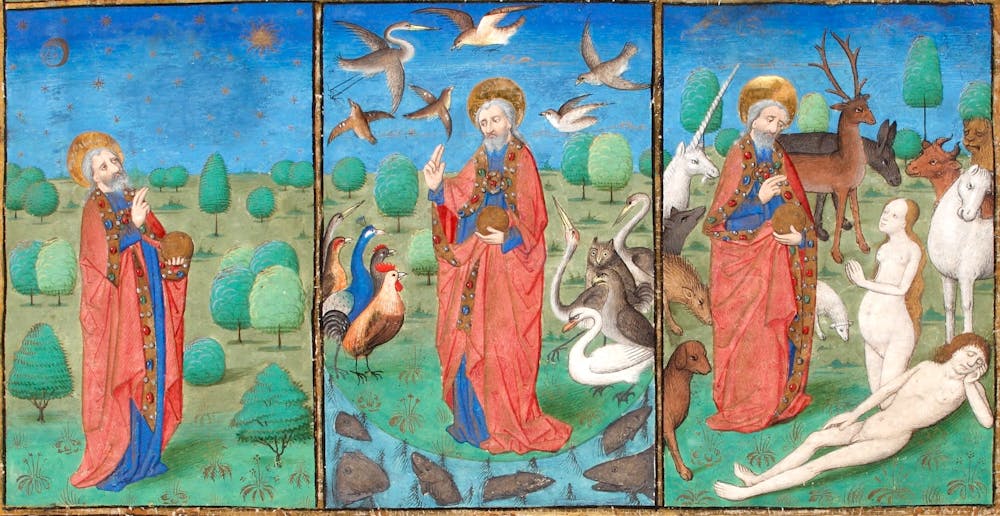
But the ideas in the librettos were developed centuries ago.
When I first thought of writing an update, the idea seemed preposterous. How could an evolutionary geneticist with little formal musical training ever conceive, let alone write, the libretto for a major new work?
Up until then I had written 462 scientific articles, but only one poem – and that was 65 years earlier.
Nothing is not nothing
I teamed up with my fellow chorister, poet Leigh Hay, with support from Peter Bandy, the conductor of our choir (the Heidelberg Choral Society). Peter persuaded the Australian-born composer Nicholas Buc to write the music.
I had the first line in my head for years: “Nothing is not nothing.” I also had an idea for the finale “Man is the astronomer”, in which soloists ask despairing questions about humanity’s future, answered by the chorus’ reassurance that we humans, uniquely, can understand the universe and our place in it.
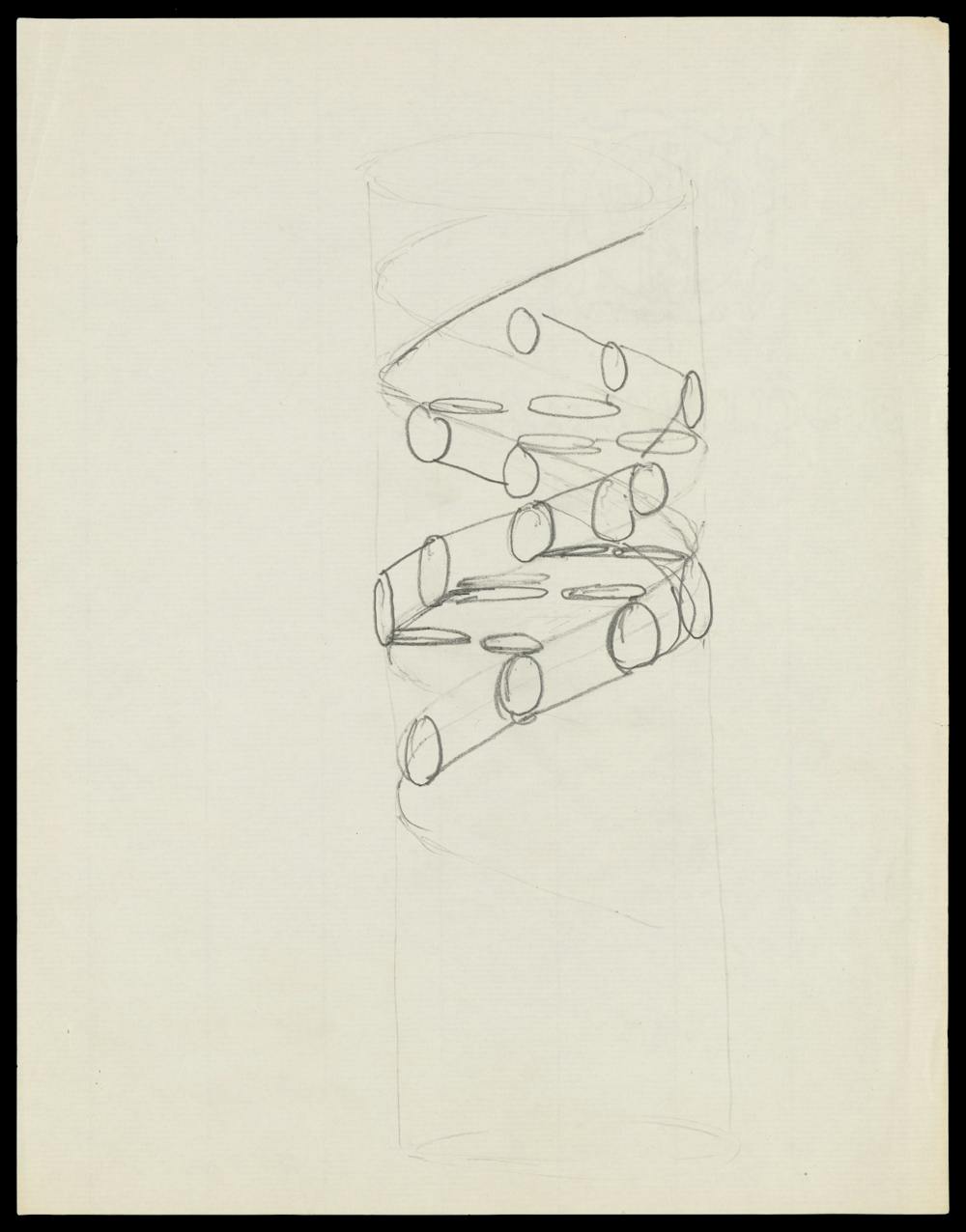 An early sketch of the double helix structure of DNA by Francis Crick.
Francis Crick via Wikimedia Commons, CC BY
An early sketch of the double helix structure of DNA by Francis Crick.
Francis Crick via Wikimedia Commons, CC BY
To my surprise, the story unfolded in my head, in (rather unkempt) verse, and fell naturally into four sections: the universe, life, species, and humanity.
First the Big Bang and the cacophony of early Earth, and our planet forming into the “pale blue dot no bigger than Neil Armstrong’s thumb”.
Then the coalescence of molecules into self-replicating machines. Dramatising the discovery of the structure of DNA was fun to write: we interrupted excited half-sentences from Watson and Crick with a plaintive aria from Rosalind Franklin.
The steely beauty of DNA, the elegance of coding. The stuttering of mutation was obviously a fugue. For early life, I looked to famous Australian fossils.
Enter Darwin, singing calmly about his “one great law” against a chorus of hysterical hecklers. I had Bach’s St Matthew Passion in mind.
Read more: Decoding the music masterpieces: Handel’s Messiah oratorio, composed in just 24 days
Then the desperation and frivolity of evolution; black and white moths, dancing lyrebirds, mechanically altruistic ants, speciating rock wallabies. Here I used my knowledge of famous Australian examples, including, alas, extinctions. A funeral march with tolling bell introduces the sixth extinction that is all our own.
When I got to the rise of the third chimpanzee, the “dominant mammal” making a mess of our planet, I started feeling gloomy and had to rescue myself by writing a strong message of hope into the finale.
Approaching the performance
With the words done, Nick Buc’s music written, and a visual backdrop created by animator Drew Berry, we are now well into rehearsals with the 100 voices of the Heidelberg Choral Society, a 60-piece orchestra and four soloists, conducted by Peter Bandy.
The premier of Origins is set for July 18 at the Melbourne Recital Centre. Some 225 years after Haydn’s Creation first dazzled audiences with its religious vision, an oratorio on our origins based in science will have arrived.
Clarification: this article has been amended to mention the 2009 oratorio Wonder, by Alan Williams, Philip Goulding and Tim O'Brien.
Authors: Jenny Graves, Distinguished Professor of Genetics and Vice Chancellor's Fellow, La Trobe University



















#/media/File:The_Creation_in_L'Antiquit%C3%A9_Juda%C3%AFque_-_Google_Art_Project.jpg)
