

We need to decarbonise our electricity supply, and quickly – Alan Finkel shows how green energy can be a reality, and bring economic benefits
- Written by: John Quiggin, Professor, School of Economics, The University of Queensland
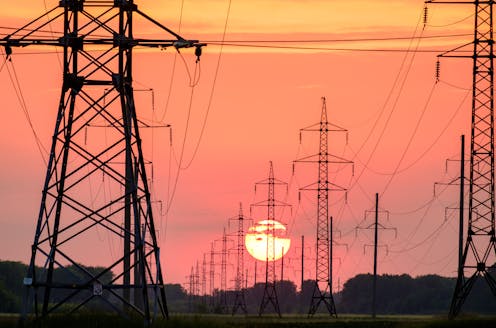
We use energy in everything we do, but few of us understand it properly. Much of the time this doesn’t matter. We can flick a light switch or turn the ignition key in a car, knowing the technology will work whether we understand it or not. Even something as simple as the distinction between alternating current and direct current is a mystery to most people without a scientific education.
But thanks to climate change, we can no longer be comfortably ignorant. A better understanding of energy systems is urgently needed if we are to transform those systems successfully.
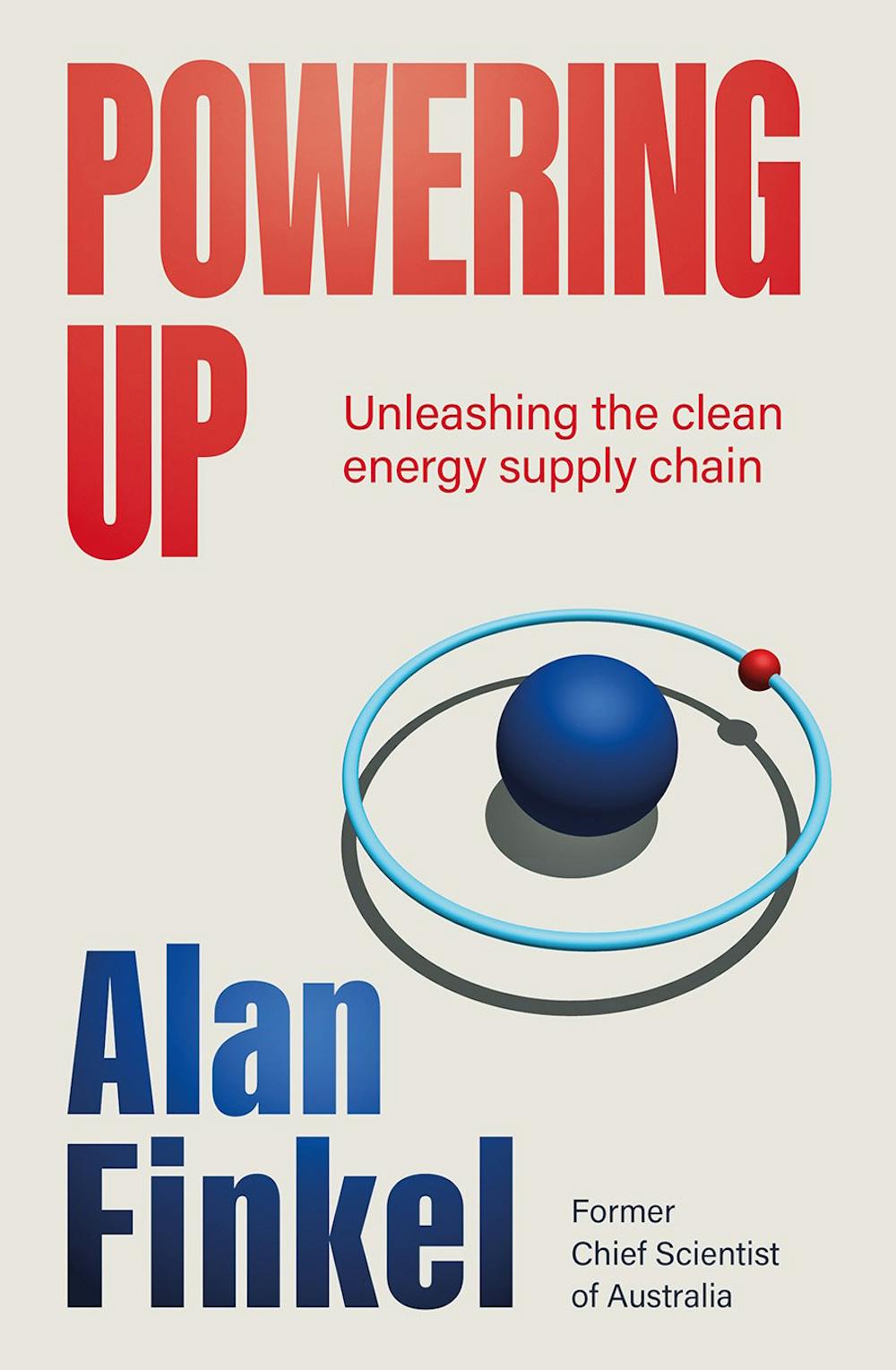
Review: Powering Up: Unleashing the Clean Supply Energy Chain – Alan Finkel (Black Inc.)
The science of climate change is complex – too complex for any individual to comprehend completely. It encompasses physics, chemistry, time-series statistics and computer modelling, among many other issues. But by now, thanks to the work of communicators like the Intergovernmental Panel on Climate Change, most of us understand the basics.
The exception to this general understanding is the shrinking group of self-described “sceptics”, determined not to understand. Members of this group pride themselves on “doing their own research”. This catchphrase does not mean “undertaking years of intensive training in science and research methods, then applying it to the study of complex problems”, but rather “using Google to find talking points that confirm my prior beliefs”.
The central findings of climate research can be simply summarised. Over the course of the 20th century, we used more and more energy, the great majority of it derived from burning carbon-based fuels – oil, coal and natural (methane) gas. The result has been a buildup of carbon dioxide and other greenhouse gases in the atmosphere, trapping more of the Sun’s heat and radiating less back to outer space.
This process has already caused the global climate to heat up, with some disastrous results, such as wildfires and heatwaves. Global heating will inevitably continue, as will climate-related disasters. If we are to avoid truly catastrophic damage, we need a rapid transition to carbon-free sources of energy for electricity, transport and industrial uses.
 Muongo Tshiondo Kuta, a worker in the Shinkolobwe Cobalt mine near Likasi, Democratic Republic of Congo, April 2004.
Schalk Van Zuydam/AP
Alternatively, as Finkel shows, it would be possible to source cobalt from other countries, including Australia, or to switch to somewhat less efficient technologies based on manganese. The lesson of history is that, just as “the cemetery is full of indispensable men”, there is no single mineral so critical that civilisation would grind to a halt without it.
The next two chapters focus on the core of the transition to an electricity system based on solar photovoltaic and wind generation. This would need to be backed up by batteries, pumped hydro, and other technologies for “firming” (dealing with short-run fluctuations) and storage (dealing with mismatches between the time electricity is generated, and the time it is needed).
In this context, “renewable” is a somewhat unfortunate term – what matters is low emissions. In particular, the term excludes nuclear power and allows potentially problematic sources, such as burning biomass.
However, as Finkel observes, nuclear power is no longer a relevant issue for Australia. There is no prospect of nuclear power here before 2040, by which time all coal-fired plants will be closed, and gas will play at most a marginal role. Globally, it makes sense to extend the lives of existing nuclear plants, but new nuclear power can’t compete with the combination of renewables and storage.
Getting the transition right is a complex problem. Finkel discusses the sorry history of energy policy over the past decade or so (a period in which we worked together as members of the Climate Change Authority). This period of failure included the rejection of the Clean Energy Target, which he recommended to the Turnbull government, and the creation of the misnamed and misbegotten Energy Security Board, now thankfully abolished.
Muongo Tshiondo Kuta, a worker in the Shinkolobwe Cobalt mine near Likasi, Democratic Republic of Congo, April 2004.
Schalk Van Zuydam/AP
Alternatively, as Finkel shows, it would be possible to source cobalt from other countries, including Australia, or to switch to somewhat less efficient technologies based on manganese. The lesson of history is that, just as “the cemetery is full of indispensable men”, there is no single mineral so critical that civilisation would grind to a halt without it.
The next two chapters focus on the core of the transition to an electricity system based on solar photovoltaic and wind generation. This would need to be backed up by batteries, pumped hydro, and other technologies for “firming” (dealing with short-run fluctuations) and storage (dealing with mismatches between the time electricity is generated, and the time it is needed).
In this context, “renewable” is a somewhat unfortunate term – what matters is low emissions. In particular, the term excludes nuclear power and allows potentially problematic sources, such as burning biomass.
However, as Finkel observes, nuclear power is no longer a relevant issue for Australia. There is no prospect of nuclear power here before 2040, by which time all coal-fired plants will be closed, and gas will play at most a marginal role. Globally, it makes sense to extend the lives of existing nuclear plants, but new nuclear power can’t compete with the combination of renewables and storage.
Getting the transition right is a complex problem. Finkel discusses the sorry history of energy policy over the past decade or so (a period in which we worked together as members of the Climate Change Authority). This period of failure included the rejection of the Clean Energy Target, which he recommended to the Turnbull government, and the creation of the misnamed and misbegotten Energy Security Board, now thankfully abolished.
 Alan Finkel.
Andre Goosen/Boem Headshots
Finkel considers what might emerge from the current rather chaotic situation, in which a variety of government initiatives interact with the remains of the artificial electricity market that emerged from the reforms of the 1990s. Looking to the future, he provides a guide to the exciting possibilities of the hydrogen economy, and the opportunity to use Australia’s massive endowment of sun and wind as the basis of an energy export industry to replace coal and gas.
This would include a revived “green” steel industry, in which direct reduction of iron ore using hydrogen would replace the blast-furnace technology that has been dominant since the 19th century. A hydrogen-based steel industry will require the use of magnetite, the highest-quality form of iron ore, with which we are also well endowed.
One disappointment in this chapter is Finkel’s failure to give adequate weight to direct export of electricity using high-voltage direct current. Projects such as Sun Cable, which aims to export Australian electricity to Singapore and other destinations, seem at least as promising as hydrogen.
Finkel concludes with a discussion of some of the complex political and social issues surrounding the energy transition in Australia and globally. His treatment of these issues is measured and sensible, but doesn’t match the depth of his analysis of the technical issues in the main body of the book. It would be wonderful to have a summary of the policy issues as accessible and comprehensive as Finkel’s overview of the technological issues.
In the meantime, this is a book that everyone interested in the energy transition should read.
Authors: John Quiggin, Professor, School of Economics, The University of Queensland
Alan Finkel.
Andre Goosen/Boem Headshots
Finkel considers what might emerge from the current rather chaotic situation, in which a variety of government initiatives interact with the remains of the artificial electricity market that emerged from the reforms of the 1990s. Looking to the future, he provides a guide to the exciting possibilities of the hydrogen economy, and the opportunity to use Australia’s massive endowment of sun and wind as the basis of an energy export industry to replace coal and gas.
This would include a revived “green” steel industry, in which direct reduction of iron ore using hydrogen would replace the blast-furnace technology that has been dominant since the 19th century. A hydrogen-based steel industry will require the use of magnetite, the highest-quality form of iron ore, with which we are also well endowed.
One disappointment in this chapter is Finkel’s failure to give adequate weight to direct export of electricity using high-voltage direct current. Projects such as Sun Cable, which aims to export Australian electricity to Singapore and other destinations, seem at least as promising as hydrogen.
Finkel concludes with a discussion of some of the complex political and social issues surrounding the energy transition in Australia and globally. His treatment of these issues is measured and sensible, but doesn’t match the depth of his analysis of the technical issues in the main body of the book. It would be wonderful to have a summary of the policy issues as accessible and comprehensive as Finkel’s overview of the technological issues.
In the meantime, this is a book that everyone interested in the energy transition should read.
Authors: John Quiggin, Professor, School of Economics, The University of Queensland 

















