

Marshall Islands, a nation at the heart of global shipping, fights for climate justice
- Written by: Christiaan De Beukelaer, Senior Lecturer in Culture & Climate, The University of Melbourne
I went sailing on a bright yellow outrigger canoe in the Marshall Islands in March. On board were Alson Kelen, founder of Waan Aelõñ in Majel (WAM, Canoes of the Marshall Islands), and a group of youngsters taking part in a climate justice workshop.
Alson’s NGO is a hive of activity. Sailing ships, some finished and some under construction, surround an A-frame building right between the government-owned Marshall Islands Resort and the Ministry of Education on Majuro Atoll. Alson acquired the land decades ago from the country’s first president, Amata Kabua, for a symbolic dollar.
As we sailed, he told us his organisation’s work is about “empowering the young men and women of the Marshall Islands, endowing them with the skillset essential to bring them into the global society”. It’s keeping the traditions of shipbuilding and wayfaring alive, while offering fossil-fuel-free transport between the country’s islands.
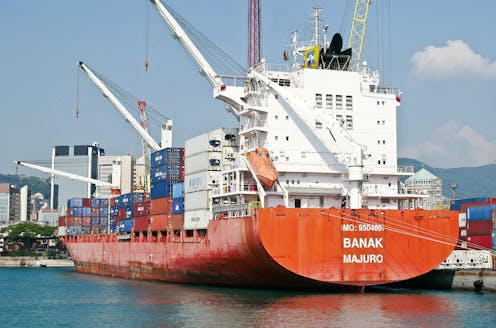
As home to the world’s third-largest ship registry, the Marshall Islands is a key player in global shipping, while rising sea levels threaten its low-lying islands. This puts the country in a unique position in negotiations on new shipping emission targets.
Although WAM’s yellow outriggers might not make a dent in greenhouse gas emissions from the world’s cargo ships, these little vessels are a local counterpoint to the Pacific state’s climate diplomacy.
Read more: To reach net zero, we must decarbonise shipping. But two big problems are getting in the way
What’s at stake?
The need to decarbonise shipping is urgent. Shipping is the most efficient means of cargo transport, but the sheer volume of goods – 11 billion tonnes a year – puts its emissions on a par with countries like Germany or Japan. Shipping emissions add up to around 1 billion tonnes a year.
In 2018, the International Maritime Organization (IMO), the United Nations agency that regulates shipping, set its first sector-wide climate target: to halve shipping emissions between 2008 and 2050.
This “initial strategy” doesn’t align with the Paris Agreement goal of keeping global warming below 1.5℃. It does, however, require a review of the strategy every five years.
A revision is due to be adopted next month. This follows years of go-slow tactics by several large developing countries and lofty commitments by most IMO member states to “keep 1.5 alive”.
Shipping looks increasingly likely to have a target of zero emissions by 2050. Whether that’s “net zero” or “absolute zero”, and whether it counts only emissions on board or the full life cycle of emissions attributable to shipping, is still being negotiated.
Zero by 2050 sounds like a big win. It will certainly be better than the current target. But emissions must come down a lot faster for the 1.5℃ limit to remain an option.
Read more: Shipping emissions must fall by a third by 2030 and reach zero before 2050 – new research
How can the energy transition be made equitable?
For a low-lying atoll state like the Marshall Islands, climate change is a matter of life and death. Exceeding 1.5℃ of warming will likely trigger tipping points that would raise sea levels as ice caps melt. This would inundate the Marshall Islands.
To “keep 1.5 alive”, the Marshall Islands and other Pacific states are calling for hard “interim targets” to reduce shipping emissions by 37% by 2030 and 96% by 2040. The United States, Canada and the United Kingdom have proposed similar targets.
A rising sea level is an existential threat to the Marshall Islands.Pacific states are also calling for an equitable energy transition. Just as Alson’s outrigger canoes won’t make much difference to shipping emissions, Pacific islanders – indeed most of the world’s population – didn’t produce the emissions that are causing the climate crisis.
In 2021, the Marshall Islands proposed a global levy on shipping emissions – at least US$100 per tonne of CO₂-equivalent – to speed up the transition. It’s increasingly clear, however, that “levies exceeding US$100 per tonne may be needed to reduce carbon emissions”.
A growing group of countries, including Ghana, Namibia, South Korea, France and Denmark, are calling for a levy on shipping. Last week at the Paris Summit for a New Global Financing Pact, 22 countries – including Norway – supported a levy. The US didn’t, but flagged it is something it will “look at”. Even so, support for the Pacific equity agenda remains limited.
Shipping costs will go up as the energy transition unfolds. Costs are expected to increase more for the poorest countries, which already often pay higher-than-average shipping charges. For small island developing states like the Marshall Islands, not getting help with these costs could prove disastrous.
‘We are not drowning. We are fighting’
A sailing cargo ship to serve the Marshall Islands’ needs is under construction at the Asia Shipbuilding shipyard in South Korea. The publicly owned Marshall Islands Shipping Corporation will operate the 48-metre vessel. While this ship may make only a small contribution to curbing emissions, the country is working hard to translate the ambitious targets of its climate diplomacy into practice at home.
Maritime transport could be the first industry to have a global price on emissions. It will raise enormous revenues, leading to questions of how to administer and spend these funds. The World Bank is positioning itself to administer the US$3.7 trillion that may be levied over the decades to 2050.
Some may argue the call for an equitable transition is too big an ask. The shipping industry, they whisper in the corridors of the International Maritime Organization, can’t be expected to solve all the world’s problems. They’re right – although no one is suggesting shipping must solve all the world’s problems.
But if the transition isn’t equitable, they’re barely trying to solve any problems. The most ambitious “equitable transition” now on the table will barely fix centuries of colonial exploitation and unfair trade.
As IMO member states gear up for two weeks of negotiations in London, the rallying cry of Pacific youth remains as important as ever: “We are not drowning. We are fighting.”
Authors: Christiaan De Beukelaer, Senior Lecturer in Culture & Climate, The University of Melbourne


















