

what the Hajj means for Muslims
- Written by: Ali Hammoud, PhD candidate, Western Sydney University
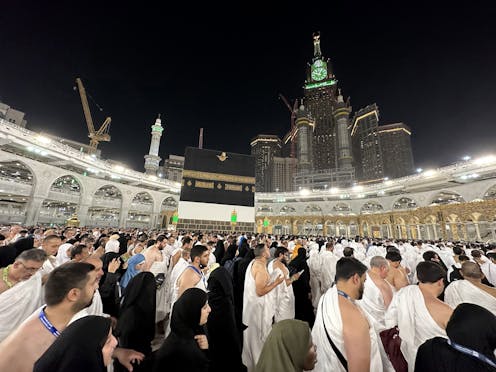
Millions of men, women and children have converged on Mecca this week for the Hajj pilgrimage. The Saudi government says it will be the largest crowd ever for the pilgrimage.
The Hajj pilgrimage is, at its core, a pilgrimage towards God. This presents a paradox of sorts. If God is beyond time and space, then what is the purpose of travelling to a particular place? Is God not present now, everywhere?
The celebrated author Gai Eaton offers an elegant response:
Our sense of the divine Presence is blunted. We need to find it focused on a particular place and, for the Muslim, that place is the Ka'ba at Mecca, which he has faced every time he prayed and to which he now journeys in pilgrimage.
A transformative experience
Within the Islamic worldview then, the Ka’ba functions as the locus of hearts. I use the plural “hearts” here, for the pilgrimage is not only an individual religious obligation. It is a communal act that strengthens ties of kinship between Muslims in a way that resembles nothing else.
When the pilgrims prepare to don the Hajj attire, they discard more than their clothes. Nationality, race and socio-economic status are tossed to the wayside — prince and pauper unite as pilgrims. All distinctions are left behind.
The experience can be transformative, particularly for those embarking on the pilgrimage for the first time.
The renowned activist and minister Malcolm X was compelled to re-evaluate his views on race in the wake of his Hajj experience. In his Letter From Mecca, he wrote:
There were tens of thousands of pilgrims, from all over the world. They were of all colours, from blue-eyed blondes to black-skinned Africans. But we were all participating in the same ritual, displaying a spirit of unity and brotherhood that my experiences in America had led me to believe never could exist between the white and non-white.
Coupled with his societal reflections was an internal revolution, one that stirred his heart. In his autobiography, he writes:
In my thirty-nine years on this earth, the Holy City of Mecca had been the first time I had ever stood before the Creator of All and felt like a complete human being.
Read more: Millions of Muslims prepare to perform the hajj amid calls for a boycott
Road to Mecca fraught with challenges
For Muslims then, the return of Hajj pilgrims to pre-pandemic numbers this year (or even surpassing them) represents another opportunity for this reorientation towards God.
Granted, globalisation has drawn the world closer, denting the impact of encountering people from completely different walks of life. Despite this, the Hajj pilgrimage remains unparalleled in its capacity to turn hearts, both individually and collectively.
All this is not to say that the experience is one of ease and comfort.
If the history of the Hajj pilgrimage has demonstrated anything, it is the road to Mecca is often fraught with challenges. The most recent challenges confronting potential pilgrims have been unforeseen, drastically altering the Hajj experience.
The COVID pandemic saw pilgrimage to the holy sites halted for two years, with only a limited number of Saudi residents permitted to perform the pilgrimage.
As the pandemic slowly subsided, many Muslims in other countries who had waited with eager anticipation booked their travel plans. But they were met with a new complication.
The struggle for getting a spot
In 2022, the Saudi government announced that all those intending to perform the pilgrimage from several Western countries, including the US, UK, Australia, New Zealand and the European Union, must register through the Motawif website. Those who had already made bookings were advised to immediately cancel them and register through Motawif.
This would place the registrant into a lottery-type system, replacing the Hajj travel tours that had operated locally in these countries for many years.
The Saudi administration claimed it was trying to remove the middle man and make the Hajj travel package process smoother and more affordable. Many testimonies, however, appear to confirm the contrary.
Read more: Technology remains at the heart of the hajj
Registrants criticised the persistent technical failures of Motawif, and those who were lucky enough to make it to Mecca bemoaned the disorganised mess that greeted them upon their arrival.
The Saudi claim of increased affordability was also contested. Prices for a Hajj package vary, depending on the level of luxury that the pilgrim desires during their stay in the holy cities. When factoring in all costs, however, the total price for the package hovered in the range of US$7,000 to $13,500 (A$10,000 to $20,000) per person.
For many Muslims in the West, a more affordable Hajj package was viewed as desirable. In reality, though, prices remained high — the only difference being the Saudi government collected the profits.
This year, the Saudi authorities have ditched the short-lived Motawif system. Rather than operating on a lottery basis, it has now been replaced with a new first-come, first-serve system. Only time will tell whether this new system is feasible, or whether it will go the way of Motawif.
Despite these challenges, Muslims from around the world continue to flock to the Hajj. Through this ritual, they direct their hearts individually and collectively towards the Ka’ba. In doing so, they step out beyond time, linking the past and present in an unbroken covenant with God.
Authors: Ali Hammoud, PhD candidate, Western Sydney University
Read more https://theconversation.com/an-unbroken-covenant-with-god-what-the-hajj-means-for-muslims-208571


















