

Cosmological models are built on a simple, century-old idea -- but new observations demand a radical rethink
- Written by: David Wiltshire, Professor of Theoretical Physics, University of Canterbury
Our ideas about the Universe are based on a century-old simplification known as the cosmological principle. It suggests that when averaged on large scales, the Cosmos is homogeneous and matter is distributed evenly throughout.
This allows a mathematical description of space-time that simplifies the application of Einstein’s general theory of relativity to the Universe as a whole.
Our cosmological models are based on this assumption. But as new telescopes, both on Earth and in space, deliver ever more precise images, and astronomers discover massive objects such as the giant arc of quasars, this foundation is increasingly challenged.
In our recent review, we discuss how these new discoveries force us to radically re-examine our assumptions and change our understanding of the Universe.
Einstein’s legacy
Albert Einstein faced huge dilemmas 106 years ago when he first applied his equations for gravity to the Universe as a whole. No physicist had ever attempted something so bold, but it was a natural consequence of his key idea. As a 50-year-old textbook reminds us:
Matter tells space how to curve, and space tells matter how to move.
Data were almost completely lacking in 1917 and the idea that galaxies were objects at vast distances was a minority view among astronomers.
The conventional viewpoint, accepted by Einstein, was that the whole Universe looked like the inside of our galaxy. This suggested stars should be treated as pressure-less fluids, distributed randomly but with a well defined average density – the same, or homogeneous, anywhere in space.
Based on the idea that the Universe is the same everywhere, Einstein introduced his cosmological constant Λ, now known as “dark energy”.
On small scales, Einstein’s equations tell us that space never stands still. But forcing this on the Universe on a large scale was unnatural. Einstein was therefore relieved by the discovery of the expanding universe in the late 1920s. He even described Λ as his biggest blunder.
Read more: Dark matter: our review suggests it's time to ditch it in favour of a new theory of gravity
Ideas about matter have evolved, but not geometry
We now have amazingly detailed models of the physics of stars and galaxies embedded in the evolving Universe. We can trace the astrophysics of “stuff” from tiny seed ripples in the primordial fireball all the way to complex structures today.
Our telescopes are wonderful time machines. They look back all the way to when the first atoms formed, and the Universe first became transparent.
Beyond is the primordial plasma, opaque like the interior and surface of the Sun. The light that left the Universe’s “surface of last scattering” was very hot back then, about 2,700℃.
We receive that same light today, but cooled to minus 270℃ and diluted by the expansion of the Universe. This is the cosmic microwave background and it is remarkably uniform in all directions.
This is strong evidence the Universe was very close to spatially uniform when it was a fireball. But there is no direct evidence for such uniformity today.
A ‘lumpy’ Universe
Far back in time, our telescopes reveal small merging galaxies, growing into ever larger structures until the present day.
The expansion of the Universe has been halted entirely within the largest matter concentrations known as galaxy clusters. Where space is expanding, the clusters are stretched in filaments and sheets that thread and surround vast empty voids, all growing with time but at different rates. Rather than being smooth, matter forms a “cosmic web”.
But the idea that the Universe is spatially homogeneous endures.
There would be a gross inconsistency between the observed cosmic web and an average curved geometry of space if all we see is all there is. Evidence for missing matter has been around since the first observations of galaxy clusters in 1933.
Our first observations of the cosmic microwave background radiation and its ripples in the decade from 1965 changed that idea.
Our models of nuclear physics are wonderfully predictive. But they are only consistent with observations if the missing mass in galaxy clusters is something like neutrinos that cannot emit light. Thus we invented cold dark matter, which makes gravity stronger within galaxy clusters.
Billions have been spent trying to directly detect dark matter, but decades of such efforts have yielded no definitive detection of what makes up 80% of all matter and 20% of all the energy in the Universe today.
An anomalous sky
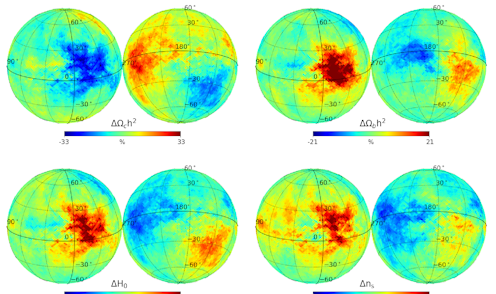
The cosmic microwave background radiation is not perfectly uniform. Superimposed on it are fluctuations, one of which is abnormally large and has the shape of a dipole: a yin-yang diagram covering the whole sky.
We can interpret this as an effect due to relative motion, provided we define the cosmic microwave background radiation as the rest frame of the Universe. If we didn’t do this, we would need a physical explanation for the large dipole.
Much of the puzzle boils down to a power asymmetry – a lopsided Universe. The temperatures of the hemispheres above and below the plane of the Milky Way are slightly different to expectation.
These anomalies have long been explained as a result of unaccounted physical processes in modelling microwave emissions from the Milky Way.
Read more: The largest structures in the Universe are still glowing with the shock of their creation
Matter within the sky
The cosmic microwave background radiation is not the only all-sky observation to show a dipole. Last year, researchers used observations of 1.36 million distant quasars and 1.7 million radio sources to test the cosmological principle. They found that matter, too, is unevenly distributed.
Another even more widely discussed mystery is the “Hubble tension”. Conventionally, we assume that an all-sky average of the Universe’s present expansion rate gives one well defined value: the Hubble constant. But the measured value differs from expectation, given a standard expansion history based on the cosmic microwave background radiation. If we allowed for inhomogeneous cosmologies, this problem may simply disappear.
Using cosmic microwave background data from individual opposing hemispheres, a standard expansion history implies different Hubble “constants” on each side of the sky today.
These puzzles are compounded by an ever-growing list of unexpected discoveries: a vast giant arc of quasars and a complex, bright and element-filled early Universe unveiled by the James Webb Space Telescope.
If matter is much more varied and interesting than expected, then maybe the geometry is too.
Models which abandon the cosmological principle do exist and make predictions. They are simply less studied than standard cosmology. The European Space Agency’s Euclid satellite will be launched this year. Will Euclid reveal that on average space is not Euclidean? If so, then a fundamental revolution in physics might be around the corner.
Read more: The Euclid spacecraft will transform how we view the 'dark universe'
Authors: David Wiltshire, Professor of Theoretical Physics, University of Canterbury


















