

NZ workers have unacceptably high exposures to carcinogens – they need better protection and long-term health monitoring
- Written by: John Donne Potter, Professor, Research Centre for Hauora and Health, Massey University
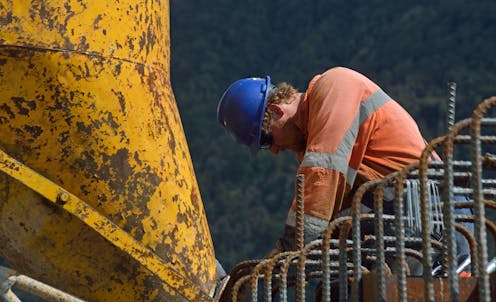
A recent survey suggests that 58% of workers in New Zealand are exposed to at least one cancer-causing agent at work. Almost one in three are exposed at a high level, at or above the standards set by WorkSafe New Zealand, and almost one in four are exposed to five or more carcinogens at any level.
The New Zealand Carcinogens Survey (NZCS), commissioned by WorkSafe New Zealand, was the first to examine the prevalence of occupational carcinogens in the working population.
It identified the ten most common cancer-causing substances and exposures across all industries as benzene (30%), solar UV (27%), UV exposure to the eye (26%), diesel engine exhaust (24%), second-hand tobacco smoke (15%), styrene (12%), crystalline silica (10%), shift work (9%), wood dust (8%) and other polycyclic aromatic hydrocarbons (8%).
The main tasks associated with benzene exposure are fuelling vehicles and equipment with petrol, using petrol or other solvents to clean hands and using solvent-based paints. The industries with the highest exposure to at least one carcinogen are mining, electricity and gas, water and waste services, construction, transport, postal and warehousing, and primary industries (agriculture, forestry, fishing).
Workers in primary industries are exposed to the highest number of carcinogens at any level. Specific occupations with the highest exposures include construction workers, farmers and emergency responders.
The distribution of carcinogen exposure differs by gender and ethnicity. Māori and Pacific workers and men are the most likely to be exposed to at least one carcinogen.
Work-related exposures
Work-related disease is estimated to account for 750-900 deaths a year in New Zealand. Cancer contributes to about half of these deaths and at least a third of work-related hospitalisations. These figures are largely based on overseas estimates applied to Aotearoa New Zealand health data.
Establishing the number of workplace injuries is relatively straightforward but investigation of work-related cancers is much more difficult because:
there is often a long latency period between work exposure and the onset of disease
it is difficult to attribute a particular cancer to a specific exposure
very few cancers are the result of a single occupational exposure (asbestosis in asbestos-exposed workers is an exception)
hazardous exposures often cluster in work environments
lifestyle factors (e.g. smoking) also contribute to cancer risk.
Therefore, understanding the prevalence, frequency and distribution of exposure to work-related carcinogens is crucial.
Read more: Nail salon workers suffer chemical exposures that can be like working at a garage or a refinery
Which exposures matter?
How do we know which workplace exposures contribute to cancer risk?
The International Agency for Research on Cancer (IARC) regularly undertakes expert reviews of the relevant scientific literature to identify cancer-causing substances and practices. They classify exposures on the basis of the quality of evidence as:
Group 1: sufficient evidence of carcinogenicity in humans
Group 2A: probably carcinogenic to humans
Group 2B: possibly carcinogenic to humans
Group 3: not classifiable.
Until the NZCS report, New Zealand-specific data on work exposures to carcinogens have been lacking.
The survey did not measure exposure directly. It used a web-based exposure-assessment programme to estimate the likelihood of exposures and probable level based on questions to workers about substances, jobs and specific tasks.
Māori and Pasifika are under-represented in the survey compared to their population numbers. It seems likely the sample does not reflect the occupational distribution of Māori and therefore we must be cautious when extrapolating to the wider population for these groups.
What is to be done?
There are some limitations to the NZCS report. This means we cannot easily generalise its findings to the wider working population. However, it is important to concentrate on the unmistakable evidence that a large number of people are exposed to high levels of workplace carcinogens.
The NZCS is an important step in improving data collection. But data alone are not sufficient; they need to inform action. There are too many examples of Aotearoa being slower than other countries to act when sufficient evidence exists.
New Zealand was the last country in the world to halt the production of the toxic dioxin-contaminated herbicide 2,4,5-T, in 1987. As late as 1986, it was still being declared harmless.
The importation of asbestos-containing products was banned only in 2016. New Zealand still has not limited widespread use of the weed killer glyphosate.
Protective efforts should start with the most common carcinogens and high-risk industries and occupations. Others have recommended an integrated system for exposure surveillance in the past.
Ideally, this would be combined with surveillance of health outcomes and actual exposure measurements. These recommendations are not new; indeed, they have been ignored for decades.
The NZCS report reinforces findings from previous studies that occupational exposures are not distributed equally across men and women and Māori and non-Māori. It is increasingly clear that high-exposure work is more commonly done by Māori.
Kia manawaroa (a call to action) is key to improving prevention and protection. As an immediate step, we suggest the Māori Health Authority Te Aka Whai Ora is brought into the conversation about Māori-led solutions to reducing risk.
A lack of dedicated health services for occupational health hampers progress in addressing work-related diseases in New Zealand. We strongly recommend setting up an occupational health service to improve access to screening and healthcare for those at high risk of exposure over their whole lifetime, not just while they are in employment.
We acknowledge the contribution of Jim McLeod, an independent occupational health physician who was employed by WorkSafe New Zealand and was involved in discussions about the NZCS. An earlier commentary was published by the Public Health Communication Centre.
Authors: John Donne Potter, Professor, Research Centre for Hauora and Health, Massey University


















