

Land clearing and fracking in Australia's Northern Territory threatens the world's largest intact tropical savanna
- Written by: Euan Ritchie, Professor in Wildlife Ecology and Conservation, School of Life & Environmental Sciences, Deakin University
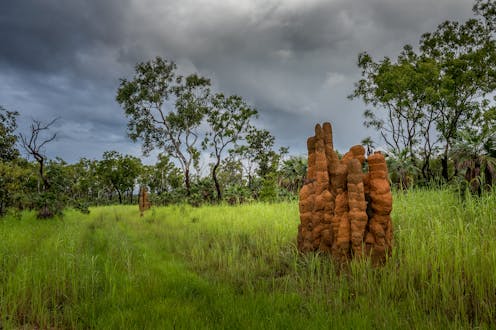
The Northern Territory government’s plan to turn 100,000 hectares over to large-scale crops such as cotton and its support for onshore gas extraction is threatening the world’s largest intact tropical savanna.
This is a region of immense cultural, environmental and economic value. It is home to the World Heritage listed Kakadu National Park and rich biodiversity.
As wildlife ecologists and conservation scientists, we are deeply concerned about plans announced last month that would intensify land clearing.
Accelerating habitat loss would all but guarantee failure of the Australian government’s zero extinctions plan, notwithstanding the fact many of the species placed in harm’s way by fracking and farming are yet to be discovered.
Rather than relaxing regulation to support development, we need to urgently overhaul Australia’s grossly inadequate environmental laws and safeguards, which also lack enforcement.
Earlier this year (2023), the ABC investigated suspicious land clearing in the NT.Read more: EcoCheck: Australia's vast, majestic northern savannas need more care
Land clearing leaves wildlife homeless
When we think of unregulated land clearing and habitat loss in the tropics, impoverished countries in tropical South America, Africa and Asia spring to mind. Not a relatively rich, developed country like Australia.
But across Australia’s tropical north, landscapes are afforded little protection. Land clearing leads to habitat loss, erosion and pollution of waterways.
Threatened species such as the Gouldian finch, black-footed tree-rat, and northern river shark are being put at risk.
Agriculture, including livestock grazing (pastoralism), is by far the greatest driver of land clearing in northern Australia.
The land subject to clearing approvals in the NT increased by 300% between 2018 and 2021. This trend is expected to continue.
First Nations Peoples, environmental scientists, conservation groups, and other members of the public fear the push to develop cotton in the NT will mean clearing a further 100,000 ha. That stems from the 2019 NT Farmers Association business case for the construction of a cotton processing facility in the NT, which is nearing completion.
Weak laws afford limited protection
Our national environmental protection law, the Environment Protection and Biodiversity Conservation Act, relies on self-referral of development activities for assessment.
Proponents of pastoral land clearing projects almost never refer their projects to the Australian government for assessment, even if their projects are set to deplete thousands of hectares of habitat within the known range of threatened species.
This means the potential impacts on threatened species and other natural values supposedly protected by national environmental laws, are never assessed by experts. And there is no mechanism for anyone else to refer the development for assessment.
The NT has no dedicated land clearing or native vegetation management legislation. The Pastoral Land Board approves land clearing across pastoral leases (which cover more than 45% of the territory’s land area). Permits for up to 5,000ha are generally granted without any formal environmental impact assessment.
On one occasion the proponent referred an application to the NT Environment Protection Agency. But it was deemed clearing the 10,000ha would not have a significant impact. So there was no environmental impact assessment required.
Some of the most notable examples of recent uncontrolled land clearing, without any assessment of biodiversity impacts, were for cotton on pastoral land in the NT.
Finally, the current regulatory system covers single development proposals. It is poorly equipped to consider the cumulative impacts of successive individual clearing events.
Fuelling fires and biodiversity loss
The push to extract gas from the Beetaloo Basin represents another major threat to the region. The export of fracked gas from Beetaloo will be facilitated by the Middle Arm Sustainable Development precinct.
This runs counter to warnings from the world’s climate scientists that we must rapidly move away from a reliance on fossil fuels if we are to meet ambitions to keep global warming below 1.5℃.
For northern Australia, climate change means more severe storms, coral bleaching, death of mangroves, more intense and extended dry seasons (with less water for wildlife), and increased fire risk and severity.
Threats may compound upon each other, as invasive gamba and buffel grass that favour and promote fire would be even more likely to thrive and expand.
A better future for Australia’s tropical savannas
To protect Australia’s tropical savannas from uncontrolled land clearing and gas extraction, we need:
Stronger national environment protection legislation. The federal government is in the process of reviewing the EPBC Act. This is a perfect opportunity to recognise and protect our tropical savannas. The new act must have stronger requirements for the formal assessment of all projects that are likely to affect threatened species. It must also take the cumulative impacts of multiple small projects into account, to avoid “death by a thousand cuts”.
New NT-focused environmental law such as a Biodiversity Conservation Act, as proposed by the Environmental Defenders Office, Environmental Justice Australia and the Environment Centre NT, would provide tighter regulation of land clearing. This could also consider greenhouse gas emissions, carbon storage and native food production (bush tucker), as well as the intrinsic cultural values of intact ecosystems.
Most importantly, conservation planning that is community-led, scientifically grounded and respects the wishes and concerns of First Nations Peoples regarding enterprises on and management of Country. Recent pastoral land clearing in the NT has ignored the concerns of Traditional Owners over the loss of Country (despite having legally recognised Native Title on the land).
Avoid repeating past mistakes
While Australia’s tropical savannas are massive in scale, they are increasingly insecure and under significant strain. Against a backdrop of climate change, biodiversity decline and extinction crises, any further development of the north must be subject to rigorous risk-assessment and appropriate environmental protections.
This is essential to ensure any economic benefits justify potential risks. We simply can’t afford to risk repeating mistakes already inflicted on much of southern Australia.
Read more: 'Existential threat to our survival': see the 19 Australian ecosystems already collapsing
Authors: Euan Ritchie, Professor in Wildlife Ecology and Conservation, School of Life & Environmental Sciences, Deakin University


















