

Decades of less rainfall have cut replenishing of groundwater to 800-year low in WA
- Written by: Stacey Priestley, Research Scientist, Environment Business Unit, CSIRO
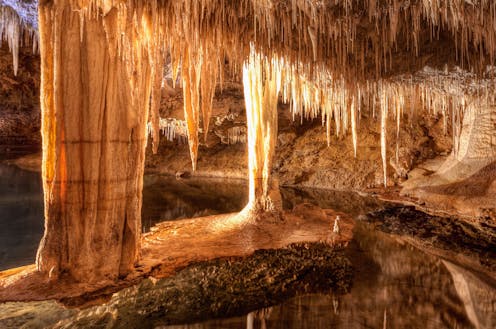
Groundwater is the world’s biggest source of easily accessible freshwater. Despite its importance, we know very little about how this resource is replenished over time. In a world-first study, we have used caves to show the decades-long decline in rainfall in south-west Australia has reduced the replenishment of groundwater in the region to an 800-year low.
Our findings highlight the immediate threat of climate change to water security for communities in the south-west – the region between Geraldton and Albany, including Perth. Groundwater is the major source of water used in Perth and many rural towns.
Rainfall across south-west Australia has been decreasing since the late 1960s. The region’s drying climate means rainfall may no longer be reliably replenishing its groundwater.
Read more: Hidden depths: why groundwater is our most important water source
How can caves tell us about groundwater recharge?
Caves are natural windows into what’s happening underground. In caves, we can directly observe water on its way to becoming groundwater. This is an advantage when we want to understand how rainfall replenishes groundwater (technically known as groundwater recharge).
In this study, we measured seven stalagmite records and also water dripping from the cave ceiling from caves located in the Leeuwin-Naturaliste National Park. Stalagmites grow up from the cave floor in limestone caves. These structures build up when dripping water deposits minerals onto the cave floor.
In our study area, the mineral calcite (CaCO₃) is deposited in layers. The oldest layers are at the base of the stalagmite and the youngest layers at the top.
Read more: Explorers just uncovered Australia’s deepest cave. A hydrogeologist explains how they form
These layers contain a record of past environmental change in the composition of their oxygen isotopes (different naturally occurring forms of oxygen atoms). We measured two of the stable isotopes of oxygen. Our study found both stalagmites and water showed the same change in their chemistry, an “uptick” or rise in the ratio between the two isotopes.
This oxygen isotope record of stalagmites is widely treated as a faithful recorder of changes in rainfall. However, it isn’t that simple in south-west Australia.
We found a change in the oxygen isotope composition of the stalagmites that was ten times greater than the drop in rainfall since the 1960s. This means another process was responsible for the oxygen isotope uptick.
We analysed the water dripping into the caves to help us understand the isotope changes in the stalagmites. We saw differences between water flow types: slower flow through the porous limestone and faster flow along fractures in the limestone, which is known as preferential flow. The faster flow of water had a different oxygen isotope composition, and the uptick in stalagmite oxygen isotopes indicates this flow type has declined in recent decades.
Read more: The world's biggest source of freshwater is beneath your feet
What does this mean for groundwater recharge?
Preferential flow is an important mechanism for rainfall recharge of groundwater. This flow supplies larger volumes of water to groundwater compared to porous flow.
The impact of reduced preferential flow can be seen in the stalagmite image below. A contraction of the growth to the centre of the stalagmite indicates a reduction in drip rate.
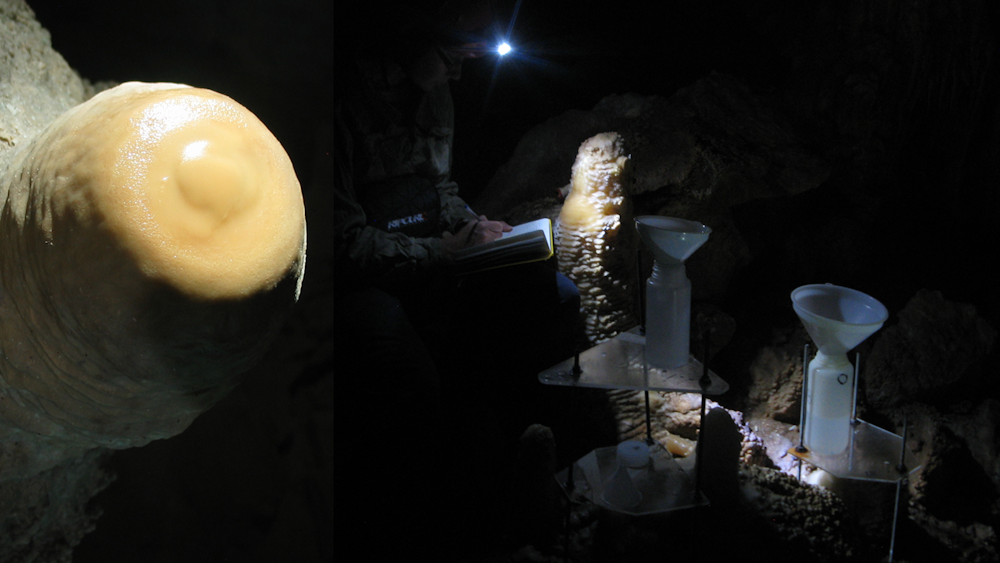
A decline in the local water table from another cave system in the region that began around 1980 matches the beginning of the oxygen isotope uptick. This confirms the decline in rainfall recharge to groundwater.
We now understood how the stalagmite record has captured changes in the groundwater recharge process. We then used the stalagmites to look further back in time to find evidence of previous upticks.
This is the second advantage of having approached this problem using caves. The stalagmite is essentially an archive of past dripwater oxygen isotope composition. Upticks further back in time would indicate if similar reductions in groundwater recharge had occurred.
Importantly, the longer record (shown below) indicates the current reduction in rainfall recharge is unprecedented in the past 800 years.
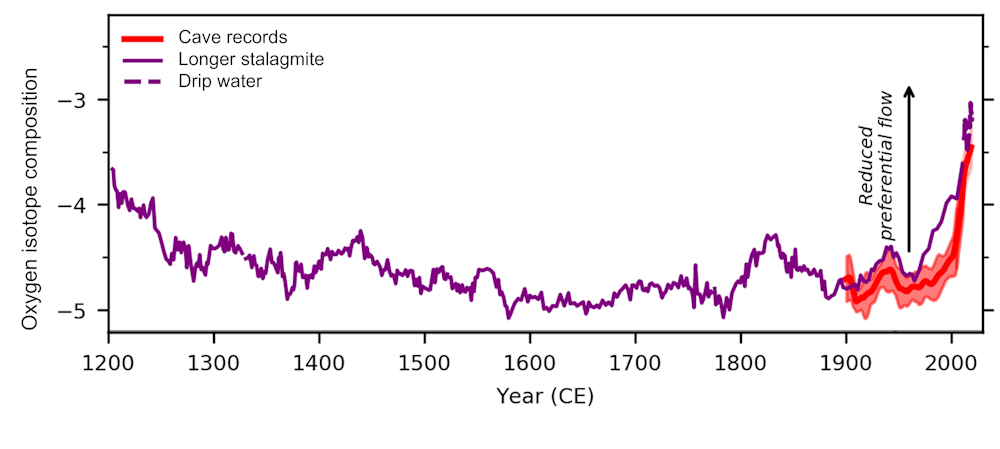 The decline in rainfall in south-west Australia corresponds to an 800-year low in the rate at which groundwater is being replenished.
Priestley et al 2023, Communications Earth & Environment
The decline in rainfall in south-west Australia corresponds to an 800-year low in the rate at which groundwater is being replenished.
Priestley et al 2023, Communications Earth & Environment
What does this mean for the region’s water supply?
South-west Australia’s drying climate and reduced groundwater recharge have important implications for sustainable use of this resource. Groundwater supplies three-quarters of the water used in the region and future groundwater use is expected to increase. These trends also pose a threat to the plants and animals that live in groundwater-dependent ecosystems.
Australia as a whole depends on finite groundwater resources, which are under mounting pressure. Drought resilience is a research focus of CSIRO, ANSTO and UNSW.
Read more: How drought is affecting water supply in Australia’s capital cities
This research includes looking at ways to improve water security, such as water banking. This involves storing water underground using managed aquifer recharge (MAR) techniques. Excess water resources, such as recycled stormwater, are stored when available and used during dry years or a drought.
We are now working towards extending the record further back in time to 10,000 years ago. Our aim is to understand when groundwater was recharged and under what past climate scenarios. This knowledge will give us a better understanding of the limits and sustainability of this vital resource for communities that rely heavily on groundwater.
Authors: Stacey Priestley, Research Scientist, Environment Business Unit, CSIRO


















