

The ancient practice of livestock guardian dogs is highly successful on Australian farms today
- Written by: Christopher Johnson, Professor of Wildlife Conservation, University of Tasmania
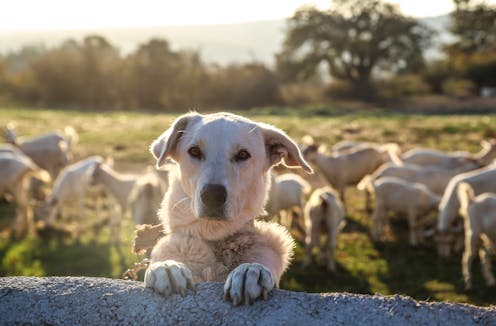
Guardian dogs do a great job of protecting Australian livestock from predators.
In a new survey of Australian farmers, we have found that with correct management, these dogs can be very effective in the long term, and at a lower cost than alternative methods. These findings should inform policy on livestock management.
An ancient practice
The use of guardian dogs for livestock protection has a long history – farmers have been using dogs to protect their livestock from predators for thousands of years.
The earliest evidence of this dates to 9,000 years ago in southern Greece. Books on agriculture written 2,000 years ago in ancient Rome made it clear that livestock guardian dogs were essential for successful farming and gave detailed instructions on their selection and management.
Guardian dogs remained important throughout Europe and Asia until the twentieth century. Then, their use declined because of widespread extermination of predators and they were almost forgotten.
Now, livestock guardian dogs are making a comeback. They allow farming to coexist with wild predators, improving both biodiversity conservation and profitability of farming.
Read more: A strong-eyed style: what makes Australian muster dogs unique
Members of the flock
In Australia, dingoes and foxes are major threats to livestock. Farmers usually respond to this threat by killing predators or fencing them out, but these methods are costly and don’t always work.
Instead, some farmers have turned to guardian dogs for help.
Traditionally, guardian dogs worked with shepherds; in modern farming they usually work independently. Pups are raised in close contact with livestock and bond with them. As adults they essentially become members of the flock or herd, giving it continuous protection and (in some respects) leadership.
This way of protecting livestock is still rare in Australia. Ten years ago we assessed its effectiveness by surveying 150 farmers who were using livestock guardian dogs. We found the dogs were very successful. Farmers reported that when they introduced guardian dogs to their farms, livestock losses dropped from previously high levels, often to zero.
Success was as high on very large properties with many animals to protect as it was on small farms.
Good for the long haul
But we had a lingering worry. What if it is just too hard to keep this system working in the long term? Maybe predators initially avoid farms protected by guardian dogs but eventually learn to outsmart or intimidate them and go back to killing livestock; or perhaps farmers find guardian dogs too difficult to manage in the long term and give up on them.
For our new research, we re-surveyed the same farmers to ask how they fared over the intervening decade. Were they still using guardian dogs? If so, were the dogs still working well, and if not why had the farmer stopped using them? Either way, we wanted to know what problems they had faced.
Half the farmers in our original sample no longer used guardian dogs, but this was mostly because they had retired or otherwise changed their business such that the dogs were not needed, not because they had failed.
Some farmers gave up on guardian dogs because of two kinds of problems: 24% had trouble with dog misbehaviour, and 19% had trouble with neighbours who objected to the presence of these dogs close to their own farms.
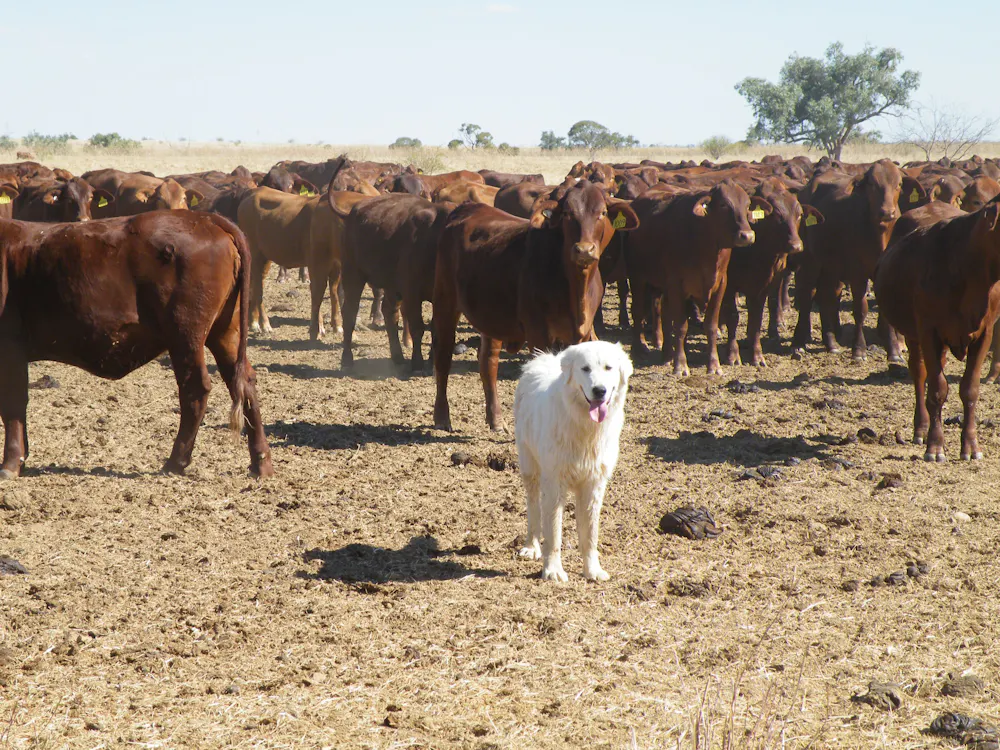
Almost all farmers (96%) still using guardian dogs said they protected livestock as well as they had done ten years earlier. The two exceptions were cases where livestock numbers had increased without a matching increase in the number of dogs.
All farmers who still used guardian dogs said they would recommend them to other farmers. That was also true of almost all farmers (98%) who had stopped using guardian dogs. That is, even those who had trouble with their dogs still saw their potential value.
Because of these good reviews, use of guardian dogs is evidently rising. We asked our participants how many other farmers had started using guardian dogs as a result of personal contact with them. From the answers, we estimate that farmer-to-farmer contact is increasing the total number of Australian farms with guardian dogs by 5% per year.
Read more: Watching over livestock: our guardian animals
A policy for the future
There is a message here for government policy. The evidence from our own and other research is that livestock guardian dogs protect livestock more successfully and at a lower cost than alternative methods.
We now know that once established on a farm, guardian dogs can continue to work well for the long term. The problems our farmers encountered could largely be resolved by expert help in managing dog behaviour and provision of better information to the general farming community.
Government agencies that met these needs could reduce the failure rate of guardian dogs and increase uptake beyond the currently modest rate driven by word of mouth.
 Maremma pups learning to be sheep guardians in Victoria.
Linda van Bommel, Author provided
Maremma pups learning to be sheep guardians in Victoria.
Linda van Bommel, Author provided
However, no Australian government currently provides any support or encouragement for farmers to use guardian dogs. The lack of government interest in this proven method of livestock protection is in stark contrast to the official support provided for fencing and killing predators.
We believe that relevant government agencies should develop programs to support and promote wider use of livestock guardian dogs in Australian farming.
This would not only help farm businesses but also bring environmental benefits. In particular, guardian dogs could help solve the vexing problem of management of dingoes.
Dingoes are good for ecosystems, and they help landholders by controlling populations of species like kangaroos and feral goats that can overgraze habitat and compete with livestock. But dingoes can be devastating predators of some livestock, especially sheep.
Livestock guardian dogs offer a way to cut through this dilemma, retaining dingoes while keeping livestock safe.
Read more: Dingoes do bark: why most dingo facts you think you know are wrong
Authors: Christopher Johnson, Professor of Wildlife Conservation, University of Tasmania


















