

Victoria Amelina, killed by Russian rockets, joins a procession of Ukrainian writers whose lives were cut short by oppressors
- Written by: Marko Pavlyshyn, Emeritus professor, Monash University
Histories of modern Ukrainian literature are often as much about writers’ lives as their works. This is scarcely surprising.
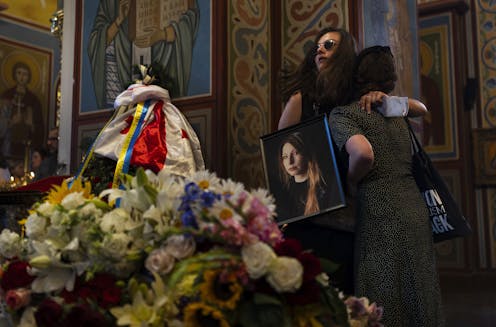
Ukrainian writer Victoria Amelina died on 1 July, from injuries she received during a Russian rocket strike on the city of Kramatorsk on 27 June.
She joins a sombre procession of Ukrainian writers and poets whose lives were blighted or violently cut short by hostile states that oppressed their homeland. They enjoy heroic status in the nation’s collective imagination.
Literature in the Ukrainian language has been one of the foremost vehicles for asserting the identity of Ukrainians as a nation and claiming the rights of that nation to be free from imperial overlords.
Taras Shevchenko is a poet of unparalleled Romantic invective against tsarist autocracy and colonialism. His symbolic aura was enhanced by his birth into serfdom and his ten-year exile.
Esteem for the challenging poetry of Vasyl Stus is amplified by reverence for the 13 years he spent in the Gulag, where he died in 1985.
The many innovative Soviet Ukrainian writers and artists of the 1920s, known collectively as “the Executed Renaissance”, are remembered no less for their works than for the fact they were killed or imprisoned in the 1930s.
It will never again be possible to read Victoria Amelina’s works without knowing she died as one of thousands of victims of a war launched against Ukraine by Russia – with the intent of seizing Ukraine’s territory, ending Ukraine’s sovereignty and erasing Ukrainian identity.
Ukrainian writer Andrey Kurkov remembers his friend Victoria Amelina.An intellectual and advocate
Victoria Amelina’s life was punctuated by fateful turns. Born in Lviv in 1986, she emigrated to Canada. She might have stayed in the safety and comfort of a Western country, but she returned to Ukraine.
A computer science graduate of the Lviv Polytechnic University, she embarked on a career in information technology. She might have continued to reap the benefits of being a member of Ukraine’s IT elite. But, as she put it,
the life of a programmer and manager, the multicultural business environment, the freedom conferred by money – at a certain moment all this began to feel like nothing, a mistake.
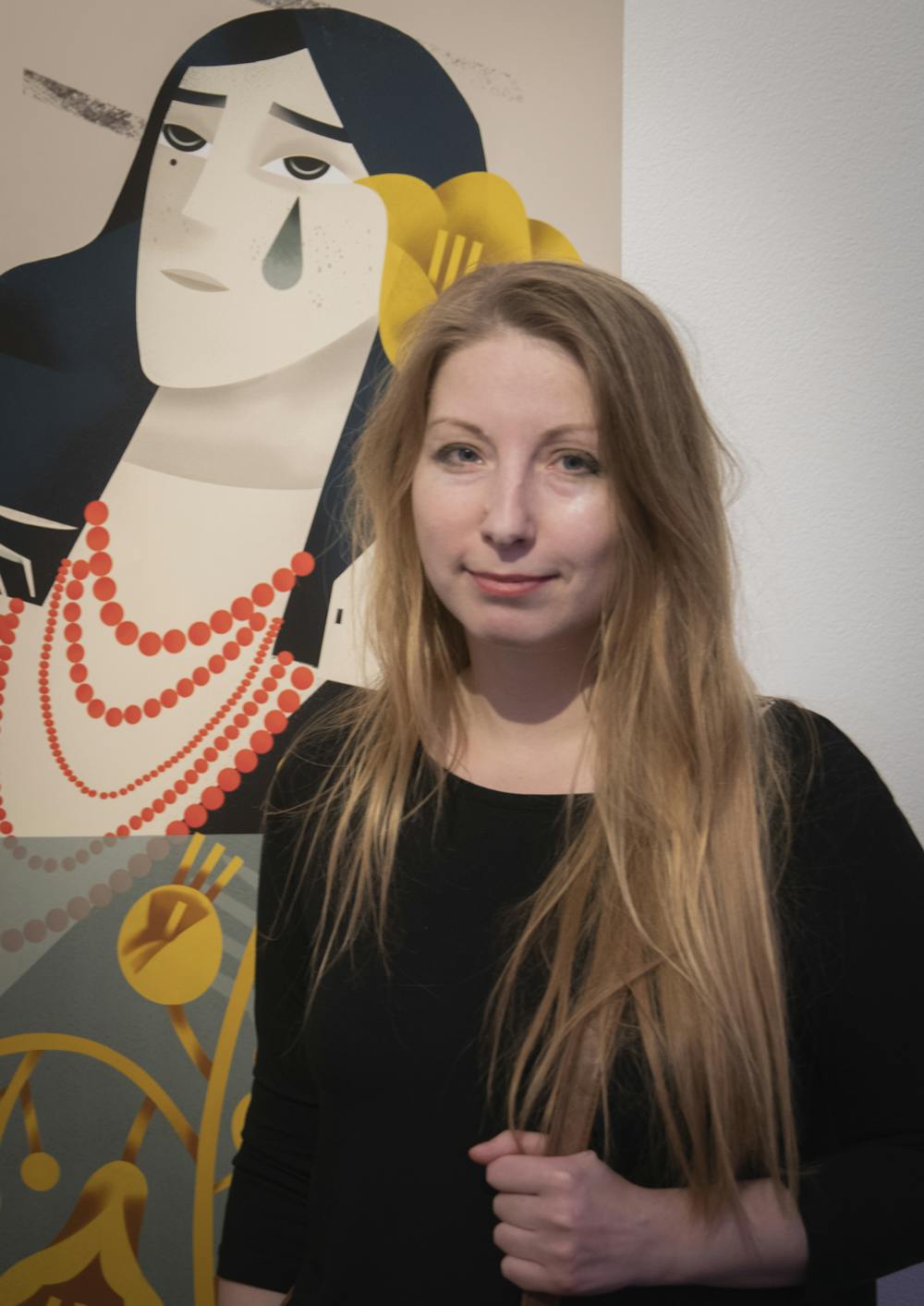
She turned to writing instead. When Russia launched its full-scale invasion, Amelina reflected on the war in literary works. And she advocated for Ukraine as a public intellectual. But she also worked as a humanitarian aid volunteer and gathered evidence of Russian war crimes in newly liberated parts of Ukraine.
Indeed, practical action at times of crisis was a central theme of her first novel, The November Syndrome: Homo compatiens (2014). It was one of the first literary works about the Euromaidan, the 2014 protests against Russian-backed president Viktor Yanukoych, after he failed to sign an agreement with the European Union and introduced new laws restricting protest.
Read more: Four years after the Euromaidan revolution in Ukraine: key gains and losses
Ethics, responsibility and temptation
The November Syndrome dealt with the ethical person’s responsibility to combat suffering and injustice – even when the task seems hopeless and the temptation of retreat into a comfortable private life seems insurmountable.
The central character, the “compassionate human being” of the novel’s subtitle, suffers from the curse (or gift) of empathising so profoundly with other human beings that he enters into their consciousness and experiences their tribulations with them. However much he yearns to cure himself of this state – “a madness, an illness, a gene mutation” – he cannot.
He vicariously suffers with the protesters of the Arab Spring in Tunis and on Tahrir Square in Cairo. Finally, he cannot resist joining the Euromaidan protests in Kyiv – not in his mind this time, but in fact.
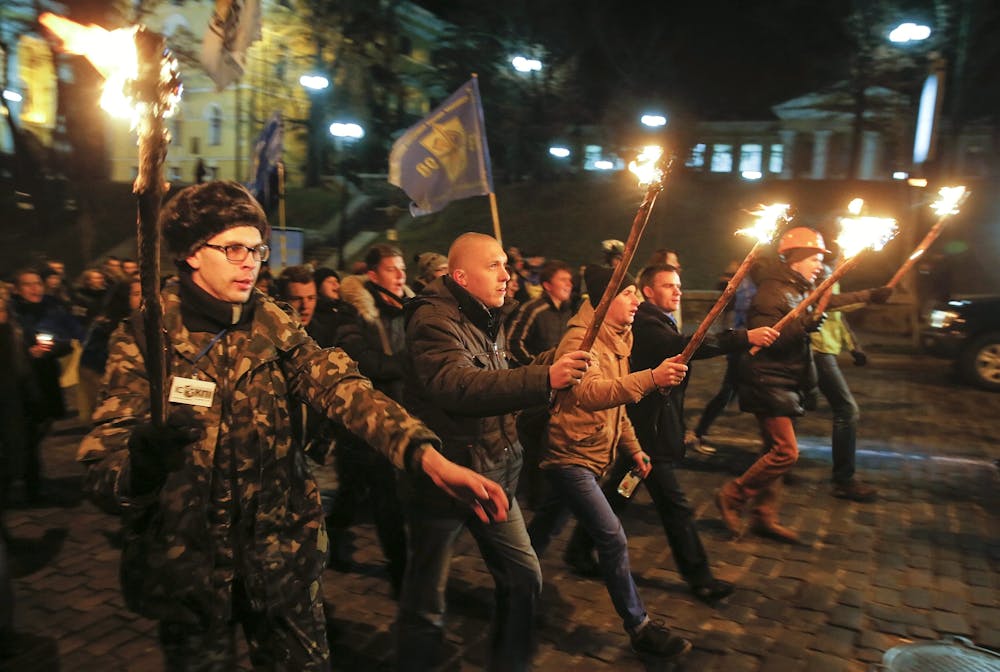 Ukrainians carry torches as they mark the first anniversary of the Euromaidan Revolution on the Independence Square in Kyiv.
Sergey Dolzhenko/EPA
Ukrainians carry torches as they mark the first anniversary of the Euromaidan Revolution on the Independence Square in Kyiv.
Sergey Dolzhenko/EPA
Victoria Amelina’s debut novel is one of many important Ukrainian works of fiction that place contemporary events into historical and global context, and address questions of individual and collective responsibility for events present and past.
Among them are Serhiy Zhadan’s Orphanage (2017), Oksana Lutsyshyna’s Ivan and Phoebe (2019) and Sophia Andrukhovych’s Amadoka (2020).
It is a sign of the meagre extent to which Ukrainian culture is present to the West that only Zhadan’s novel has so far been published in English translation.
It is a convention of contemporary Ukrainian literary culture that serious fiction must not be too straightforwardly realistic. The November Syndrome meets this expectation by combining vivid representation of social reality – of peaceful and violent moments of the Euromaidan, for example – with a plot based on the fantastic premise of the hero’s congenital hypercompassion.
Compassion, sympathy and the dangerous past
Amelina’s second and only other published novel, A Home for Dom (2017), also follows this convention. Its exquisitely detailed and plausible painting of urban life in the twilight years of the USSR and the dawn of Ukraine’s independence is framed as a first-person narrative told by a poodle named Dominicus (or Dom, for short).
A critic has called A Home for Dom a family novel with a central character whom “we prefer not to see, hear or, as far as possible, remember: Soviet Lviv”. The family in question consists of five women and one man, members of three generations, déclassé relics of the old Soviet military elite.
To different extents, they modify their loyalties and identities as they experience (mourn, endure or accept) the emergence of a new Ukraine, where a coloniser’s foreignness is no longer an advantage.
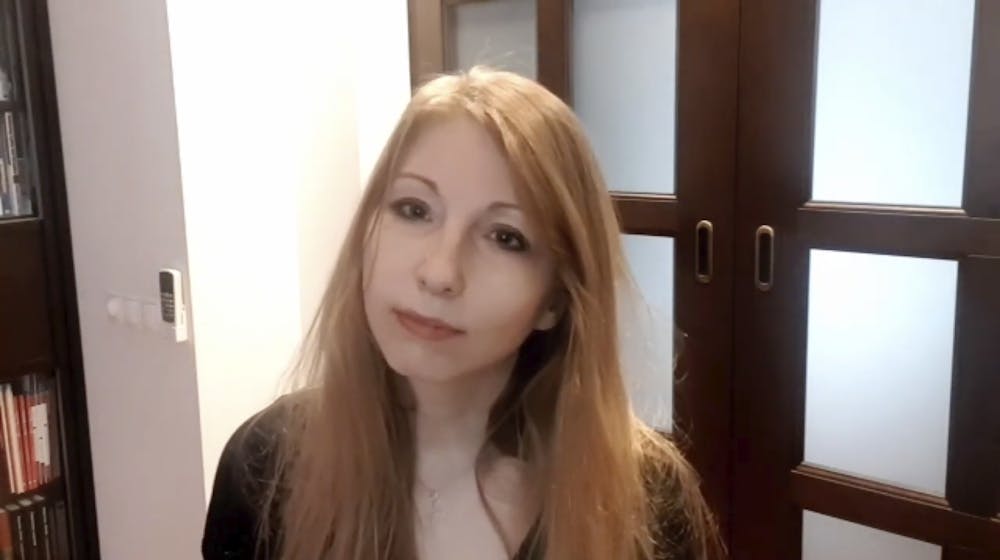 Victoria Amelina’s second novel ‘exquisitely’ explores life in the twilight years of the USSR and the dawn of Ukrainian independence.
Konkakt/AAP
Victoria Amelina’s second novel ‘exquisitely’ explores life in the twilight years of the USSR and the dawn of Ukrainian independence.
Konkakt/AAP
As one would expect of a novel by the author of The November Syndrome, A Home for Dom is a compassionate book that invites sympathy for all its characters. None of them have simple values, convictions or desires.
The pangs of transition all of them suffer are exemplified by the life trajectory of Olia. A history teacher, she must switch from teaching the Soviet historical narrative to the patriotic Ukrainian one.
She loses her teacher accreditation for lack of a bribe, learns to run a street kiosk in the criminalised new economy, falls into a relationship with a businessman (who alongside shadier activities, deals in antiques) and ends up using her historical expertise to concoct stories for his customers – “ones they want to hear. About Jews, or the insurgency, or the KGB.”
The real past, however, is a dangerous place where only the lucky survive. The old colonel, the sole male denizen of the Lviv apartment, is one of them:
he was not killed, repressed, or marched under convoy for interrogation; he was neither a priest, nor an aristocrat, nor Jewish nor Roma, nor a bourgeois nationalist, nor a Polish prisoner of war, nor an all-too-ardent communist.
No less dangerous is the present, where living in Ukraine is to risk losing your life to Russian rocket fire, as you sit down to a meal with your Colombian guests.
A literary legacy
Victoria Amelina’s literary legacy is not large: other than the two published novels, it comprises some writing for children, an unfinished novel in English, essays, and some lyrical poetry.
The invasion inspired her to write the powerful polemical essay Cancel Culture vs. Execute Culture, which decries the West’s enchantment by Russian literature, whose complicity in Russian imperialism it routinely overlooks.
And it inspired her to publish some equally forceful poems, on the internet.
In one of them, Victoria Amelina proposes a new and bitter take on her perennial theme, the sharing of experience with another:
Why do you resemble them? / You’re brothers, perhaps?
No, our arms crossed / not in embrace, but in battle / Our blood mingled with the earth / from which they gathered our harvest / Our eyes shed tears / that turned to ice / outside the gates of the warm cities / from which they banished us Our language was burnt alive / after shouting on the Maidan / And we picked another / like a stranger’s rifle / And from convicts’ books we learned / the pathways of the prison labyrinth / Our mother cursed us / so that we would resemble those who slay / not our slain father / So that we would die not in a slaughterhouse / but in battle
When our battle begins / You had better not ask / Why we resemble those / who have been killing us since time began
Authors: Marko Pavlyshyn, Emeritus professor, Monash University


















