

China is pumping out carbon emissions as if COVID never happened. That's bad news for the climate crisis
- Written by: David Stern, Professor, Crawford School of Public Policy, Australian National University
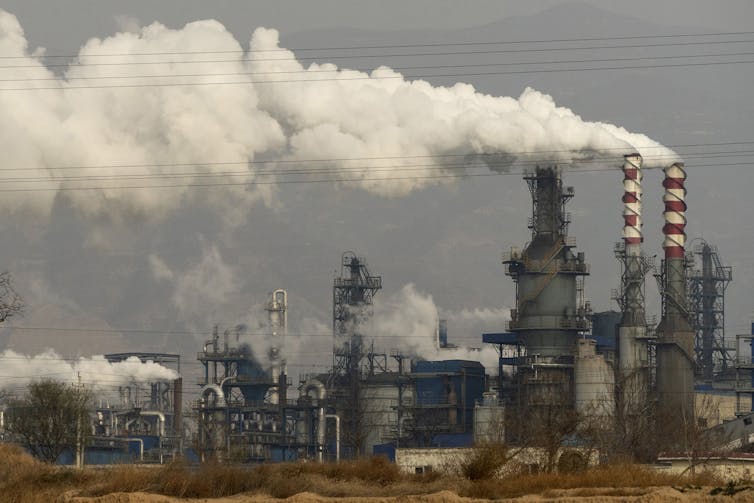
Carbon emissions from China are growing faster now than before COVID-19 struck, data show, dashing hopes the pandemic may have put the world’s most polluting nation on a new emissions trajectory.
We compared emissions in China over the first four months of 2019 – before the pandemic – and 2023. Emissions rose 10% between the two periods, despite the pandemic and China’s faltering economic recovery. Power generation and industry are driving the increase.
Under the Paris Agreement, China has pledged to ensure carbon emissions peak by 2030 and reach net zero emissions by 2060. Our analysis suggests China may struggle to reach these ambitious goals.
Many believed the economic recovery from COVID would steer global development towards a less carbon-intensive footing. But China’s new path seems to be less sustainable than before. That’s bad news for global efforts to tackle climate change.
An alarming trend in emissions
The COVID pandemic curbed greenhouse gas emissions in 2020, largely due to a drop in passenger travel. This led to hopes of a “green” economic recovery in which government stimulus spending would be invested into climate-friendly projects, to ensure a longer-term slowing of growth in emissions.
Some researchers examined the trends in China’s emissions up to 2019 and predicted the nation’s emissions would peak by 2026. Others have said the peak will occur even earlier, in 2025.
But unfortunately, it seems those predictions were too optimistic.
We examined data from Carbon Monitor, which provides science-based estimates of daily CO₂ emissions across the world. We compared emissions data from January to April 2019 (which represents typical pre-pandemic conditions in China) with the corresponding months in 2023. This period followed the removal of most COVID-related restrictions in China – such as testing requirements and quarantine rules – which essentially restored the country’s economy to business-as-usual.
We found average daily carbon emissions increased substantially between the two periods. In the first four months of 2019, China’s transport, industry, energy and residential sectors together emitted an average 28.2 million tonnes of CO₂ a day. In the first four months of 2023, daily emissions from those sectors were an average 30.9 million tonnes.
Emissions from the residential and transport sectors didn’t change much. This is mildly good news – it’s better than emissions going up. But these are the two smallest sectors, together accounting for only 18% of China’s emissions.
Rather, the increase was driven by emissions from China’s industrial and energy sectors. Average daily emissions from industry rose between 2019 and 2023 by 1.1 million tonnes or 11%. From energy, which includes electricity generation, they rose by 1.75 million tonnes or 14%.
Energy production from solar and wind in China did increase substantially between the two periods. But the growth was outweighed by electricity generated from fossil fuels.
Separate data show the growth of coal production in China has accelerated. In the two years prior to the pandemic, coal production variously fell or only grew slightly. But coal production grew during the pandemic, and this has continued. In the year to April 2023, coal production increased by about 5%.
While coal’s share of energy consumption fell substantially from 2007 to 2019, it has changed little since then. That’s mainly because energy use is growing fastest in the electricity sector, which remains dominated by coal.
The global picture
Emissions in many developed countries have fallen in recent years due to government policies, slow economic growth, and the shift from coal to natural gas.
Developing nations increasingly dominate global emissions. China might be expected to be a leader on the clean energy shift among developing countries – in part because it produces much less oil than it consumes. That means its energy supply is not secure, giving it an incentive to find alternative sources of power.
There’s another reason why China should be a trailblazer on emissions reduction. China is the world’s biggest emitter – so a percentage reduction in emissions there leads to far fewer tonnes of CO₂ in the atmosphere than if a smaller country reduced emissions by the same percentage. And, partly because China’s population and economy are so big, it stands to benefit more than any country in the world from a more stable global climate.
But as we’ve outlined, China’s trajectory is by no means world-leading. What’s more, moves by China on the international stage suggest it’s becoming less cooperative in climate negotiations than in recent years. We saw this at the COP27 global climate conference in Egypt late last year, when China did not join a pledge to curb methane emissions and refused to provide financial support to developing nations vulnerable to climate change.
The potential for cooperation on climate policy is being reduced further by ongoing tensions between China and the United States. All this serves to cast doubt on China following through on its Paris pledges – and certainly, on any chance its emissions will peak in the next two years.
Read more: Why are so many climate records breaking all at once?
Authors: David Stern, Professor, Crawford School of Public Policy, Australian National University


















