
New transmission lines are controversial for nearby communities. But batteries and virtual lines could cut how many we need
- Written by: Lasantha Meegahapola, Associate Professor, RMIT University
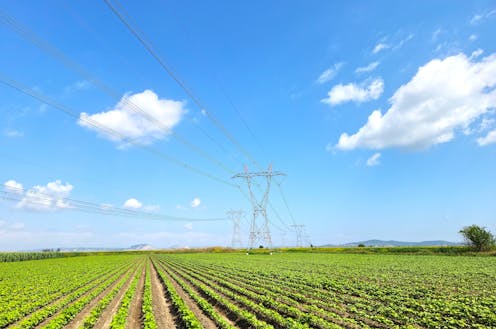
Australia’s power grid was built to transport power from coal-fired power stations or the Snowy Hydro scheme to large cities and industrial precincts. The large transmission lines were designed with generation supply and demand, the shortest routes, and cost in mind.
But this ageing grid isn’t designed to cope with a green future where power flows into the grid from solar farms and windfarms on land and out at sea. To cope, Australia’s energy market operator is proposing over 10,000 kilometres of new transmission lines, linking major renewable precincts with the cities.
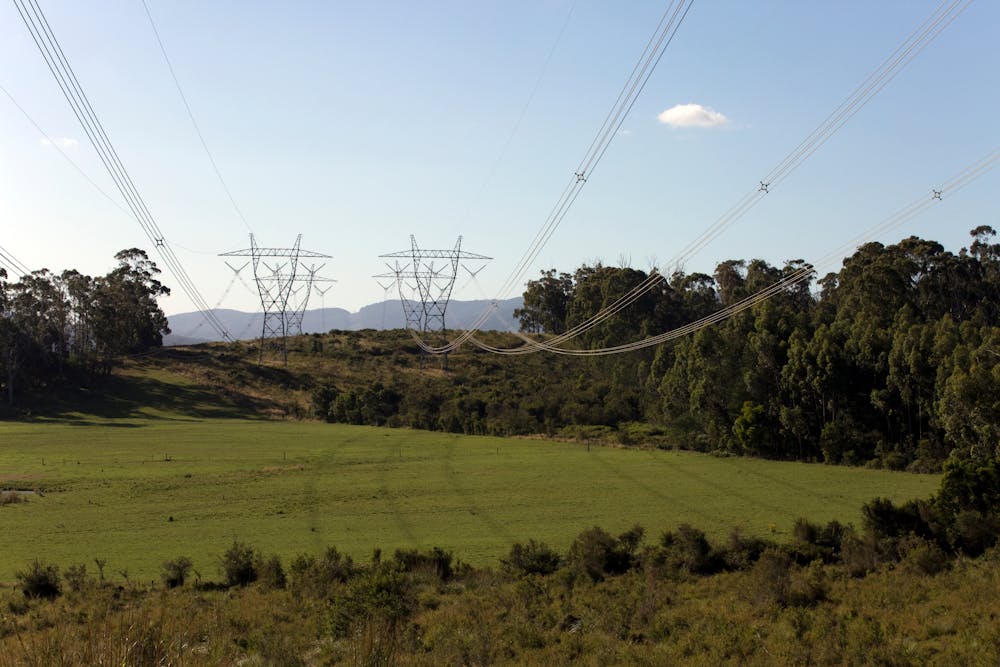
The problem? No one likes having large, unsightly lines built near them. There’s already been strong pushback from communities near sites slated for new power lines. Community resistance has now forced the federal government to launch a review of how transmission projects are approved.
The good news is, some alternatives to large-scale transmission lines have come of age. Grid-scale battery banks have already proven their use to store intermittent flows of green electricity for later. And we may be able to build more lightly if we adopt dynamic line rating, which means letting more power flow through when, say, cold winds cool the lines and stop them overheating. Western Australia – which has its own grid – is having success with microgrids as a way to avoid having to send power long distances.
How can we minimise new transmission lines?
Coal power was concentrated in coal-rich areas such as the LaTrobe Valley in Victoria and the Hunter Valley in New South Wales.
But the best renewable resources are often located in different places. That means a green grid has to connect new renewable zones such as Victoria’s Murray River zone and New South Wales’ Illawarra zone. (Some coal areas, like the LaTrobe Valley, will be able to take advantage of resources such as offshore wind and pair this with existing transmission infrastructure).
We will have to build some new transmission infrastructure. That’s unavoidable. But we can do this cleverly and minimise the impact on communities and landowners.
How? Battery banks allow us to store energy for later use. So if new transmission lines are built leaner and smaller, we could use these grid batteries to store excess energy and transmit it later.
Dynamic line rating offers another way to reduce the scale of new transmission lines.
Every transmission line is rated to a certain power capacity. A key factor limiting how much electricity can flow through a given line is heat. As electrons move, they produce heat. Too high a current and the line will overload.
But if, say, the wind is blowing strongly, it can cool the power lines and let them carry more capacity. That’s especially useful in a grid with a lot of wind energy flowing in. When the weather conditions are right, it could mean carrying as much as 20% more current.
Aren’t grid batteries more about reliability?
At present, large-scale lithium batteries are the most technically viable way to store electricity relatively cheaply. These are already up and running. South Australia’s Hornsdale battery was one of the first, but other states are now joining in. Victoria recently installed a new big battery on the site of a former coal power station.
To date, these batteries have mainly been used to firm up output and boost system reliability.
But they can do more. We can use them as virtual power lines, storing excess power close to a renewable zone and transmitting it to another storage system close to cities and towns as the peak load arrives.
The virtual power line concept has been adopted in Germany and Chile to relieve transmission systems at risk of congestion when bursts of renewable power arrive.
We can even use them as virtual reservoirs, storing energy from hydro plants for later transmission.
 Grid-scale batteries like this 250 MWH battery on Torrens Island, near Adelaide, can do much more than just firm up the existing grid.
Matt Turner/AAP
Grid-scale batteries like this 250 MWH battery on Torrens Island, near Adelaide, can do much more than just firm up the existing grid.
Matt Turner/AAP
How can we put these to use?
It’s in everyone’s interests to minimise how many new transmission lines we build. For the government, being able to reduce the size of the build means savings – and less demand on our already stretched workforce. And for local communities, it means some – but not all – new lines could be avoided.
How do we make it a reality? Essentially, by embedding these new approaches into the way we plan for the electricity grid of the future. When considering any new transmission lines, planners should assess whether part of the needed transmission capacity could instead be provided by virtual powerlines in the form of batteries, and whether the area is suitable for dynamic line rating schemes.
If we integrate these methods of making the most out of our grid’s capacity, we could keep the number of new lines to the minimum while ensuring we can take clean power from where it’s produced to where it’s needed.
Authors: Lasantha Meegahapola, Associate Professor, RMIT University


















