
The furry puss caterpillar's venom packs a painful punch. Now new research shows it came from an unlikely source
- Written by: Andrew Walker, Postdoctoral Research Fellow, Institute for Molecular Bioscience, The University of Queensland
Did you know venom – a toxic substance injected by one animal into another – has evolved around 100 times?
In our laboratory at the University of Queensland, my colleagues and I study all kinds of venomous animals. One reason we do this is to find new molecules that can be used in medicines, or as bio-friendly insecticides.
Scientists have used venom toxins from snakes, spiders and scorpions in various medical contexts, including to lower blood pressure, protect against stroke, and label tumours during surgery.
There are several other groups of venomous animals, such as assassin bugs and robber flies, which have been largely neglected – yet their venom may prove to be just as useful to humans.
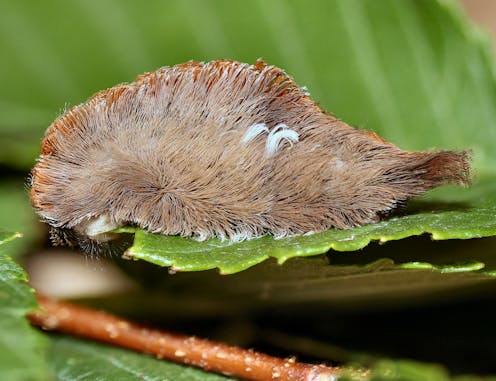
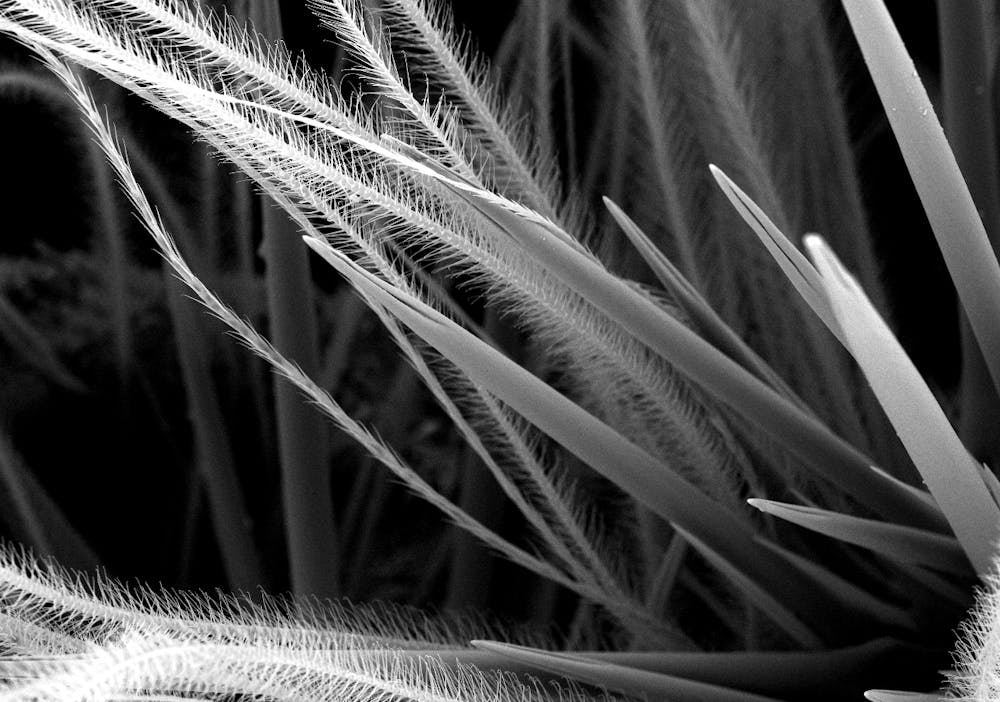
In research published today in the Proceedings of the National Academy of Sciences, our team investigated the venom from a group of caterpillars called asp caterpillars, which are notorious for their ability to cause excruciating pain. They’re also called puss caterpillars since they sport long, soft hairs that have been dubbed “toxic toupées”.
We were surprised to find the main painful toxins in asp caterpillars belong to a family of molecules usually found in disease-causing bacteria. We discovered that a gene that codes for this kind of toxin hopped from bacteria to the ancestors of moths and butterflies millions of years ago, in a phenomenon called horizontal gene transfer.
Float like a butterfly, sting like a bee
The insect group Lepidoptera, which we usually think of as butterflies and moths, are my favourite venomous animals. Interestingly, it’s always the larval forms (caterpillars) that are armed with venom, and not the adults. We think this is because caterpillars are particularly helpless against predators, and therefore need special defences.
This is also why venom has evolved multiple times just within Lepidoptera. Unlike most arthropods, which use venom for hunting, caterpillars are among a select few (including bees) that use it purely to defend themselves from predators.
However, the venom of some of these caterpillar groups, including asp caterpillars, has never been examined with modern methods.
Evolution by horizontal gene transfer
People who have been stung by asp caterpillars have described the feeling as being similar to “touching burning coals” or “being hit with a baseball bat”. We set out to find what this venom contains and how it can inflict such incredible pain.
Asp caterpillars aren’t found in Australia, so I had to travel to Florida to collect them from oak and elm trees. Although I couldn’t return with live individuals (due to the threat of invasive species), with the help of some US researchers I was able to bring some venom and preserved caterpillars back to the lab for analysis.
We used a variety of imaging and molecular techniques to build a picture of where the venom is made, what kinds of toxins it contains, and how those toxins produce pain.
Surprisingly, when we looked at the structures of the main pain-causing toxins, we found they belonged to a toxin group usually produced by bacteria, including disease-causing bacteria such as E. coli and salmonella. These caterpillar toxins work by punching holes in cells – the same mechanism the bacterial toxins use to inflict damage on humans.
When we analysed the family tree of the toxins in detail, we found a gene that codes for this kind of toxin had “hopped” from a bacterium to the ancestors of butterflies and moths hundreds of millions of years ago.
These hopping events are called horizontal gene transfer to distinguish them from the vertical transfer of genes from parents to offspring. These events are very rare.
In the case of asp caterpillars, DNA from the infecting bacteria would have not only had to come into contact with the ancestral caterpillar, but also get incorporated into its DNA, inside the cells that would become sperm or eggs (and be passed on to subsequent generations).
We know of only a few examples of the horizontal gene transfer of venom toxins.
Harnessing nature’s resources
Our study shows evolution and life are weirder and more complex than we usually assume. Beyond this, projects like this can also help us discover new ways in which venom toxins may benefit humans and the environment.
For example, toxins that make holes in cell membranes are already being investigated for their ability to deliver lifesaving drugs to the inside of cells.
Another potential application is in engineering toxins that could punch holes in cells to selectively kill cancer cells, while leaving normal cells intact. Our ability to develop such new technologies depends on discovering and understanding the molecular resources that exist in nature.
Read more: Ever wondered who'd win in a fight between a scorpion and tarantula? A venom scientist explains
Authors: Andrew Walker, Postdoctoral Research Fellow, Institute for Molecular Bioscience, The University of Queensland


















