
The true origins of the world's smallest and weirdest whale
- Written by: Nic Rawlence, Senior Lecturer in Ancient DNA, University of Otago
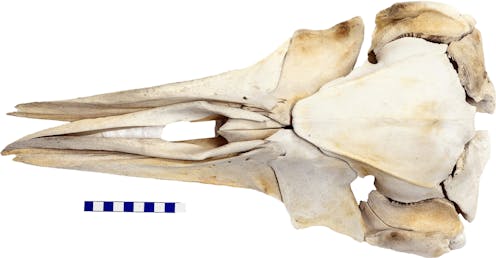
The pygmy right whale, Caperea marginata, is the weirdest whale you’ve probably never heard of.
It is the smallest of the living baleen whales and restricted to the Southern Hemisphere.
Its tank-like skeleton is unique among whales, and its ecology and behaviour remain virtually unknown. Even its mitochondria – the power plants of the cell – seem to be ticking differently.
Because Caperea is so unusual, its evolutionary relationships have long been a bone of contention.
Our new study in the international Marine Mammal Science journal finally solves this enduring mystery.
You are what you eat?
For 150 years, anatomists considered Caperea a relative of right whales.
Then came the age of DNA, and Caperea was reinterpreted as a distant cousin of rorquals, which include the mighty blue whale, humpback and minke whale.
Many scientists remained unconvinced, however, leading to decades of acrimonious debates over bones, fossils and molecules.
For more than a century, the case for Caperea being a right whale seemed sound. Sure, it looked weird and small, but its feeding strategy was a dead ringer.
Like right whales, Caperea uses long, finely-fringed baleen plates to skim tiny crustaceans from seawater. Also like right whales, it has a hugely arched snout to accommodate its long baleen, which water and prey stream past continuously during feeding.
Now compare this to rorquals. Unlike Caperea, they feed in short bouts during which they engulf enormous amounts of water and prey in expandable throat pouches. They then expel the water through their short, coarsely-fringed baleen and trap any prey inside the mouth.
The implications of this brief comparison are obvious: Caperea resembles right whales far more than it does rorquals, and so must have the same evolutionary origin.
Morphology versus molecules
Molecular data for Caperea first became available in the 1990s and immediately challenged the traditional view. Time and again, genes allied Caperea with rorquals, rather than right whales.
Such disagreements are normal in science and do not diminish the importance of anatomy, which, after all, remains the only way to study the 99% of species that are already extinct. But anatomical family trees have a nemesis: convergence.
Convergent evolution happens when unrelated species evolve similar traits. Just think of the streamlined bodies of sharks, whales and the extinct ichthyosaurs. Could this be what happened to Caperea?
As molecular evidence mounted, geneticists began to accept Caperea as a distant rorqual relative. Anatomists, however, disagreed.
Fuelling the debate was the fact that only some of the DNA of Caperea had actually been sequenced. Interpreting such a subset is risky, as each gene can have its own unique evolutionary history.
Read more: Northern exposure: fossils of a southern whale found for the first time in the north
Also unhelpful was the deplorable fossil record of pygmy right whales. Sometimes, key fossils can settle evolutionary debates, as happened in 2001 when two pivotal finds confirmed the origin of whales from hoofed mammals.
Caperea, however, remains largely alone. Even though its lineage is undoubtedly ancient, we only know of six related fossils worldwide.
With both traditional genetic and fossil approaches at a loss, where else was there to turn? Enter genomics.
What our DNA testing revealed
Genomics studies all of an organism’s DNA – its entire molecular blueprint. DNA ultimately determines body shape, so comparing genomes should either corroborate anatomical family trees or expose the effects of convergence.
Sequencing genomes is costly and took a long time to achieve at scale. Even so, recent years have seen huge advances and produced genomes for most baleen whales. Except, you guessed it, the elusive Caperea.
Here is where our study comes in. Using a sample from a stranded individual from South Australia, we finally sequenced the genome of the pygmy right whale.
Unbeknown to us, a separate research group in Europe had had the same idea. Both teams published their results within a few weeks of each other.
Crucially, their conclusions were the same: Caperea is indeed related to rorquals like the blue whale. Its similarities with right whales are the result of similar feeding strategies, rather than genetics.
So what is Caperea really?
Proving that Caperea is not a right whale raises another question: why is it so unlike its rorqual cousins?
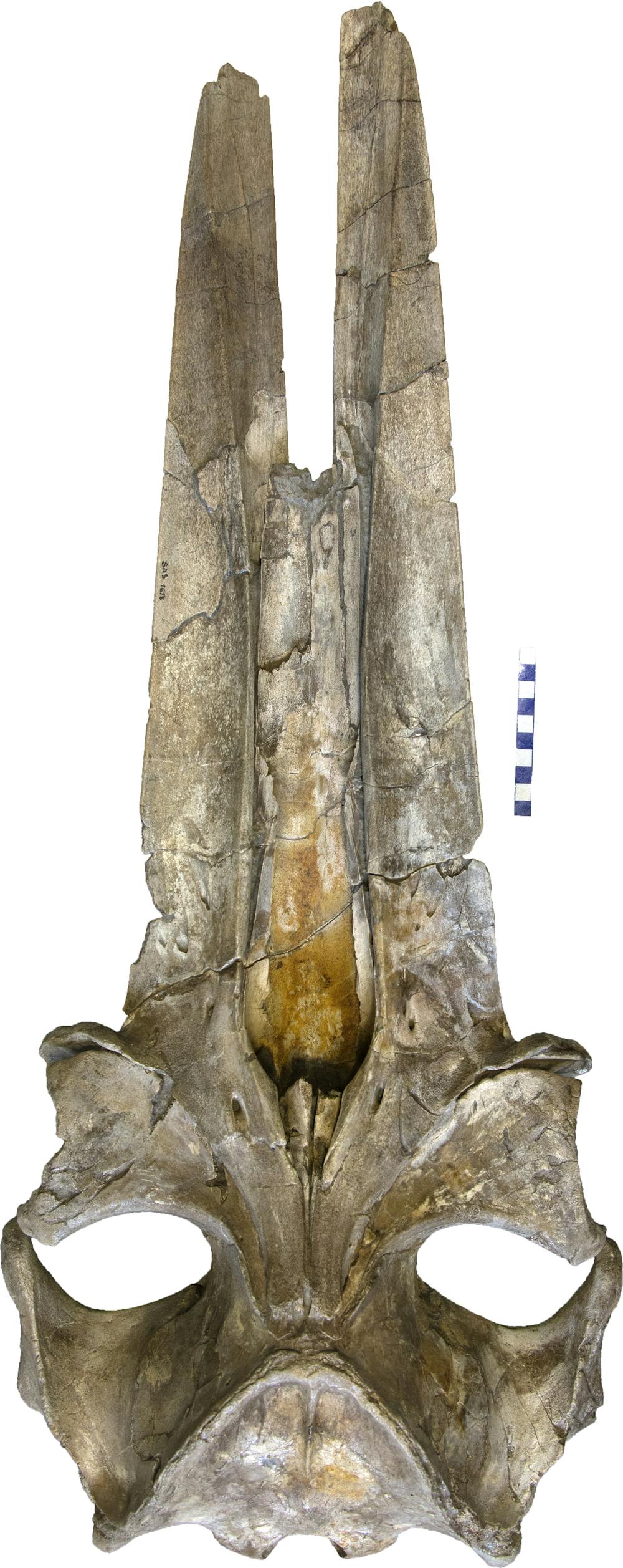
To start answering this, we need to consider the great antiquity of Caperea‘s ancestry. Molecular dating suggests it diverged from other whales at least 14 million years ago, and perhaps much earlier. The oldest recognisable fossils, however, are just 10 million years old.
What, then, fills the gap? One possibility is that Caperea sprang from the cetotheriids, an ancient family of whales once thought to be extinct.
Many palaeontologists remain sceptical about this idea and instead have clung to the traditional grouping of Caperea with right whales. But anatomical data sets will now need to be re-examined to weed out the effects of convergence.
What this process might reveal remains unclear, of course, but cetotheriids are certainly back in the running.
New insights might also come from new fossils or ancient proteins. Whereas DNA completely breaks down after about a million years, proteins can persist far longer - maybe just long enough to test ideas like Caperea’s cetotheriid origin more rigorously.
Read more: Empty mollusc shells hold the story of evolution, even for extinct species. Now we can decode it
Authors: Nic Rawlence, Senior Lecturer in Ancient DNA, University of Otago
Read more https://theconversation.com/the-true-origins-of-the-worlds-smallest-and-weirdest-whale-208279


















